Building Upper Body Strength: Beyond Basic Hypertrophy for Better Posture
A new GQ guide lists eight upper body movements as the mechanical baseline for a strength program, framed explicitly as a corrective for the postural deficits created by prolonged desk work.
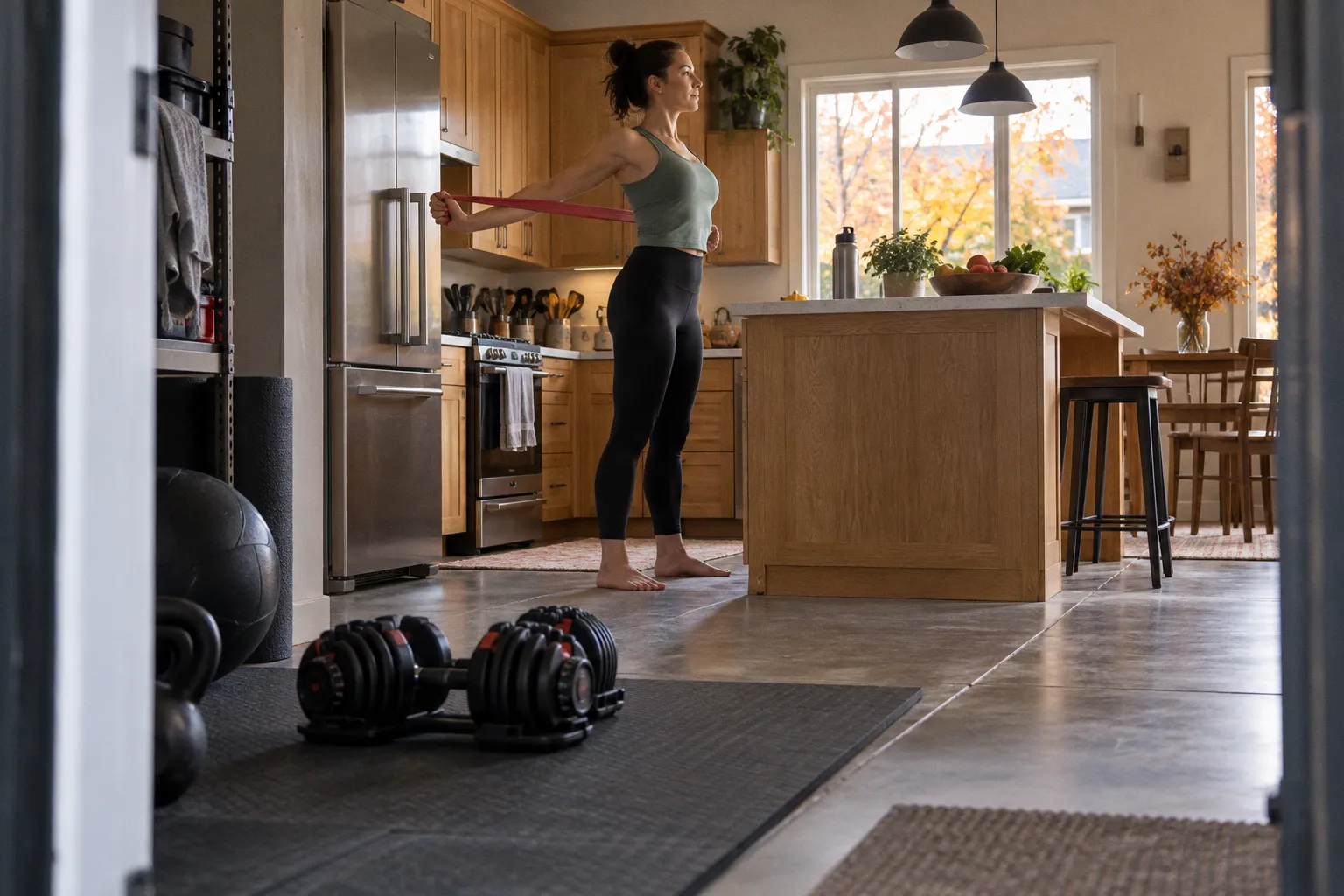
The piece sources three coaches and a university lecturer, and the operational claim is narrow: target the pecs, deltoids, triceps, biceps, lats, and traps, then stop pretending the rotator cuff and forearms are accessory tissue. The question worth asking is which of these movements actually transfer to durable joint mechanics versus which ones deliver visible hypertrophy with no functional carryover.
The Movement Inventory — and the Gap
The GQ roster (bench press, shoulder press, flys, shrugs, and related patterns) covers the major prime movers but, per Telegadas of Telegadas Performance Training, fails to routinely address two structures with disproportionate mechanical consequence. The rotator cuff governs glenohumeral stability and dictates safe ROM through pressing and pulling arcs. The forearms govern grip, which sets the ceiling on every loaded carry, row, and pull-up. Skip them and the kinetic chain fails at the weakest link.
Brown, a senior lecturer in Strength & Conditioning at the University of East London, anchors the skeletal argument: resistance loading maintains bone density and joint integrity, reducing the probability of joint disease over time. Santos of Instate Fitness extends the case into posture, linking cervical protraction, thoracic flexion, and scapular anterior tilt directly to chronic sitting, and noting that loaded upper body work demanding scapular retraction and thoracic extension reverses the pattern. The visible hypertrophy — broader shoulders, wider chest, larger arm circumference that Telegadas describes — is real, but it is a downstream effect. The functional case is force production capacity and postural restoration.
Dosage and Frequency
GQ places effective upper body work at three to four sessions weekly. This aligns with current mechanical load research: stimulus frequency, not chronic volume, drives the adaptive signal. The cited evidence positions resistance training as associated with reduced all-cause mortality — a population-level correlation, not a prescription, but a defensible reason to keep the sessions programmed.
A separate Women's Health feature addresses the opposite end of the compliance spectrum: clients with no contiguous training window. Former orthopaedic surgeon and current PT Dr Kate Ella prescribes exercise snacking — micro-doses of functional movement inserted into routine transitions. Her starting set:
- Wall sit during the two-minute toothbrushing window, building from 30 seconds to full duration
- Tricep dip off a kitchen counter while the kettle heats
- Dead bug on the bed pre-sleep, 60 seconds, non-moving limbs locked
This is maintenance-grade stimulus, not hypertrophy programming. For chronically under-loaded populations, density of movement beats magnitude of load. The mechanism is joint lubrication, neuromuscular activation, and posture interruption — not tissue growth.
Assessment and Implementation
Men's Health has surfaced a 10-minute upper body screen under a "Gym Bro" framing. The methodology is not available in the public snippet, so treat it as a directional flag rather than a validated diagnostic. For measurable capacity, baseline with a fixed cluster: bench press 1RM, weighted pull-up max, strict overhead press, and a grip dynamometer reading. Re-test at six-week intervals. Adaptation without measurement is not programming.
For the implementation protocol:
- Prioritize compound movements first — bench or floor press, overhead press, row variation, pull-up progression
- Add rotator cuff work — face pulls, external rotation at 90° abduction — before pressing volume
- Load the forearms — farmer carries, dead hangs, wrist curls — to support grip-dependent lifts
- Match frequency to recovery: two to four sessions per week, 48-hour minimum between high-intensity upper body bouts
- Reassess grip strength and shoulder ROM quarterly; regress load if either deteriorates
Posture correction is a downstream effect of loaded movement. Train the tissues, not the symptom.