Fitness Bodyweight Muscle Growth Exercises At Home Muscle Building At-Home Workout For Men
According to a News18 report dated September 9, 2026, actor Soha Ali Khan posted a high-intensity gym session on social media ahead of her husband Kunal Kemmu's film Vibe (theatrical release noted as September 18 in the source).
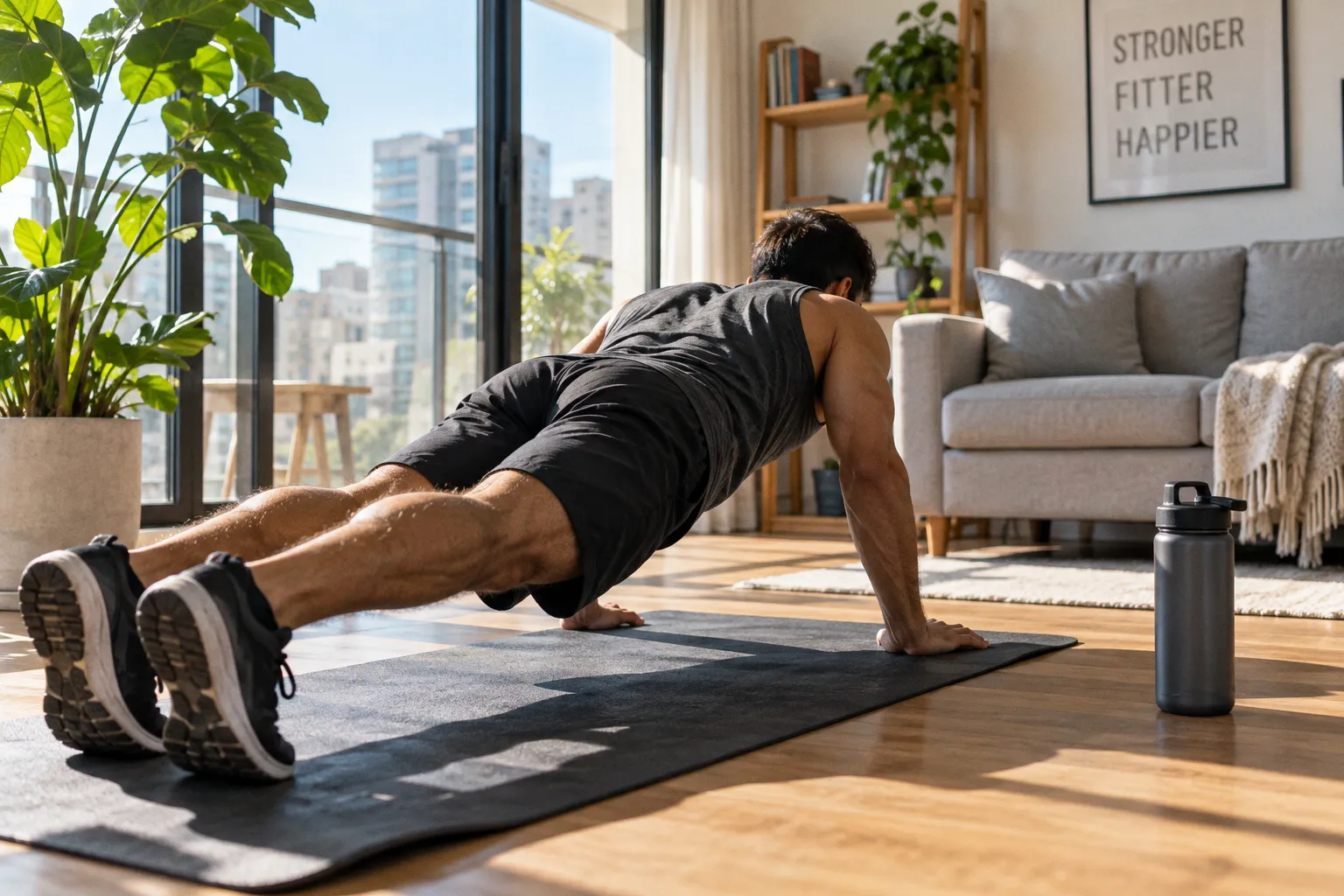
The session compresses five distinct mechanical demands into a single block: vertical pull, seated hip adduction, decline pressing on an unstable surface, wall-supported inversion, and high box jumps. Read as biomechanics, the sequence is a textbook load-complexity gradient — fresh nervous system to scapulohumeral work, then isolated adductor bracing, anterior chain under unstable load, closed-chain shoulder stabilization, and reactive triple extension against gravity. That is the structure worth borrowing, not the celebrity framing.
Decoding the Session
Pull-ups come first for a reason. Loaded scapular depression and lat recruitment under bodyweight suspension establish scapulohumeral rhythm before fatigue degrades the motor pattern. Seated thigh adduction follows, supplying an isometric adductor stimulus that has documented carryover to squat stability — the adductors brace the pelvis against valgus collapse. Decline push-ups on medicine balls shift the resistance vector anteriorly and force the rectus abdominis and anterior deltoid to keep the ribcage depressed while the chest and triceps produce force through a lengthened shoulder ROM. Wall-supported handstand is not a balance drill; it is a closed-chain shoulder stability hold at roughly 90° of shoulder flexion under full bodyweight. High box jumps close the loop with a stretch-shortening-cycle demand requiring rapid ankle, knee, and hip extension against gravity.
Translating to a Home Setup
The News18 feature maps the session to seven consumer products. Four are mechanically relevant to a bodyweight-build trajectory:
- Pull-up bar (Lifelong). The only true vertical-pull tool in the lineup. Door-frame and doorway models are valid; ceiling-mounted bars are preferable if grip angle variety and full dead-hang depth are priorities.
- Resistance band (Boldfit Heavy). Functions as a warm-up tool, mobility device, and accommodating-resistance adjunct to push-up variations. Tension curves do not replicate free weights, so treat it as a supplement, not a substitute.
- Medicine ball (Korbax). In the source video it functions as a deficit for decline push-ups, increasing ROM at the shoulder. Same implement covers rotational core and overhead slam work.
- Foam plyo box (Protoner). Softer construction lowers shin-impact risk versus a wooden box. The source explicitly flags high box jumps as an advanced movement; landing impulse scales with drop height, so box selection should match tendon tolerance, not ego.
Implementation Protocol
Four checkpoints to adapt the session to a 30–45 minute home block:
1. Vertical pull volume: 3–4 sets of 5–8 controlled reps with a full dead hang between reps. No kipping. Build to a strict neutral-grip before progressing to weighted variants.
2. Decline push-up tempo: 3-second eccentric, 1-second pause at chest contact, controlled press. Quarter-range is acceptable until shoulder end-range tolerance is established.
3. Wall handstand: accumulate 45–90 seconds total contact time across sets, ribs stacked over shoulders. Progress to free balance only after the hold is clean for 30 continuous seconds.
4. Box jump calibration: cap height where knee and hip flexion stay below 90° at landing. Step-ups are the correct regression when patellar tendon or Achilles tolerance is uncertain.
Two adjacent items sit in the same news window per Healthshots (September 8, 2026) and Rolling Stone (September 3, 2026) — heat-acclimation guidance for tropical-climate training and an updated P90X program, respectively. Source text was unavailable for both at the time of this brief; treat them as separate events rather than components of the routine above.