Maximize Fat Loss with This 25-Minute Full-Body Compound Workout
According to Hindustan Times reporting on fitness coach Mackenzie Wells' August 15 Instagram post, a viral 20-minute full-body protocol claims to burn 300 calories in 25 minutes through five compound movements.
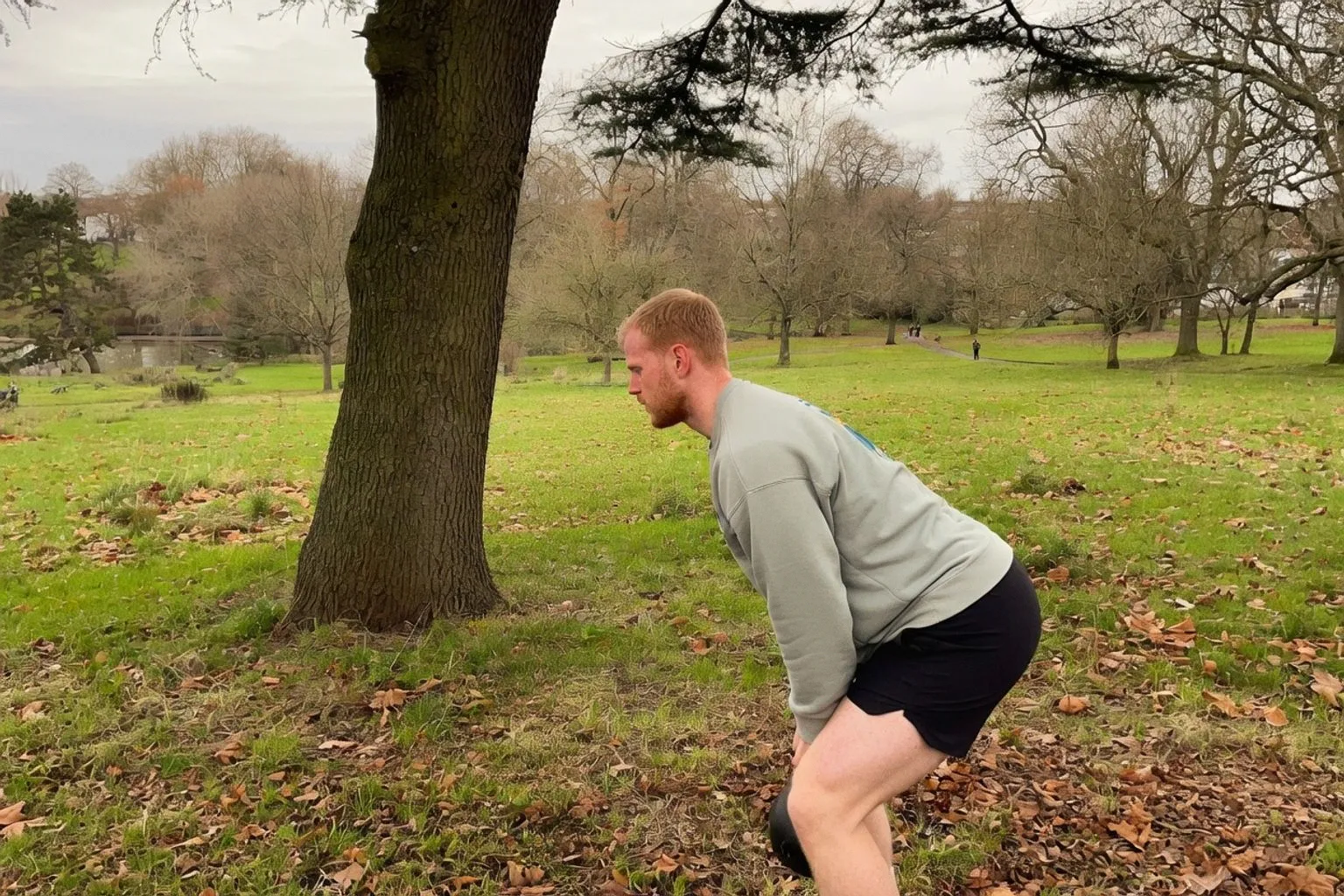
Each exercise is performed for 12 reps across lower-body, upper-body, and core segments.
Movement Mechanics
The protocol stacks joint actions across planes. Each block loads a different segment of the kinetic chain:
- Goblet squat to overhead raise: hip and knee extension under load, transitioning into shoulder flexion. Sagittal-plane dominant, with shoulder elevation at lockout.
- Hammer curl to overhead press: elbow flexion with neutral grip, then shoulder flexion and elbow extension under tension. Loads biceps brachii, brachialis, deltoids, triceps.
- Lateral step-out squat with curl: frontal-plane lunge variation combined with elbow flexion. Targets gluteus medius, adductors, biceps.
- Glute bridge with controlled drop: hip extension isometric hold with eccentric lowering. Targets gluteus maximus and posterior chain.
- Supine weighted crunch with leg extension: spinal flexion combined with knee extension. Loads rectus abdominis and quadriceps.
Wells' three-pillar system — targeted 30-minute workouts five times weekly, structured caloric deficit via weekly meal plans, and a consistency mechanism — frames the routine, per the Hindustan Times report.
Caloric Output Is Variable
The 300-calorie figure is a marketing ceiling, not a universal constant. Actual energy expenditure scales with body mass, relative intensity, inter-set rest duration, and movement economy. A 70-kg trainee working at moderate intensity will not match a 90-kg trainee moving at maximum effort. The Hindustan Times piece explicitly notes this variance.
A separate piece in The Independent featuring coach Dan John reinforces the calorie question from a different angle. John frames general fitness as a three-part formula: strength training, daily walking, and caloric correctness. The principle applies here. A 25-minute session produces a deficit only if total daily intake does not compensate. Without that match, the metabolic cost of the workout is absorbed by the next meal.
Execution Protocol
For lifters implementing this template:
- Load selection: start at a weight allowing 12 strict reps with controlled tempo. If the final reps compromise lumbar position or scapular control, reduce load. Form breaks before rep 12 mean the load is wrong.
- Rest intervals: keep rest under 30 seconds to maintain the cardiovascular demand the protocol claims. Longer rest shifts the session toward a strength stimulus, not the stated metabolic target.
- Breath sequencing: the squat-to-raise requires simultaneous hip drive and shoulder elevation. Exhale at lockout to prevent Valsalva stacking and stabilize the spine.
- Progressive overload: add 2.5–5% load weekly, or one rep per set. Do not chase the 300-calorie number by adding load the nervous system cannot stabilize.
What to Watch
Consistency drives the outcome, not any single session. The protocol is mechanically sound for general conditioning — it covers squat, hinge, push, pull, and core patterns in a compact block. The implied caloric deficit requires matching nutrition. Anyone new to loaded movement should spend the first two weeks on bodyweight variations before adding external resistance, and confirm the squat-to-raise pattern with light load before stacking it with overhead work.