8 Essential Movement Patterns for Building Lasting Strength After 40
Men's Health is reporting that 48-year-old coach Tom Ragusa has trimmed his full-body programming to eight movement patterns, executed primarily with dumbbells.
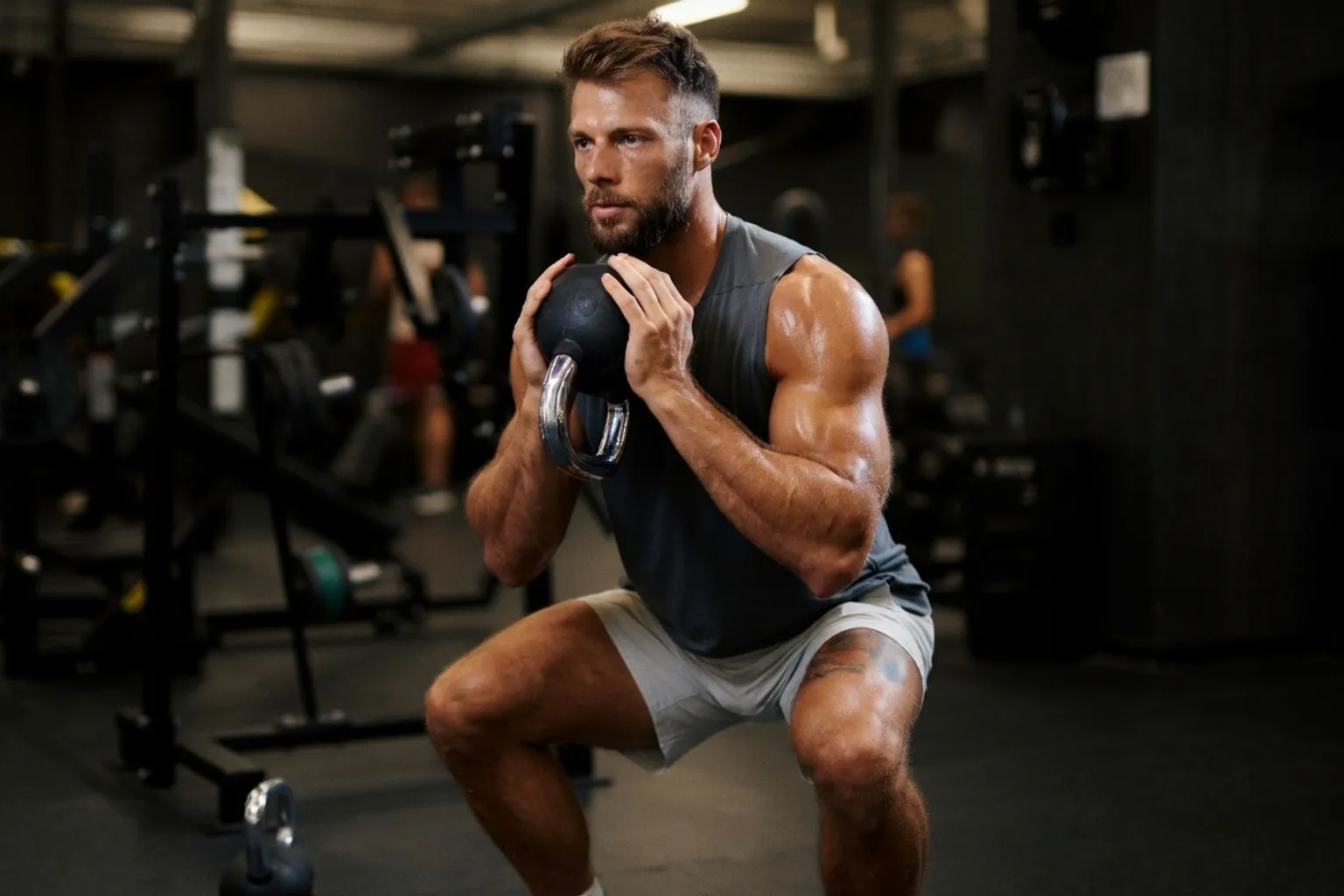
The list, shared in an Instagram post, functions less like a workout and more like a biomechanical maintenance protocol — eight patterns covering the joint actions the body is designed to perform under load.
The framing matters past 40: training shifts away from maximizing hypertrophic response toward preserving range, tendon tolerance, and the capacity to move external load through a full arc. Ragusa's framework is consistent with that shift.
The eight patterns, mechanically
A pattern-by-pattern readout, with the joint action and the tissue under demand:
- Squat — bilateral flexion and extension at the knee and hip in the sagittal plane. Preserves ankle dorsiflexion, knee tracking, and hip mobility under axial load. The tool is interchangeable; the pattern is the constant.
- Overhead press — vertical force transfer through the glenohumeral joint and scapulothoracic articulation. Maintains upward rotator cuff function and thoracic extension. Without it, shoulder elevation degrades measurably by the sixth decade.
- Horizontal press, incline angle — chest and anterior delt loading with reduced shear at the shoulder compared to a flat barbell bench.
- Hip hinge — the deadlift family. Posterior chain: hamstrings, glutes, spinal erectors. The pattern that determines whether the lumbar spine stays competent under external load.
- Horizontal row — counterbalance to pressing volume. Restores scapular retraction and mid-trap endurance, undoing the protracted posture prolonged sitting produces.
- Vertical pull, chest-supported — lat and upper-back loading without lumbar substitution. The support removes the low back from the equation, forcing the target tissue to absorb the torque.
- Walking lunge — single-leg knee and hip flexion-extension with a frontal-plane stability demand. Balance training disguised as leg work. The single-leg constraint is the intervention.
- Loaded carry — concurrent demand on grip, anti-extension core, and shoulder stabilizers. One movement, multiple systems under simultaneous tension.
Eight vectors. Full joint coverage. No isolated fluff.
Protocol for the 40-plus trainee
The list is the inventory. Execution is where the lift fails.
- Frequency. Two to three full sessions weekly. Recovery kinetics slow past 40; volume tolerance drops before strength does.
- Load. Dumbbells only, progressed across mesocycles. The equipment constraint forces clean mechanics and surfaces weak links faster than a barbell hides them.
- Sets and effort. Three to four working sets per pattern, submaximal. Terminate one to three reps from failure. Soreness is not the progress metric.
- Tempo. Controlled eccentric. Connective tissue tolerates time under tension better than ballistic output at this age.
- Progression rule. Add load only when full range of motion holds across every rep. Tendon adaptation lags muscle adaptation — respect the lag.
- Audit cadence. Periodically retest each pattern under a standardized load. If squat depth collapses, press grinds, or hinge rounds — regress. Do not push through degraded mechanics.
Eight patterns, executed cleanly, progressed slowly, recovered adequately. That is the minimum effective dose for a body expected to keep lifting into its sixth decade.