Beyond the Core: 4 Pilates Moves to Sculpt and Strengthen Your Lower Body
According to Woman & Home, Pilates instructor Isobel Palmer — founder of LIM Studio — recently outlined a home-mat sequence that targets the deep stabilizers around the hips, knees, and glutes, not…
According to Woman & Home, Pilates instructor Isobel Palmer — founder of LIM Studio — recently outlined a home-mat sequence that targets the deep stabilizers around the hips, knees, and glutes, not just the trunk flexors. The protocol pairs core engagement with lower-body resistance work to build joint stability and muscular endurance without external loading. It is a direct rebuttal of the common assumption that Pilates is a core-only modality.
The Lower-Body Targets
Palmer's framing is mechanical: the core provides a stable base, which then permits the lower body to operate with greater control and precision. Her sequence isolates four movement patterns, each with a specific joint-level demand:
- Side-lying leg series: Gluteus medius and minimus activation. Palmer notes these muscles "play an important role in stabilising the pelvis and supporting good lower-body alignment." Weakness here compromises pelvic position under load.
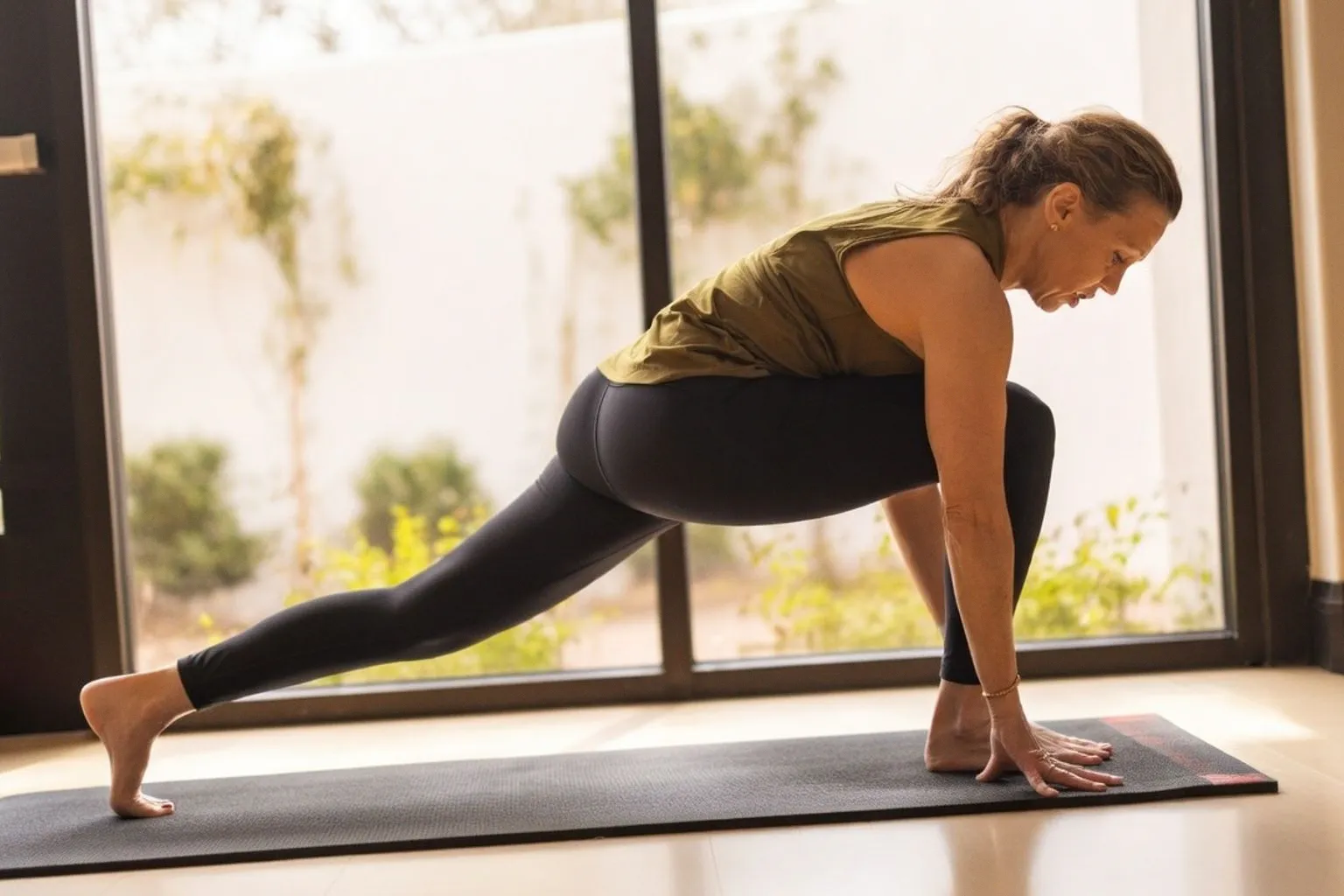
- Split-stance lunges: Quad and glute recruitment with continuous balance demand. The split stance forces the body to control movement through hips, knees, and ankles while the pelvis and core remain stable. The balance component, not the range of motion, is the training variable.
- Single-leg glute bridge: Pelvic stability under asymmetric load. Palmer advises that once a regular bridge feels strong and controlled, progressing to a single-leg variation increases the challenge considerably — each side of the body must work independently, eliminating bilateral compensation.
- Calf raise with ball between ankles: Isolates the gastrocnemius and soleus. Palmer recommends squeezing a small Pilates ball between the ankles to prevent the ankles from rolling out, forcing the calves to absorb the load.
Why Stability Training Matters
The smaller muscles around the hips, knees, ankles, and feet determine how force transfers through the kinetic chain. Most lifters chase hypertrophy in the prime movers and ignore these stabilizers until compensation forces the issue. Weak calves specifically correlate with overuse injuries in runners and cyclists — the calf assists venous return and absorbs ground reaction force at every foot strike. Training these tissues in a controlled, low-load environment allows the motor system to learn the position before heavier loading is applied.
Pilates does not replace barbell training. It is a stability primer that reduces compensation patterns when external load increases.
Implementation Protocol
- Frequency: Two to three sessions per week, layered as accessory work to primary strength training.
- Progression ladder: Bilateral → single-leg → external perturbation (band, ball, or unstable surface).
- Sequence logic: Core activation first, then lower-body integration, then unilateral balance demand.
- Equipment: Mat and a small soft Pilates ball. No external load required for the base protocol.
- Cue focus: Pelvic position, ankle tracking, knee alignment over the second toe — not range of motion or tempo.
Treat the sequence as deload-week or warm-up work if heavy lifting is already in the program. If barbell training is not yet part of the program, this protocol prepares the joints for future loading without the compensation risk that comes with starting heavy.