Ferne McCann’s 36-Year-Old Fitness Strategy: Why Variety Beats Intensity
Women's Health profiled 36-year-old Ferne McCann's training block this month: Pilates, gym-based strength work, tennis, padel, and ten-minute home finishers.
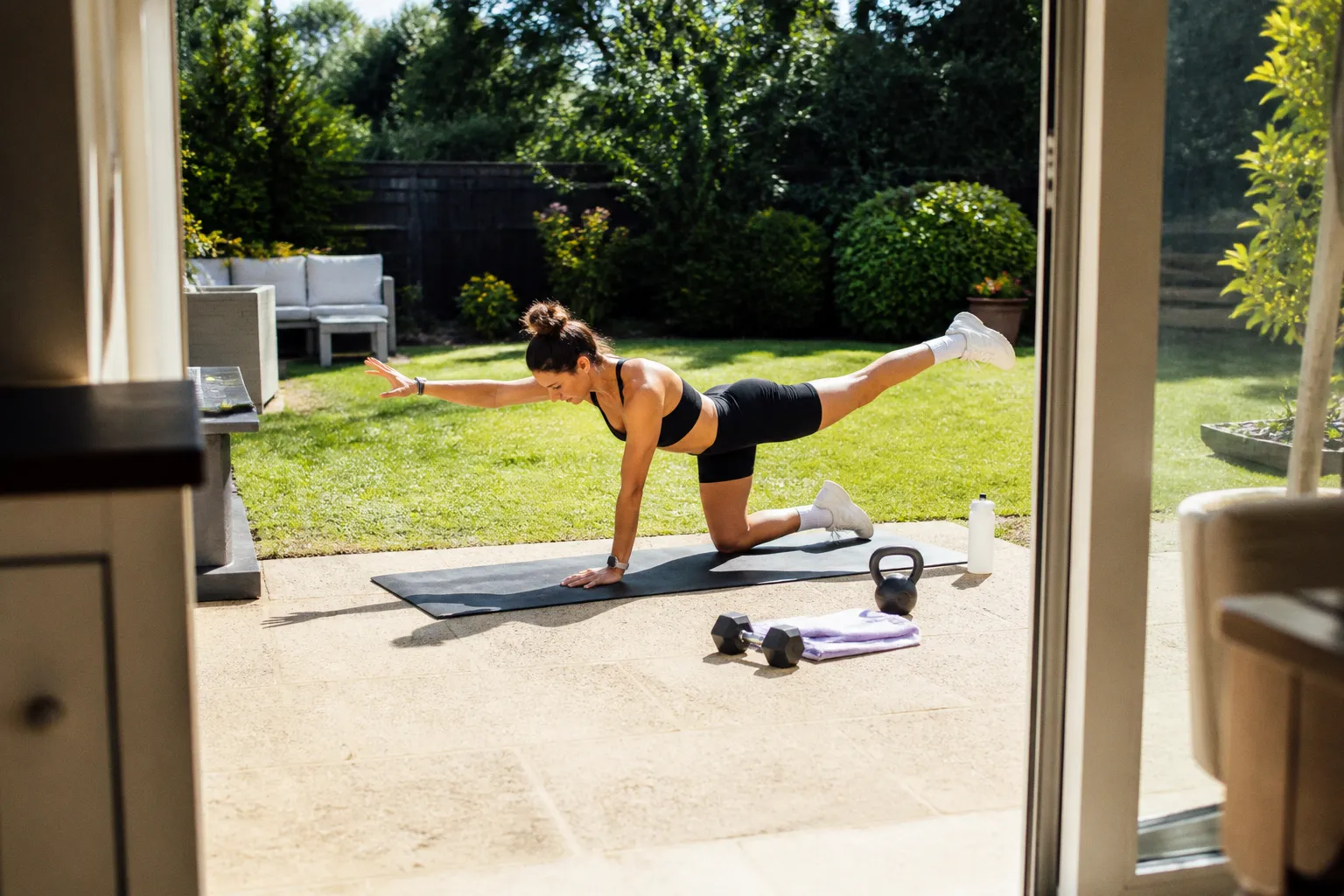
A 30-year BMJ Medicine cohort of 110,000 adults — 70,000 of them women — found that participants with the broadest exercise portfolio carried a 19% lower all-cause mortality risk than those training in the narrowest range. The variety is the variable doing the work, not any single modality.
Why modality variety shifts the stimulus
McCann's weekly block loads four distinct mechanical vectors:
- Sagittal-plane loaded work: reverse lunges, dumbbell deadlifts, wall balls — biasing hip and knee extensors through full-range compound patterns.
- Vertical pulling: progressing from band-assisted to unassisted pull-ups — recruiting the latissimus dorsi, teres major, lower trapezius, and biceps through scapular depression to full humeral elevation.
- Horizontal and anti-rotational work: renegade rows, SkiErg intervals, treadmill blocks — driving posterior chain torque while challenging trunk stabilizers.
- Anti-extension core: dead bugs, penguin taps, bicycle crunches, leg raises, flutter kicks, hip-dip planks — isolating deep trunk control without spinal shear.
Each vector targets a different combination of motor unit recruitment, connective tissue loading, and metabolic demand. Strength work maximizes mechanical tension and the hypertrophic response. Tennis and padel add unpredictable lateral acceleration and reactive stabilization — loads the gym cannot replicate. Short ab finishers accumulate low-intensity core volume under fatigue. No single tissue accumulates excessive fatigue; no single system gets neglected.
The pull-up progression is the standout data point
In June, McCann posted band-assisted reps she could barely clear to face level. Four months later: six unassisted pull-ups, chin above bar, zero assistance. The biomechanics are straightforward:
- Assisted pull-ups reduce effective body-weight load by roughly 20–40% depending on band tension. This permits volume accumulation before the scapular stabilizers and grip are conditioned.
- Removing assistance shifts the entire load onto the lats, teres major, lower trapezius, and the elbow flexor chain. The first unassisted rep is rarely a strength problem — it is a scapulohumeral rhythm problem.
- Submaximal band work builds the tendon tolerance required for repeated full-range humeral elevation under load.
Four months from near-zero to six strict reps is a conservative timeline. It reflects clean neural adaptation, reasonable tendon conditioning, and adequate protein intake — all within normal physiological ranges.
Protocol for replication
Strip the variables:
1. Frequency: 3 sessions per week, non-consecutive days.
2. Band selection: enough assistance to complete 3×5–8 with controlled scapular depression at the bottom of every rep.
3. Progression: when 3×8 is clean, drop to the next stiffer band. Continue until no band is required.
4. Termination criteria: chin below bar, kipping, or forward shoulder roll ends the set.
5. Adjunct work: chest-supported rows, scapular pull-ups, dead hangs. Do not skip these.
6. Load: once 3×3 unassisted is achieved, add external load via a dip belt.
The pull-up is solved by scapular control first, hypertrophy second, and ego last.