How Jennifer Aniston Builds Core Strength Using Three Essential Training Tools
Women's Health reports that Jennifer Aniston, 57, works with trainer Dani Coleman using three regular core-training tools: Pvolve gliders, a strapped P.Ball, and the P3 resistance system.
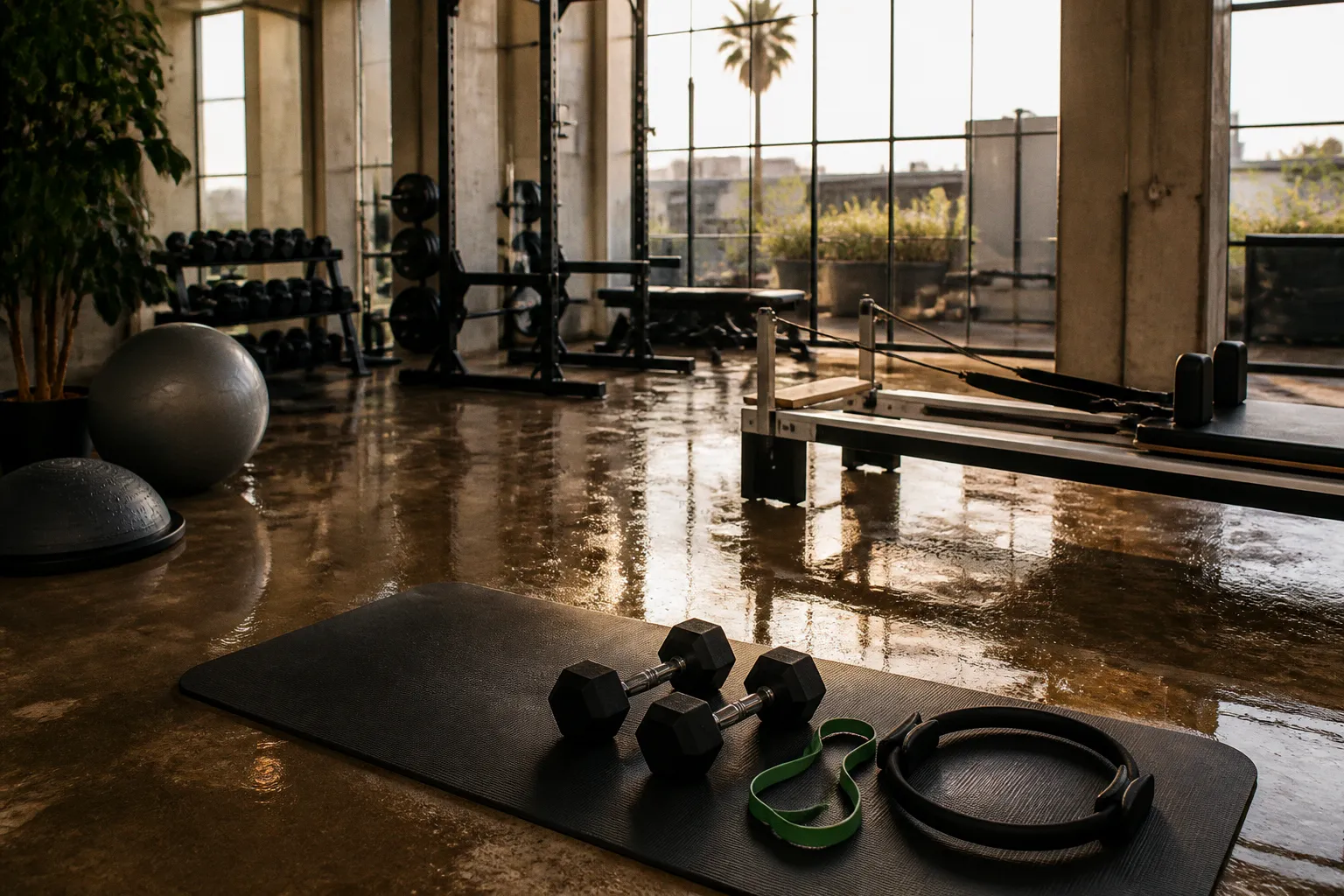
Coleman says their sessions run for 30 to 40 minutes and combine weight training, sculpt, and sculpt cardio, with core work retained inside a full-body plan. The transferable point is not the celebrity. Each tool has a specific job, and the core is treated as a support system rather than as an isolated ab target.
Match the tool to the mechanical job
- Gliders: These small sliding discs make simple movements more challenging by requiring control and stabilization. Coleman says they are used for plank work, kneeling oblique work, and standing stability work. She also notes that they are compact and travel-friendly, so they can be used on set or while traveling. Generic sliders can substitute for the Pvolve version in exercises such as curtsey lunges and knee tucks to pikes.
- P.Ball: This is a Pilates-style ball with thick bands attached around its circumference. It can be placed around the body for pelvic-floor and deep-core work, positioned under the back for traditional crunches and curls, or placed under the tailbone while lying on the back to isolate the legs, hip flexors, and lower abs. The report identifies a Pilates ball or medicine ball as a simpler alternative, depending on the exercise.
- P3 resistance system: The P3 uses two resistance straps, a ball, and a handle. It can attach at the ankle and be held in the hand, allowing the body to function like a cable machine while resistance travels through a movement. Coleman says it can be used to challenge the core and can also be combined with gliders. Resistance bands with ankle and wrist straps can provide a simpler home alternative; a band can also be secured around the ankle while the other end is held in the hand.
These devices should not be treated as interchangeable. Gliders alter the surface beneath the moving body, the P.Ball changes support and positioning, and the P3 adds external resistance that links the upper and lower body. The practical classification is straightforward: use gliders for stability demands, the ball for pelvic-floor, deep-core, or leg-and-hip positioning, and P3 or bands for connected resistance work.
Core training as whole-body control
Coleman says that core strength is always a priority in sessions that also target the whole body. She describes the goal as building a core that supports the pelvis, hips, and muscles involved in staying upright, rather than focusing only on the surface layer of the abdominals. She also notes that Aniston has dealt with back injuries and other injuries from filming, and that this is one reason the program emphasizes core strength.
That is a meaningful distinction for program design. The report is not presenting visible abs as the sole measure of core training. Its stated target is a system that helps the body remain supported during movement.
The report presents Coleman’s coaching method, not a comparative study of tools or a clinical prescription. It does not establish that gliders, the P.Ball, or the P3 produce better results than other resistance or stability methods. The age reference frames the report; it does not demonstrate that the same exercise selection is appropriate for every 57-year-old. Individual injuries, training history, and movement tolerance still need to govern the actual program.
A source-faithful implementation protocol
Use this sequence when translating the report into a practical session:
1. Select the tool by task. Use gliders for plank, kneeling oblique, and standing stability work. Use the P.Ball for pelvic-floor and deep-core work, crunches and curls, or the leg, hip-flexor, and lower-ab positioning described in the report. Use P3 or strapped bands when the goal is connected upper- and lower-body resistance.
2. Keep the work full-body. Do not remove the core from the surrounding training context. Coleman’s reported structure includes weight training, sculpt, and sculpt cardio within 30- to 40-minute sessions.
3. Use the generic alternative when appropriate. Generic sliders cover the reported sliding exercises. A Pilates ball or medicine ball can replace the P.Ball depending on the movement. Strapped resistance bands can replace the P3 when portability or equipment access matters.
4. Judge the tool by control, not branding. The glider’s reported purpose is to increase stabilization demand. The P.Ball’s position determines the intended region. The P3 uses resistance to connect body segments. If the movement cannot be controlled, additional equipment has not improved the exercise.
A core program does not become stronger because the tool has a recognizable name. Match the device to the mechanical demand, retain the full-body context, and progress only when the intended movement remains controlled.