Build a Resilient Deep Core with This 12-Minute Partner Resistance Band Routine
According to a Fit&Well report, trainers Matt Van Mol and Cyan Koay — co-founders of resistance band brand Strong Band and both CIMSPA-qualified in strength, rehab, and longevity — built a 12-minute…
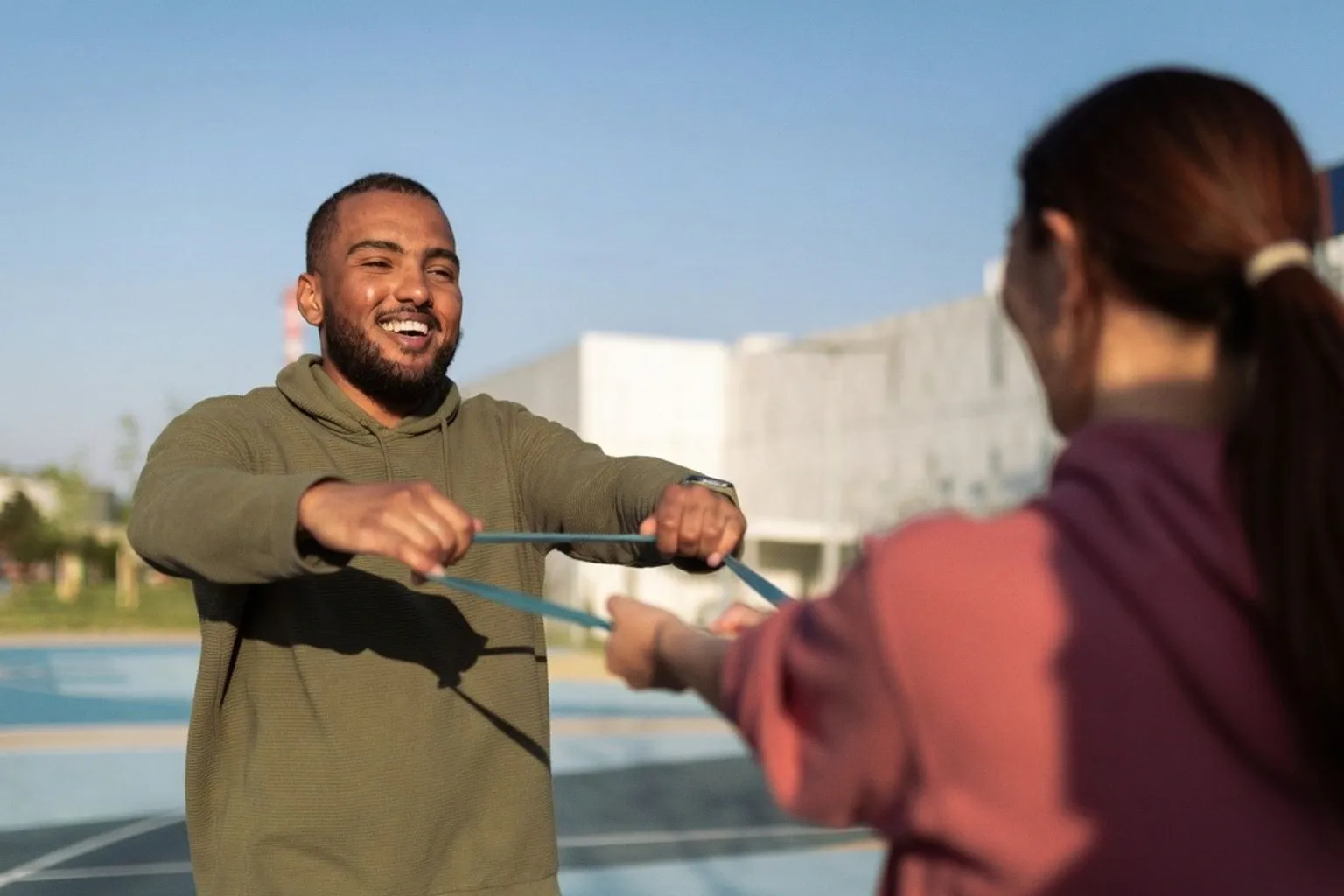
The deep core has a recruitment problem that solo training cannot fix. According to a Fit&Well report, trainers Matt Van Mol and Cyan Koay — co-founders of resistance band brand Strong Band and both CIMSPA-qualified in strength, rehab, and longevity — built a 12-minute partner routine that loads the trunk through tension it cannot ignore.
The Four-Movement Stress Test
The protocol targets four mechanical functions of the trunk, not just the rectus abdominis:
- Dead bugs — anti-extension control. Prevents lumbar hyperextension under limb loading.
- Towel pull-ups — lower back tensile strength. Loaded through the band, not bodyweight pull.
- Side plank rows — lateral stability. Resists frontal-plane collapse.
- Pallof presses — anti-rotation. Partner acts as the anchor; rotation control is the lift.
A medium-resistance band handles the primary load. A light band is used where movement velocity is higher. Standard long-loop bands produce the same stimulus; Strong Band's printed Progress Lines only standardize setup across sessions.
Why the Partner Variable Matters
Solo core work tolerates compensation. The nervous system cheats — it shifts load to the spinal erectors, holds breath, locks the pelvis. A partner at the other end of the band removes that option. Van Mol notes the setup forces the trainee to maintain trunk position because the band is either pulling them out of alignment or providing the brace that allows a clean movement. There is no slack to hide in.
Implementation Protocol
- Equipment: one long-loop resistance band (medium); light band optional for fast components.
- Partner assignment: one follows Van Mol, two follows Koay. Match pace, rest as needed.
- Duration: 12 minutes total. Four movements, continuous rotation.
- Use case: standalone session or finisher appended to a full-body routine.
- Progression metric: resistance selection. Move up one band tension when completion becomes mechanical rather than demanding.
Run the circuit three times per week. Reassess band tension every two weeks. The core adapts to load faster than the limbs — if the 12 minutes feel routine, the protocol is no longer producing a stimulus.