Building Resilience: Why Core Strength Is Essential for Women Over 40
Bone mineral density declines sharply in the years around menopause as oestrogen falls and bone resorption outpaces formation.
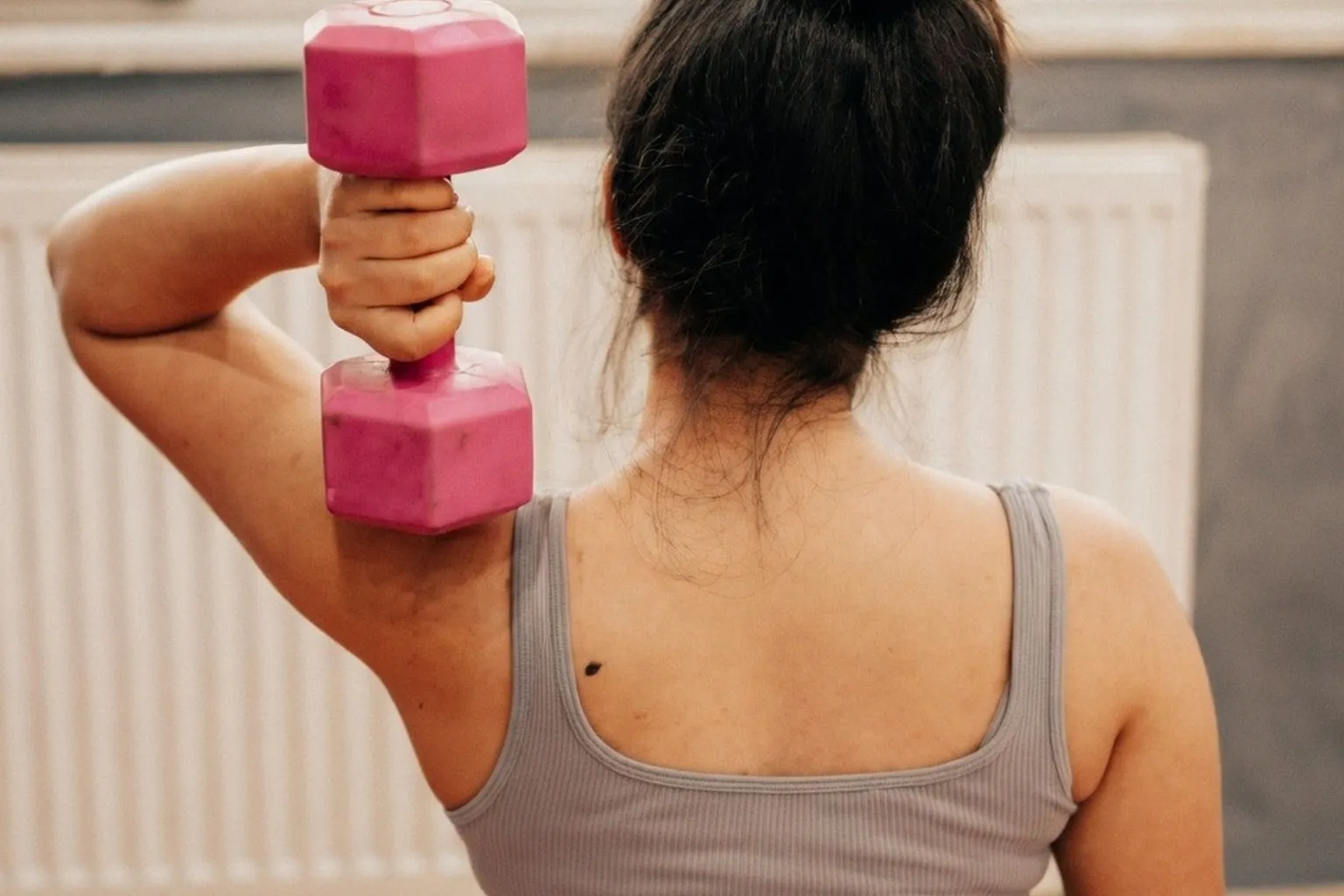
A new breakdown of Jyotika's recent training block, published by Indulge Express, maps directly onto that problem with a structured mix of resistance, core, and balance work. The routine is a textbook case of mechanical loading applied across multiple planes — not a cardio circuit dressed up as training.
Where the Routine Hits Hard
- Dumbbell squat: bilateral lower-body driver with built-in trunk anti-extension demand. Recruits quadriceps, glutes, and the deep stabilisers of the lumbar spine.
- Slider knee tuck: anti-extension core drill under sliding instability. Loads the rectus abdominis, obliques, and shoulder stabilisers in a closed chain.
- Weighted wall sit: isometric quad and glute hold with added axial load. Trains endurance under compression — relevant for joint integrity, not hypertrophic response.
- Battle ropes: upper-body power and conditioning with rotational torque on the trunk.
- Pull-ups and chest presses: vertical and horizontal pulling/pushing balance for scapular control.
- Single-leg reverse hack squats and leg presses: unilateral leg work that exposes asymmetries — critical past 40, when compensation patterns calcify.
- L-sit/press progressions with yoga blocks and wall support: direct core compression work. High neural demand on the anterior chain.
- V-hold or weighted leg raise with kettlebell: loaded hip flexor and lower abdominal isometric. Builds the lumbopelvic stiffness that protects the spine under load.
- Yoga wheel balance finish: proprioceptive work on an unstable surface.
The Bone Density Argument
Strength work is not optional for women over 40. As reported by Mamamia, bone is living tissue and remodels in response to mechanical load — that signal is what drives new bone formation. Calcium and vitamin D support mineralisation; they do not, on their own, trigger the remodelling cycle.
The clearest data come from the LIFTMOR trial — Beck et al., Griffith University, published in the Journal of Bone and Mineral Research in 2018. 101 postmenopausal women with low bone mass completed eight months of twice-weekly, 30-minute supervised high-intensity resistance and impact training. Result: roughly 3% gain at the spine, 2.2% at the hip, plus large gains in back and leg strength. The low-intensity home comparison group lost bone.
Two caveats. LIFTMOR used supervised, high-intensity programming — it is not a beginner at-home protocol. Anyone with diagnosed osteopenia or osteoporosis needs clearance from a GP or an accredited exercise physiologist before loading at that level.
Protocol to Implement
- Two resistance sessions per week, minimum. Matches Australian Physical Activity Guidelines and aligns with the LIFTMOR frequency.
- Progress load before adding complexity. Unilateral leg work comes first; balance drills come last in the session.
- Use a load that challenges the target muscles in the final 3–5 reps. Submaximal effort does not generate the mechanical stimulus for bone.
- Close every session with one anti-extension or anti-rotation core drill under load. L-sit progressions or weighted V-holds qualify.
- Audit posture and asymmetry monthly. Bilateral work hides what unilateral work exposes.