Cold plunge vs infrared sauna for muscle recovery
Muscle soreness is not always a sign that you need more intensity. Sometimes it is simply telling you that your training load, sleep, hydration, or recovery routine is out of balance.
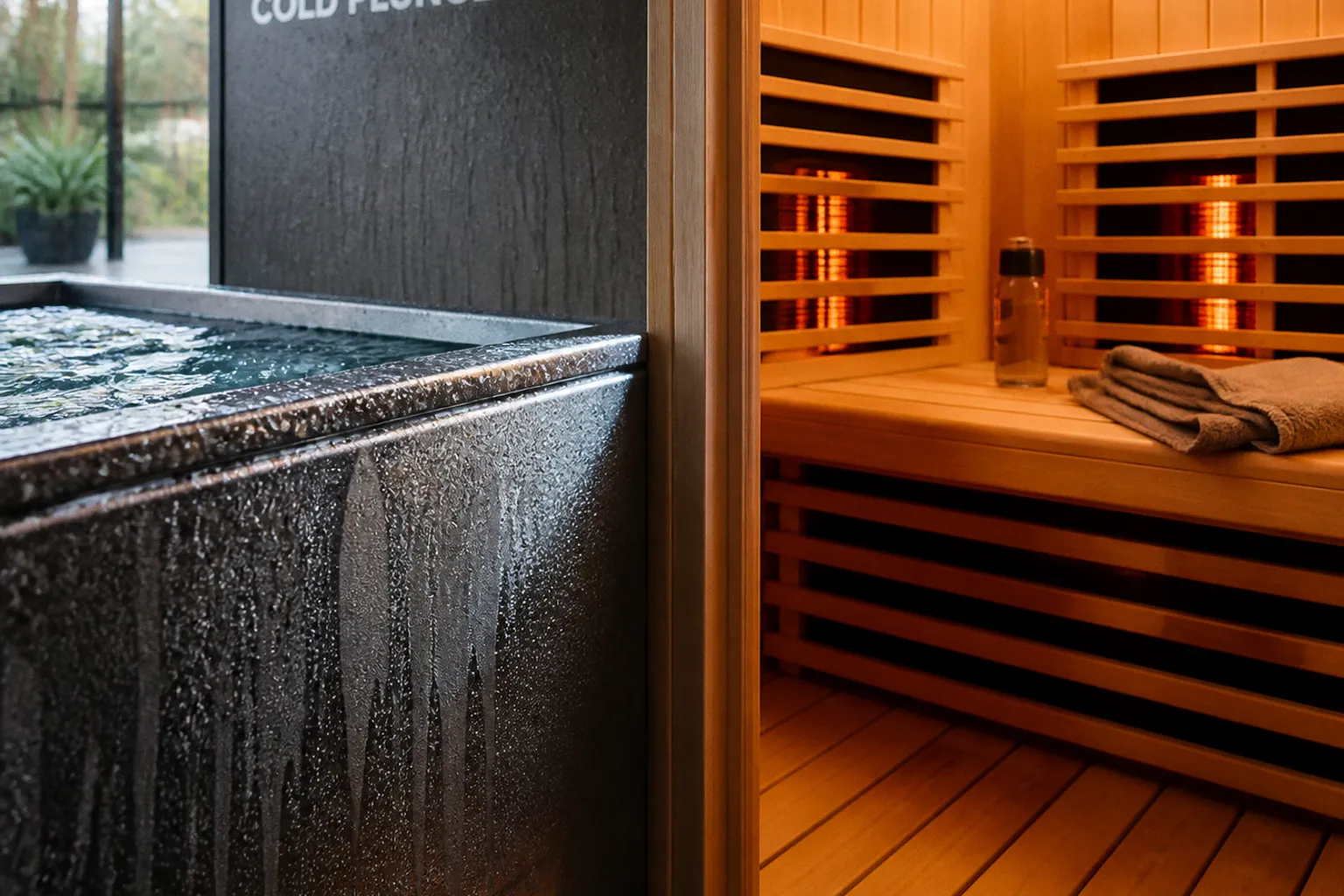
Cold Plunge vs Infrared Sauna: Recovery Science Explained
That is why the choice between a cold plunge and an infrared sauna deserves more thought than the usual question of which one feels tougher.
Both approaches may reduce perceived soreness, but they do not work in the same way. Cold water immersion narrows blood vessels and dampens some of the acute inflammatory response after exercise. Infrared sauna exposure raises tissue temperature, encourages vasodilation, and may support the return of neuromuscular performance. The better choice depends on what you need next: less discomfort, faster readiness, or continued progress in strength and muscle size.
The most useful way to compare them is not to ask which recovery tool is universally better. Ask how to check cold plunge vs infrared sauna for muscle recovery against your actual training goal, workout timing, and response to heat or cold. That turns a wellness trend into a practical decision.
Cold plunge and infrared sauna use different recovery signals
A cold plunge is a form of cold water immersion. Recovery protocols commonly use water around 50°F to 59°F, or 10°C to 15°C, for several minutes. Depending on the temperature and the individual protocol, exposure may last from roughly 5 to 20 minutes, although shorter sessions are often enough to create a meaningful cold stimulus.
The immediate effect is vasoconstriction: blood vessels become narrower, skin and superficial tissues cool, and the body works to protect its core temperature. This can reduce the sensation of post-exercise soreness and may help settle some of the acute inflammatory response that follows demanding training.
An infrared sauna creates a different environment. Instead of heating the surrounding air to the extreme temperatures associated with a traditional Finnish sauna, it uses infrared light to warm the body more directly. Infrared sauna temperatures commonly sit around 109°F to 140°F, or 43°C to 60°C. That lower room temperature can feel more approachable, although the session still places a real thermal demand on the body.
Heat promotes vasodilation, meaning blood vessels widen. It also raises body temperature and can stimulate heat shock proteins, which are involved in the body’s response to cellular stress. In practical terms, infrared heat may be useful when you want to relax stiff tissues, reduce the perception of soreness, and prepare the nervous system for movement rather than simply numb discomfort.
| Recovery tool | Main physiological direction | Typical temperature | Common session length | Best fit |
|---|---|---|---|---|
| Cold plunge | Vasoconstriction and reduced acute inflammation | 50–59°F / 10–15°C | Several minutes; protocols may extend to 20 minutes | Short-term soreness relief, competition recovery, feeling less beaten up |
| Infrared sauna | Vasodilation, tissue warming, and heat exposure | 109–140°F / 43–60°C | About 20–30 minutes | Relaxation, stiffness, heat-based recovery, maintaining training momentum |
| Traditional Finnish sauna | Strong ambient heat exposure | 175–210°F / 80–100°C | Varies by protocol | A separate heat modality, not interchangeable with infrared sauna |
The distinction matters because recovery is not one biological process. Soreness, inflammation, muscle damage, nervous-system fatigue, tissue stiffness, and reduced performance can overlap, but they are not identical. A tool that changes one may not solve all the others.
Cold reduces the volume of the alarm. Heat helps the body move through the aftermath. Neither replaces sleep, food, or sensible programming.
The hypertrophy paradox: when cold may work against your goal
The cold plunge is especially popular after hard strength sessions because it can make the body feel better quickly. That immediate relief is real for many people, but relief and adaptation are not the same thing.
Resistance training creates a series of signals that tell the body to repair and remodel muscle tissue. Some of the inflammation that follows training is part of that communication process. Cold water immersion immediately after resistance exercise can dampen cellular signaling pathways involved in muscle building. Over time, frequent post-lifting cold exposure may blunt aspects of hypertrophy and strength adaptation.
This does not mean cold plunges are automatically harmful, or that one session will erase the benefit of a workout. It means timing deserves attention. If your priority is building muscle, using a cold plunge directly after every resistance session may not be the most productive default.
A more useful framework looks like this:
1. Identify the main objective of the session.
If the workout is designed to build muscle or strength, protecting the training signal may matter more than eliminating every trace of soreness.
2. Separate competition recovery from adaptation-focused recovery.
Athletes who need to perform again soon may reasonably prioritize feeling ready for the next event. That is a different goal from maximizing long-term hypertrophy.
3. Use cold strategically rather than automatically.
A plunge may make more sense after an unusually demanding event, during a congested training schedule, or when soreness is interfering with basic movement.
4. Watch what happens across several sessions.
Your response matters. If cold exposure leaves you feeling energized and does not affect performance or training quality, it may have a place. If it becomes another stressor, reduce the dose.
This is where how to check cold plunge vs infrared sauna for muscle recovery becomes a personal question rather than a search for a universal winner. Compare the tool with the result you want, not with the most dramatic version of the ritual online.
Why infrared sauna may suit resistance training better
Infrared sauna sessions can be appealing after strength training because they offer recovery without the same concern about immediately suppressing the muscle-building response. Heat does not simply switch recovery on, but it may support circulation, relaxation, and the return of neuromuscular function.
A Finnish crossover study involving basketball players found that a single 20-minute infrared sauna session at 43°C, or 109°F, after exercise reduced the drop in countermovement jump performance and lowered subjective muscle soreness 14 hours after resistance training. That is a narrow finding, not a promise for every athlete, but it points toward a useful role for post-exercise heat: helping preserve readiness after demanding work.
The most practical benefit may be that heat makes movement feel easier. Warm tissues often feel less guarded, and a relaxed nervous system can make gentle mobility, walking, or low-intensity stretching more comfortable. That creates a bridge back to normal activity instead of turning recovery into complete stillness.
A reasonable infrared sauna routine after training might look like this:
- Allow your breathing and heart rate to settle after the workout.
- Rehydrate before and after the session, especially if the workout itself was sweaty.
- Start with a moderate exposure rather than chasing the longest possible session.
- Use around 20 to 30 minutes as a practical range, adjusting based on tolerance.
- Leave the sauna if you feel dizzy, nauseated, unusually weak, or confused.
- Follow the session with a normal meal that includes protein and carbohydrates.
The sauna should complement recovery basics. It should not become a way to compensate for a skipped meal, poor sleep, or a training plan that asks for more than you can consistently absorb.
Heat is not a shortcut for muscle repair
It is tempting to treat sweating as proof that the body is recovering more efficiently. That is too simple. Infrared sauna exposure may reduce soreness and support neuromuscular performance in specific settings, but it does not rebuild muscle on its own.
Your training response still depends on adequate energy, protein, rest, and progressive programming. Heat can make the recovery environment more comfortable. It cannot replace the raw materials required for adaptation.
This is also why the lower temperature of an infrared sauna should not be confused with a traditional sauna. Infrared units typically operate around 109°F to 140°F, while Finnish saunas may reach approximately 175°F to 210°F. They are different heat experiences, with different demands on the body.
Cold plunge vs infrared sauna for soreness, stiffness, and readiness
Both modalities can reduce subjective soreness, but they may feel useful for different reasons.
Cold is often the more noticeable intervention. The sensory input is intense, and the body’s immediate response can shift how discomfort feels. This may be helpful when soreness is making stairs, travel, or the next training session unnecessarily difficult. The limitation is that a rapid reduction in discomfort can tempt us to underestimate fatigue. Feeling less sore is not identical to being fully recovered.
Infrared heat is usually gentler in presentation. It can be useful when the main complaint is stiffness, a heavy feeling in the limbs, or difficulty relaxing after a demanding session. Because it is warming rather than numbing, it often pairs naturally with easy mobility work.
Think of the difference this way:
- Choose cold when immediate soreness management is the priority.
- Choose infrared heat when stiffness, relaxation, and movement readiness are the priority.
- Choose neither as a substitute for reducing training load when performance is falling repeatedly.
Specific trials of far-infrared lamp therapy have reported soreness reductions of roughly 55% to 60% and decreases in creatine kinase of up to 89%. Those findings come from particular protocols and should not be treated as a guaranteed result from every infrared sauna. The broader lesson is more modest: heat-based and infrared interventions can influence how recovery feels, but the size of the effect depends on the device, dose, timing, and person.
The Nordic cycle: combining heat and cold
Contrast therapy alternates heat and cold. One commonly described Nordic-style cycle uses 15 to 20 minutes of sauna exposure followed by approximately 1 to 12 minutes of cold exposure. The underlying idea is to move between vasodilation and vasoconstriction, creating repeated changes in circulation and sensory input.
It is an appealing ritual, especially after long travel, intense competition, or a training block that leaves you feeling generally flat. The rhythm is easy to understand: warm up, cool down, and repeat if appropriate.
But contrast therapy has a reputation that currently runs ahead of the evidence. Research uses varying temperatures, durations, order, and numbers of rounds. There is not one universally established contrast protocol that guarantees superior long-term muscle growth or athletic adaptation compared with using heat or cold alone.
If you enjoy the Nordic cycle, keep the practice simple:
1. Begin with heat for a moderate period rather than trying to tolerate an extreme session.
2. Use a brief cold exposure instead of treating the plunge as a test of willpower.
3. Stop when you feel light-headed, shaky, or unusually distressed.
4. Avoid interpreting a dramatic sensation as proof of a better physiological outcome.
5. Track the next day’s training quality, not only how impressive the ritual felt.
The combination may be useful for comfort and perceived recovery. We still need to be cautious about claiming that it is the best choice for hypertrophy, strength development, or every form of athletic recovery.
The most effective recovery tool is the one that supports tomorrow’s training without undermining today’s adaptation.
How to choose based on your training goal
Your recovery modality should follow the job your body needs to do next. This is more reliable than copying the routine of an athlete with a different schedule, climate, sleep pattern, or training phase.
If you are prioritizing muscle growth
Infrared sauna is generally the more compatible option immediately after resistance training, particularly if your concern is soreness or stiffness. Cold immersion right after lifting may interfere with some of the signaling involved in hypertrophy, so it is better used selectively rather than as a reflex after every session.
You do not need to avoid cold completely. Place it farther away from your lifting session when practical, or reserve it for situations where short-term readiness matters more than maximizing the adaptation from that particular workout.
If you are preparing for another event soon
Cold may be useful when the immediate goal is to feel less sore and more capable of performing again. This is especially relevant when training or competition is repeated within a short window. In that setting, managing discomfort and perceived fatigue can be more urgent than preserving every possible long-term adaptation signal.
The trade-off is not a reason for alarm. It is a reason to be deliberate.
If you are dealing with stiffness after travel
Heat often makes more sense as a first step. A warm infrared session followed by light walking or mobility work can help you transition out of prolonged sitting and reconnect with normal movement. The recovery win here is not simply sweating; it is restoring comfortable motion.
For travel, the most useful addition may be a portable recovery kit rather than a complicated protocol:
- A resistance band for gentle activation and mobility.
- A lacrosse ball or compact massage tool for localized tissue work.
- Comfortable layers that keep muscles warm without restricting movement.
- A water bottle and a reliable meal plan instead of relying on airport snacks.
- A short movement routine you can repeat in a hotel room.
If your nervous system already feels stressed
Both cold and heat are stressors. A challenging plunge can be invigorating for one person and exhausting for another. A long sauna session can feel restorative when you are well hydrated, but draining when you are under-fueled or sleep-deprived.
On those days, the better recovery choice may be a normal meal, an earlier bedtime, and an easy walk. There is no prize for adding more intensity to recovery.
A practical decision map for your next session
When choosing between cold plunge and infrared sauna, run through five questions:
- What did you train?
A heavy hypertrophy session has different recovery priorities from a tournament, race, or high-volume conditioning day.
- What do you need next?
Are you trying to protect long-term muscle growth, reduce soreness before another event, or simply move more comfortably?
- How close is the next hard session?
The shorter the turnaround, the more useful short-term soreness management may become.
- What is your current recovery foundation?
If food, fluids, sleep, or overall training load are unstable, a recovery gadget cannot correct the root problem.
- How do you respond afterward?
Track energy, sleep, soreness, and performance over time. A ritual that leaves you depleted is not a recovery strategy, even if it looks disciplined.
This framework also helps with the personal side of the question: how to check cold plunge vs infrared sauna for muscle recovery personal to your routine. The answer is found in repeated, honest observation—not in choosing the most extreme temperature or the longest session.
The overlooked recovery variable: fueling after training
Timing a recovery modality can be useful, but meal timing still deserves the first word. After resistance training, your body needs energy and protein to support repair. A sauna session cannot compensate for consistently under-eating, and a cold plunge cannot make a depleted training plan sustainable.
For the next meal, keep the target uncomplicated:
- Include a clear protein source.
- Add carbohydrates if the workout was demanding or another session is coming soon.
- Include fluids and, when appropriate, foods that replace what you lost through sweat.
- Choose a portion that fits your appetite and the rest of your day rather than forcing a rigid formula.
This is where sustainable progress becomes practical. Recovery should not require a perfect stack of devices, supplements, and rituals. It should make your training easier to repeat.
Final call: choose the tool that matches the adaptation
Cold plunges and infrared saunas are not interchangeable. Cold water immersion cools the body, promotes vasoconstriction, and can reduce the perception of soreness. Infrared sauna exposure creates a lower-temperature heat environment that supports vasodilation, thermal stress, relaxation, and, in specific research, improved next-day neuromuscular readiness.
For muscle growth, avoid making immediate post-lifting cold immersion an automatic habit. For short-term soreness relief or a tight competition schedule, cold may be useful. For stiffness, relaxation, and maintaining movement after resistance training, infrared heat is often the more sensible starting point.
Your small win for the very next meal is simple: eat enough to support the work you just did, drink some water, and then choose recovery based on tomorrow’s goal—not today’s trend.
FAQ
Is a cold plunge or infrared sauna better for muscle recovery?
Can cold plunges interfere with muscle growth?
Should I use an infrared sauna after strength training?
When is a cold plunge useful after training?
Can I combine an infrared sauna and cold plunge?
More products
 CongelumUSD49
 Motion EnergyUSD49