Travel recovery gear: choosing the right tool for your body
Travel can turn a strong training routine into a stiffness routine surprisingly quickly. Hours in a cramped seat, unfamiliar beds, long walks through terminals, and a sudden increase in hiking or sightseeing all place stress on the body in different ways.
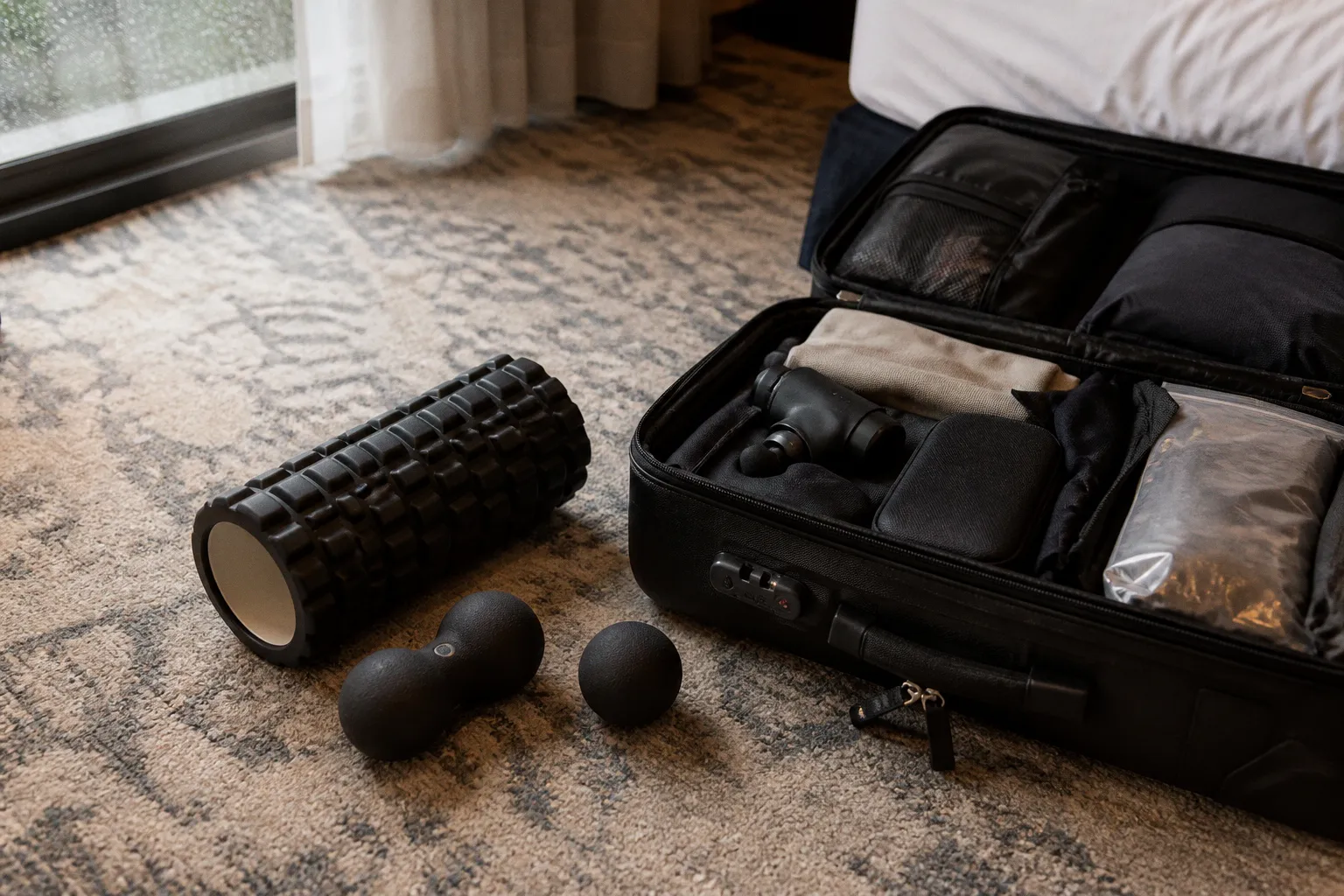
Add a workout before or after the journey, and your recovery needs become more specific than simply packing a water bottle and hoping for the best.
The best portable muscle recovery tools are not necessarily the most advanced ones. A mini massage gun may be useful for large muscle groups after training, while a massage ball can handle a tight foot or glute with almost no luggage space. A collapsible roller may be the smarter choice when you want broader, slower mobility work. Compression sleeves can make sense for long periods of sitting, but they solve a different problem from percussion or trigger-point tools.
The right travel recovery gear depends on four practical questions: how much space you have, what your body tends to need, how often you will use the tool, and whether you are recovering from training or simply trying to feel less stiff after a long day.
The most useful recovery tool is the one you will actually use in a hotel room, at an airport, or beside your carry-on—not the one with the longest feature list.
Start with the job, not the gadget
Recovery is not one single sensation. “My legs feel heavy after a flight” is a different situation from “my glutes are sore after a lower-body workout,” and both differ from “my upper back feels locked after carrying a backpack all day.”
That distinction matters because each tool has a different reach and rhythm:
- Massage guns deliver rapid percussion to accessible muscle groups and can be useful when you want a short, focused session.
- Foam rollers provide broader pressure across the back, thighs, calves, and hips, with more control over pace and body position.
- Massage balls target small areas with precision, especially the feet, glutes, shoulders, and upper back.
- Pneumatic compression sleeves apply rhythmic pressure around the lower legs, making them more relevant to prolonged sitting and post-activity leg fatigue than to isolated knots.
- Movement, hydration, sleep, and adequate food remain the foundation. Portable equipment can support those habits, but it does not replace them.
A useful way to choose is to identify your most common travel problem before you compare products.
| Your main travel problem | Most suitable tool | Why it fits | Main limitation |
|---|---|---|---|
| Tight calves or feet after walking | Massage ball | Small, inexpensive, and highly targeted | Less useful for broad muscle groups |
| General stiffness after sitting | Collapsible or hollow-core roller | Covers more surface area and encourages slower movement | Takes more space than a ball |
| Post-workout soreness in glutes or thighs | Mini massage gun | Fast, convenient percussion for larger muscles | Requires charging and careful technique |
| Heavy lower legs on long journeys | Compression sleeves | Designed for rhythmic calf compression | Does not address the quads, hamstrings, or full leg |
| Frequent training while traveling | A small combination kit | Covers several body areas and situations | Adds weight and requires a simple packing system |
This is also where we need to be honest about the word “recovery.” A tool may help you feel more comfortable or mobile, but that is not the same as proving that it accelerates muscle repair. Sleep, sufficient calories, protein, fluids, and sensible training load still do the foundational work.
Mini massage guns: compact does not mean automatically capable
A travel massage gun has an obvious appeal: it can fit into a carry-on and offers a quick way to work through the glutes, quads, calves, or shoulders after a workout or a long day on your feet. But “mini” is not a complete performance category. Some compact devices are genuinely useful; others are simply small and underpowered.
For a travel model, a practical benchmark is a device weight below 1.5 pounds on its own, or below 3 pounds once you include the case, attachments, and charger. That total-package figure is often more relevant because luggage space is taken by the whole system, not only the device.
Two other specifications help separate a functional mini massage gun from a decorative gadget:
- Amplitude: Look for at least 6 mm as a travel-oriented benchmark. Amplitude describes how far the attachment moves into the tissue with each stroke.
- Stall force: Around 10 pounds or more gives you a better chance of using moderate pressure without the motor stopping immediately.
These numbers do not make a mini massage gun equivalent to a full-sized professional percussion massager. Smaller devices generally make compromises in motor strength, battery capacity, or depth. That is not necessarily a problem. You are choosing portability, not trying to recreate a clinic treatment room inside your suitcase.
Battery life also changes the experience. A useful benchmark for a travel device is roughly 2.5 hours at minimum, with some models reaching five hours or more on a charge. If you are traveling for several days without reliable access to an outlet, the battery figure becomes more than a specification on a product page. It becomes part of the packing plan.
The Theragun Mini, for example, offers three speed settings—1,750, 2,100, and 2,400 RPM—in a compact format. Multiple speeds are helpful because different areas respond better to different pressures and rhythms. You may prefer a gentler setting around the calves or shoulders and a stronger one for the glutes, without assuming that more intensity is always better.
How to use a mini massage gun while traveling
The most useful approach is brief and specific. You do not need to spend half an hour on every muscle group. Start with a low setting, keep the device moving, and use it on soft tissue rather than directly over bones or joints. If the sensation becomes sharp, numb, or unpleasantly intense, reduce the pressure or stop.
A simple travel session might look like this:
1. Begin with broad, easy passes. Spend a short period moving over the muscle rather than staying on one sensitive point immediately.
2. Reduce pressure around tender areas. Post-workout soreness is not an invitation to force the tool deeper.
3. Stay on larger muscle groups. Glutes, quads, hamstrings, calves, and the upper back are generally easier to reach than small or bony areas.
4. Keep the session focused. The goal is to feel more comfortable and ready to move, not to create additional soreness.
5. Follow with gentle movement. A few bodyweight squats, ankle circles, walking laps around the room, or controlled mobility drills can help you transition back into normal activity.
There is a behavioral advantage here as well. A small device can make a recovery habit easier to start. If you already know that you will use it for five minutes after a hotel-room workout, it may earn its space. If you dislike charging it, carrying the case, and deciding which attachment to use, the ball in your side pocket may be the better tool.
Collapsible and hollow-core rollers: more coverage, smarter packing
Foam rollers are useful when your body feels generally compressed rather than affected by one isolated tight spot. They give you a way to work across the thighs, calves, hips, and upper back with your own body weight controlling the pressure.
Traditional rollers, however, can be awkward travel companions. Even when they are not especially heavy, their cylindrical shape consumes valuable space. This is where hollow-core and collapsible designs become practical rather than gimmicky.
A hollow-core roller such as the TriggerPoint GRID creates an internal cavity where you can pack soft items such as socks and T-shirts. It does not reduce the roller’s outside dimensions, but it changes how much unused space it occupies in your bag. That can be a meaningful difference when every section of a carry-on already has a job.
Collapsible designs take the concept further. The Brazyn Morph, for example, can collapse to around 2 inches in thickness, then expand into a functional roller weighing approximately 1.5 pounds. The benefit is not only storage. A flatter object is easier to slide into a suitcase, under a bed, or beside a laptop compartment.
When a roller earns its space
A collapsible roller is a strong choice if:
- You train several days during a trip and want broader recovery work.
- Your legs tend to feel stiff after walking, hiking, or long periods of sitting.
- You prefer slower, pressure-controlled movement to the sensation of percussion.
- You want one tool that can serve both warm-up mobility and post-activity cooldown.
- You have enough luggage space for a longer item, even if it collapses.
The trade-off is that rollers are less precise than balls. They are not ideal when you want to work on one small area of the foot or glute. They also require more floor space and a little more willingness to get down on the floor. In a hotel room, that may be easy. In a crowded airport lounge, it is not exactly discreet.
For travel, use the roller in short passes rather than treating it as a test of tolerance. Move slowly over the calves and thighs, pause briefly where the pressure feels useful, and avoid turning a mobility session into a painful endurance event. The body tends to respond better to repeatable, moderate input than to occasional aggressive sessions.
Travel recovery works best when the tool matches the size of the problem: a roller for broad stiffness, a ball for precision, and a gun for quick, accessible muscle work.
Massage balls: the smallest tool with the clearest target
High-density massage balls are easy to underestimate because they have almost no technology and take up very little room. That simplicity is exactly their advantage. A lacrosse ball or compact vibrating dual-sphere tool can provide targeted pressure for the feet, glutes, and upper back without adding meaningful luggage volume.
A ball is especially useful when your travel days involve walking. Feet and calves often become the first places where accumulated steps show up, and a ball lets you work on the sole of the foot while seated. You can also use it against a wall for the upper back or place it under the glute while controlling pressure with your body position.
Compared with a massage gun, the ball gives you more direct feedback. You control the pressure by shifting your weight, and you can stop instantly. Compared with a foam roller, it is much more precise. That makes it a strong standalone option for minimalist travelers.
Its limitations are just as clear:
- It does not cover large muscle groups quickly.
- A firm ball may feel too intense if you press aggressively into already tender tissue.
- It requires positioning and body control, especially around the hips and upper back.
- It cannot provide rhythmic compression for the lower legs.
A useful travel kit can therefore be surprisingly small: one dense ball, plus a resistance band if you are already carrying one for workouts. The ball supports localized recovery, while the band gives you a way to restore movement through the ankles, hips, shoulders, and upper back. Neither item requires charging, and both can be used in a small hotel room.
A practical ball routine for feet, glutes, and upper back
For the feet, roll slowly from the heel toward the ball of the foot and adjust pressure by keeping some weight through the other leg. For the glutes, use a seated position on the floor and shift gradually rather than dropping your full weight onto the ball. For the upper back, place the ball between your back and a wall so you can control both intensity and location.
The rule is straightforward: pressure should feel manageable and useful, not like a challenge to endure. If you find yourself holding your breath, clenching your jaw, or bracing against the tool, the pressure is probably too high.
Compression sleeves: a different answer to a different problem
Portable pneumatic compression is often grouped with massage tools because all of these products are marketed around recovery. Mechanically, though, compression sleeves do something different. They apply rhythmic pressure around a specific area, usually the lower leg, rather than targeting a muscle with direct friction or percussion.
Wireless calf compression sleeves such as the Normatec Go are designed for lower-leg use during long periods of sitting or after activities such as hiking. They can be appealing when your main complaint is that your calves feel heavy after a flight, train journey, or long day on foot.
The travel advantage is obvious: no wired machine is required, and the sleeves can be used without taking up the floor space needed for a roller. The practical limitation is battery life. Portable lower-leg compression sleeves typically provide around three to four uses per charge, so they need to be treated as electronic travel equipment rather than a passive accessory.
They also have a narrow target area. Calf sleeves do not treat the full leg, including the quadriceps or hamstrings. If your soreness is mostly in the thighs after a strength session, compression sleeves may not be the most relevant purchase.
Before using any compression product, follow the manufacturer’s instructions and consider whether you have a medical condition that makes compression inappropriate. A recovery gadget is not a substitute for medical advice, and unusual swelling, persistent pain, skin changes, or one-sided symptoms deserve proper evaluation rather than another round of compression.
Compression versus percussion
The choice becomes easier when you compare the experience you want:
- Choose compression when prolonged sitting or travel-related lower-leg heaviness is the main issue.
- Choose percussion when you want quick, localized work on accessible muscles after exercise.
- Choose a roller when you prefer broad, controlled movement across several areas.
- Choose a ball when luggage space is tight and precision matters most.
You do not need to own all four categories. In fact, carrying every possible recovery device usually creates a kit that is too complicated to use. A good travel setup should remove friction from your routine, not become another piece of equipment to manage.
Build a recovery kit around your itinerary
The best portable recovery equipment changes depending on the trip. A business trip with flights and short hotel-room workouts has different demands from a hiking holiday, and both differ from a competition weekend.
For frequent flights and long sitting
Prioritize a compact massage ball or a small roller alternative for stiffness after sitting. If lower-leg heaviness is a recurring issue and you are comfortable with the added cost, battery-powered compression sleeves may be worth considering. A mini massage gun can work too, but it is less convenient if you do not want to charge another device or carry a case.
Add movement breaks whenever possible. A few ankle pumps, gentle calf raises, shoulder rolls, and short walks are unglamorous but effective ways to interrupt long periods of stillness. The recovery tool works better when it supports movement rather than replacing it.
For hiking and active sightseeing
A dense ball is excellent for feet and glutes at the end of a walking-heavy day. A collapsible roller gives you more coverage if you expect several consecutive days of hiking. A mini massage gun is useful when you already know you prefer percussion and have room for the charger.
Do not wait until the final day of the trip to discover that the tool irritates a tender area. Use familiar equipment and familiar pressure. Travel is not the ideal time to experiment with the most aggressive setting, especially when you still plan to walk or train the next morning.
For hotel-room strength training
If your travel routine includes resistance bands, a massage ball creates a very efficient pairing. The bands maintain strength and mobility work, while the ball provides targeted pressure after training. A mini massage gun is a reasonable upgrade when your workouts regularly involve substantial lower-body volume.
A roller is helpful when the room has enough open floor space and you enjoy using it consistently. If it remains in the suitcase because unpacking it feels like a project, it is not the right solution for your routine.
For minimalist packing
Start with the smallest useful tool:
1. Choose a massage ball if you want the lowest weight and simplest setup.
2. Add a resistance band if movement and strength training are part of your travel plan.
3. Move to a collapsible roller when broad leg and back work matters more than absolute compactness.
4. Choose a mini massage gun when quick percussion is your preferred method and you can manage charging.
5. Consider compression sleeves only when lower-leg compression directly matches your travel needs.
This sequence keeps the decision practical. You are not building a professional recovery room. You are building a small system that fits your schedule, body, and luggage.
The technology still needs a foundation
It is easy to spend too much attention on amplitude, RPM, battery life, and attachments while overlooking the habits that determine whether you feel recovered in the first place. Portable tools can make a routine more comfortable, but they cannot compensate for consistently short sleep, inadequate food, dehydration, or a training plan that asks too much from your current capacity.
We get better results when recovery is treated as a daily balance rather than an emergency response. That might mean eating a proper meal after training instead of relying on coffee, carrying fluids during a walking day, or protecting a realistic bedtime before an early flight. It may also mean reducing workout volume when the itinerary is already demanding.
A simple travel recovery framework looks like this:
- Move regularly: break up long sitting and use gentle mobility before reaching for intense pressure.
- Eat enough: include a satisfying source of protein and carbohydrates around active days.
- Hydrate consistently: do not wait until you feel depleted to start drinking.
- Sleep as well as the trip allows: a gadget cannot reproduce the effects of adequate rest.
- Use tools for comfort and consistency: choose the level of pressure that helps you move better, not the level that makes the session feel dramatic.
- Watch the response: soreness that worsens, unusual swelling, numbness, or persistent pain calls for caution and, when appropriate, professional assessment.
The aim is not to eliminate every sensation from travel. Some fatigue is a normal response to more walking, less familiar sleep, and a different schedule. The aim is to arrive at the next activity feeling capable rather than needlessly restricted.
The final choice: one dependable tool or a small combination
For most travelers, the decision comes down to two sensible paths.
A single massage ball is the best minimalist choice. It is light, quiet, durable, and useful for the feet, glutes, and upper back. It has no battery and almost no packing penalty. If your travel routine is mostly walking and occasional workouts, this may be enough.
A small combination kit makes more sense when you train regularly or take longer active trips. Pair a collapsible roller with a massage ball for broad and targeted work, or choose a mini massage gun plus a ball if speed and convenience matter more than slow mobility. Compression sleeves belong in the kit only when lower-leg heaviness is a repeated, specific concern.
Before buying, consider the complete packed system rather than the product alone:
- Device, case, charger, and attachments
- Collapsed or expanded dimensions
- Battery runtime and access to outlets
- Muscle groups you can realistically reach
- Noise and privacy in shared spaces
- Whether you prefer active movement, sustained pressure, or rhythmic compression
- How often you are likely to use it during a normal trip
Your body does not need the most impressive travel recovery gear. It needs a tool that fits the actual journey.
For the next trip, start with one small win: pack the tool that matches your most common problem, then use it for five to ten minutes after your next long sitting period or workout. Add water, a balanced meal, and a short walk. That combination may look less exciting than a suitcase full of recovery technology, but it is far more likely to leave you ready for the next day.