Foam Roller vs Massage Gun: Travel Recovery Tools
Travel recovery gets complicated when your legs feel heavy after a long flight, your back tightens up after hours in a car, and your workout schedule does not politely pause until you feel better.
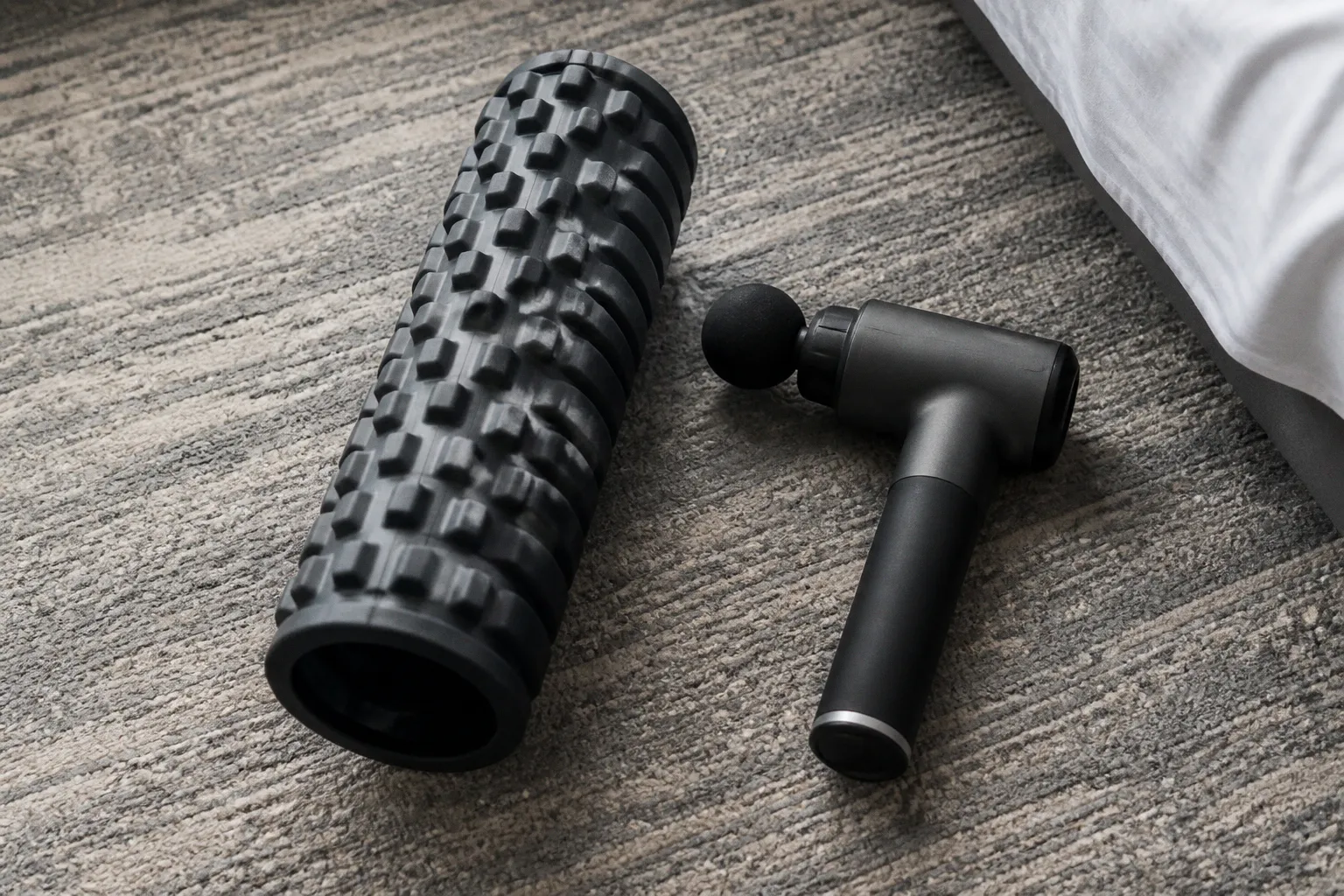
The question is not simply whether a foam roller or massage gun is more effective. It is which tool gives you the right kind of relief, fits your luggage, and works with the way you actually travel.
In the foam roller vs massage gun travel recovery debate, both tools can be useful, but they solve slightly different problems. A foam roller gives you broad, steady pressure across larger areas. A massage gun delivers focused percussive treatment to a specific muscle. One is simple and low-maintenance; the other is faster to aim but brings batteries, charging, noise, and airport rules into the equation.
We do not need to turn either tool into a miracle device. Recovery is still built from movement, sleep, food, hydration, and sensible training. These tools are additions to that foundation—helpful when matched to the situation, less helpful when used aggressively or treated as a substitute for addressing the cause of pain.
The physiology: broad pressure versus targeted percussion
A foam roller and a massage gun may create a similar immediate sensation—less stiffness, more freedom of movement—but they do so through different forms of mechanical input.
A foam roller uses your body weight to apply sustained pressure while you move over the roller. That makes it especially practical for large muscle groups such as the quadriceps, hamstrings, glutes, and calves. The pressure is broad, and you control the intensity by changing your position, the amount of weight you place on the roller, and how quickly you move.
A massage gun uses a rapidly moving attachment to deliver repeated pulses into a smaller area. You can place it on a particular part of the calf, glute, shoulder, or upper back without having to support your body over a roller. That precision is useful when a larger tool feels excessive or when you need a short session between meetings, flights, or sightseeing stops.
Neither approach should be understood as literally scraping away knots or permanently reshaping muscle tissue. The more realistic explanation is that mechanical stimulation can temporarily alter how a region feels, improve tolerance to movement, and support a greater range of motion. The nervous system’s response matters here. When a movement feels less threatening or uncomfortable, you may move with less guarding.
That distinction matters during travel. Your body may feel stiff because you have been sitting, sleeping in a different bed, walking more than usual, or changing your training schedule. A tool can help you move more comfortably, but it does not automatically resolve a joint problem, nerve irritation, or a persistent injury.
Research on foam rolling is reasonably encouraging, although not dramatic. A 2020 meta-analysis by Skinner and colleagues reviewed 32 studies and found that foam rolling could increase range of motion, support recovery from exercise-induced muscle damage, and avoid the performance losses sometimes associated with prolonged static stretching. A separate body of research, including the 2019 meta-analysis by Wiewelhove and colleagues, found that the effects on performance and recovery were often minor or negligible, while still identifying possible benefits for flexibility, sprint performance, and muscle pain.
That is a useful way to frame the tool: foam rolling may improve how ready you feel to move, without guaranteeing a faster biological recovery process.
Massage guns have a similar limitation. Percussive therapy can feel effective because it is immediate, localized, and easy to adjust. You can work around a specific muscle without rolling an entire body region across a firm cylinder. But the feeling of release is not proof that the underlying issue has been fixed. A massage gun can make a tight muscle feel more comfortable; it cannot permanently eliminate a chronic structural injury.
The best travel recovery tool is not the one with the strongest sensation. It is the one that helps you return to comfortable movement without creating another problem.
What each tool is best at
The difference becomes clearer when we stop asking which tool wins and ask what you need from it.
A foam roller is usually the stronger choice when you want:
- Broad treatment for large muscle groups after running, strength training, hiking, or long periods of sitting.
- A tool that requires no charging, app, motor, or battery management.
- A predictable, self-paced routine in a hotel room, apartment, or gym.
- Gentle movement-based work before training, particularly when stiffness is limiting your range of motion.
- A more affordable and durable addition to a home fitness kit.
A massage gun is usually the stronger choice when you want:
- Focused treatment for one muscle or a small area.
- A short routine that does not require getting down on the floor.
- Adjustable intensity and several attachment shapes.
- A convenient option after a long day when you do not want to perform a full rolling sequence.
- More control around areas that are difficult to reach with a standard roller.
There is overlap. You can use either one before or after activity, but the goal and pressure should change. Before a workout, the priority is usually comfortable movement and readiness, not exhausting the muscle with intense pressure. After activity, the priority may be reducing the sensation of tightness and making normal movement easier.
A 2020 systematic review by Wilke and colleagues examined 26 trials related to foam rolling and range of motion. That kind of evidence supports foam rolling as a potentially useful mobility strategy, but it does not establish a universal protocol for every traveler, sport, or body region. Your response is still the deciding factor. If the tool makes you feel looser and you can move normally afterward, it may be serving you well. If it leaves you bruised, irritated, or more guarded, the dose is wrong.
Portability and packing: the practical difference appears at the airport
The best recovery gear for travel has to survive more than a workout. It needs to fit into your luggage, tolerate being carried around, and remain usable when your schedule is crowded.
A standard foam roller is simple from a transport perspective, but it can be awkward in a small suitcase. Even compact rollers take up a meaningful amount of space because their shape cannot be compressed. Travel versions may be shorter, hollow, or designed to nest with other gear. That improves packing efficiency, but it can change the rolling experience. A shorter roller may be easier to pack and less stable for certain movements. A very firm, textured model may feel effective in a gym but unnecessarily aggressive when your legs are already tired from walking or training.
A massage gun is often more compact in shape, particularly when it comes with a travel case. It can fit beside clothing or electronics rather than occupying a long section of the bag. The trade-off is that it contains a lithium-ion battery, and that changes how you pack it.
Massage guns with non-removable lithium-ion batteries under 100 watt-hours are permitted in carry-on baggage under TSA rules. Lithium-ion batteries are prohibited in checked bags. Batteries over 160 watt-hours are not permitted in carry-on baggage, and the middle range may involve additional airline approval or restrictions. The practical habit is straightforward: keep a battery-powered massage gun in your carry-on, confirm the watt-hour rating, and check the current rules of both the airport authority and the airline operating your flight.
The device’s marketing language is not enough. Look for the battery specification on the product label, manual, or manufacturer documentation. Many travelers know the voltage but not the watt-hour rating, and those are not interchangeable details. If the rating is unclear, contact the manufacturer before you travel rather than hoping security staff will interpret an incomplete label for you.
Here is the packing comparison in plain terms:
| Travel factor | Foam roller | Massage gun |
|---|---|---|
| Power source | No battery or charging required | Requires charging and battery management |
| Airport concern | Mainly size and luggage space | Lithium-ion battery rules and airline policies |
| Packing shape | Long or cylindrical; compact models are available | Usually compact, especially with a case |
| Use in a small hotel room | Requires floor space and a stable surface | Can be used standing or seated |
| Noise | Nearly silent | Motor noise varies by model and setting |
| Maintenance | Wipe down after use; few moving parts | Clean attachments, charge device, protect motor and battery |
| Best for | Broad muscle groups and simple routines | Targeted areas and short sessions |
| Main inconvenience | Takes up space | Needs charging and careful carry-on packing |
For a road trip, the decision may be different from a flight. In a car, van, or larger luggage setup, the roller’s lack of battery restrictions becomes more attractive. For a short flight with only a personal item, a compact massage gun may be easier to fit physically—but it still belongs in the cabin, not the checked suitcase.
A travel roller can also be paired with smaller mobility tools. A compact massage ball may reach the feet, glutes, or upper back more precisely than a roller while taking up less room. That does not make it a replacement for either option, but it can be a better fit when your recovery kit needs to stay minimal.
Warm-ups and performance: more pressure is not more preparation
One of the easiest mistakes with portable muscle recovery tools is using them as if intensity automatically equals effectiveness. It does not.
Foam rolling and massage guns are often included in warm-ups because they can change the sensation of stiffness and temporarily improve range of motion. That can be useful before a run, lifting session, or long day of walking. However, the warm-up still needs to prepare you for the movement you are about to perform. A tool should support that process, not replace it.
Research has not produced a simple rule that massage guns or foam rollers improve every performance outcome. The 2019 Wiewelhove meta-analysis suggested that foam rolling may help flexibility, sprint performance, and muscle pain, but the overall effects on recovery and performance were small. More recently, a 2025 randomized crossover trial in trained athletes found that adding either a massage gun or foam roller to a dynamic warm-up slightly reduced jump performance compared with the dynamic warm-up alone.
That finding does not mean you should never roll or use a massage gun before exercise. It means the context and dose matter. If you already feel ready to move, adding a long, intense treatment may be unnecessary. If your ankles, hips, or upper back feel restricted, a brief, comfortable intervention followed by dynamic movement may be more sensible.
A practical pre-workout sequence looks like this:
1. Start with general movement. Walk, cycle lightly, or perform the first easy repetitions of your planned exercise.
2. Identify the actual restriction. Do not automatically treat every muscle just because you brought the tool.
3. Use low to moderate pressure for a short period. The goal is a more comfortable range of motion, not soreness.
4. Follow with dynamic movements. Use bodyweight squats, lunges, arm circles, marching, or sport-specific drills.
5. Reassess before increasing intensity. If the area still feels painful rather than simply stiff, change the session or seek professional guidance.
For post-training use, the same principle applies. You are not trying to win a contest against your muscles. Slow foam rolling and light-to-moderate percussion may help reduce the feeling of tightness, but deeper is not automatically better. A muscle that is already tender from exercise may respond poorly to forceful pressure.
Where not to use either tool
A common travel problem is trying to treat discomfort too broadly. Your entire body feels off, so you reach for the strongest setting or spend half an hour rolling every major muscle. That approach can turn normal fatigue into additional soreness.
Avoid using a massage gun directly over bones, the front of the neck, open wounds, areas of altered sensation, or places where you have unexplained swelling. Be similarly cautious with foam rolling over joints, the spine itself, or any area where pressure creates sharp, radiating, or nerve-like symptoms. These tools are designed for muscular soft tissue, not for forcing a painful joint into submission.
If pain is sharp, escalating, associated with significant swelling, accompanied by numbness or weakness, or not behaving like ordinary post-exercise soreness, recovery gear is not the right diagnostic tool. A qualified clinician can help determine whether the problem is muscular and whether self-treatment is appropriate.
Travel itineraries call for different recovery strategies
Your itinerary should guide the choice more than brand loyalty. The right tool for a three-day city break may not be the right tool for a hiking trip, a business journey, or a competition weekend.
For a flight-heavy business trip
A massage gun may be convenient because you can use it while standing beside the bed or sitting in a hotel chair. That matters when your room is small, your schedule is tight, and getting on the floor feels like one more task. Keep it in your carry-on and make sure it is charged before leaving. Use a lower setting after a long flight, particularly if your legs feel generally fatigued rather than locally tight.
A short mobility routine still deserves a place in the plan. Walking through the terminal, standing periodically, and moving the ankles and hips will usually contribute more to circulation and comfort than relying on a device alone.
For hiking, skiing, or active sightseeing
A foam roller can be valuable when the main demand is repeated loading across large muscle groups. Hiking tends to challenge the calves, quadriceps, glutes, and feet over many hours. A roller or compact roller-and-ball kit can provide broad work at the end of the day without needing a battery.
The limitation is luggage. If every item has to fit into a small backpack, a full roller may be too bulky. In that case, a compact roller or massage ball may offer a better compromise than choosing between a full-size roller and a full-featured massage gun.
For a race or organized event
A massage gun is appealing when you need targeted work and already understand how your body responds to it. It can be useful for a brief routine before or after an event, but this is not the ideal time to experiment with maximum intensity or a new attachment.
A foam roller works well when you have enough floor space and want a familiar sequence. The key is to use the same general approach you have practiced at home. Travel is already full of variables—different sleep, food timing, terrain, and stress. Your recovery method should be one of the predictable parts.
For a long road trip
This is where the foam roller often becomes more competitive. There are no airport battery restrictions, and you can use it at a rest stop, hotel, or rental apartment. You may also have more freedom to pack a larger model that is comfortable for the hips and upper back.
Still, do not roll immediately after hours of driving as though pressure alone will reverse the effects of sitting. Start with a walk and gentle movement. A few minutes of mobility may tell you more about what your body needs than a long session on the roller.
How to choose without overbuying
Fitness equipment becomes frustrating when it is designed around features rather than behavior. The best tool is the one you will use consistently, in the places you actually travel, at an intensity you can manage.
Use these questions to narrow the choice:
- How much luggage space do you have? If your bag is already full, the physical shape of a roller may be the deciding factor.
- Will you be flying? A massage gun belongs in carry-on luggage because of its lithium-ion battery. Confirm the watt-hour rating and airline policy before departure.
- Do you prefer broad or precise pressure? Choose a roller for larger regions and a gun for targeted work.
- Do you want a quiet tool? A foam roller is more discreet in a hotel or shared accommodation.
- Will you use it before training, after training, or both? For warm-ups, choose a tool you can use briefly and follow with dynamic movement.
- How sensitive are you to pressure? A very firm roller or high-powered gun is not automatically a better fit.
- Do you need a tool for the whole body or one recurring area? A compact massage gun may make sense for one stubborn muscle, while a roller may be more versatile for full-body sessions.
- Are you willing to charge and maintain another device? If not, the simplicity of a roller is a real advantage, not a lack of sophistication.
There is also a financial consideration, although price alone should not decide the purchase. A basic foam roller can be a durable, low-complexity tool. A massage gun may offer speed and precision, but the cost can rise with battery capacity, motor design, attachments, travel cases, and brand positioning. More settings do not necessarily translate into a better recovery outcome.
Travel gear should remove friction from your routine, not create a second routine that needs managing.
For many people, the most balanced setup is not an either-or decision. A compact foam roller paired with a small massage ball covers broad muscle work and precise pressure without adding a battery to the luggage. For others, particularly those who travel with limited floor space or prefer short, targeted sessions, a massage gun is the more realistic choice.
Foam roller vs massage gun: the practical verdict
Choose a foam roller if your priority is simplicity, broad muscle coverage, quiet use, and a tool that works anywhere without charging. It is especially well suited to road trips, active holidays, and travelers who already enjoy floor-based mobility work.
Choose a massage gun if you value targeted treatment, quick access, and the ability to work while standing or seated. It can be convenient for business travel, compact hotel rooms, and travelers who want to address one or two recurring areas. Pack it in your carry-on, confirm the battery rating, and do not assume airport rules are identical across every airline or country.
If you are undecided, start with the tool that matches your most common travel constraint. Limited floor space points toward a massage gun. Limited charging access points toward a foam roller. Tight luggage space may favor a compact model of either type. A history of using too much pressure points toward the gentler, more controllable option—not the most powerful one.
For your next trip, keep the first session intentionally small: take a short walk, use your chosen tool on one stiff area for a few minutes, and then move through a few easy, active exercises. That is enough to learn whether the tool is helping you move better. Recovery does not need to be elaborate to be effective; it needs to fit the body, the itinerary, and the next meal, workout, or day of travel waiting for you.
FAQ
Can I pack a massage gun in my checked luggage?
Are massage guns allowed on airplanes?
Should I use a foam roller or massage gun before a workout?
Do foam rollers and massage guns actually fix muscle knots?
Where should I avoid using a massage gun?
More products
 Motion EnergyUSD49
- Foot TrooperUSD49