Foam rollers or massage guns: choosing your recovery tool
The fitness industry has managed to turn muscle recovery into a small electronics department. One corner sells textured cylinders that look like medieval punishment devices.
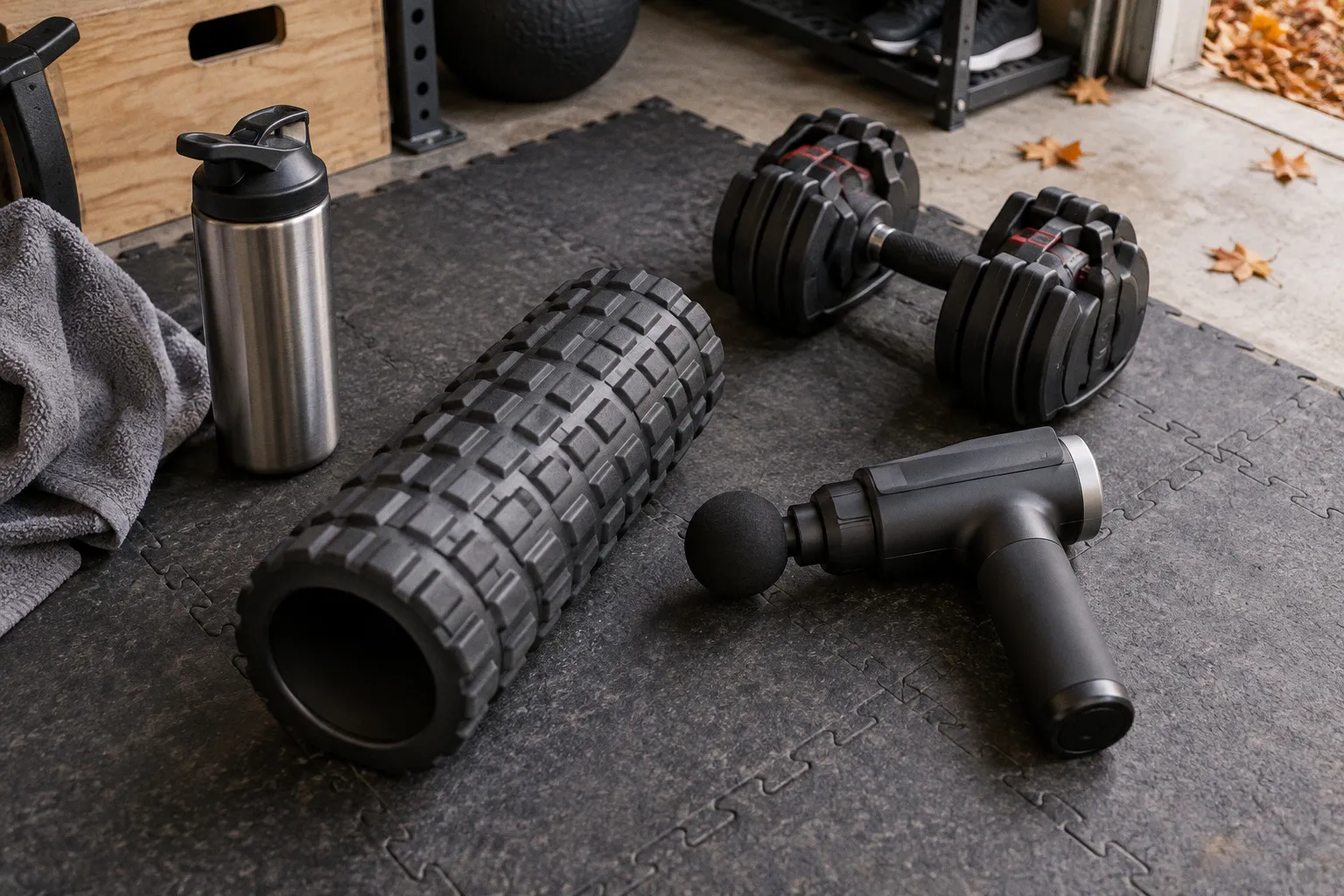
The other sells vibrating power tools with enough speed settings to make a cordless drill jealous. Both promise looser muscles, less soreness, and a faster return to training.
The reality is less exciting and more useful: a foam roller and a massage gun do not perform the same job. For long-term post-workout stiffness and delayed-onset muscle soreness, foam rolling has the stronger case. For quick, targeted flexibility work before training or relief in a hard-to-reach area, a massage gun is more convenient.
So in the foam roller vs massage gun for muscle recovery debate, the winner depends on what you need the tool to do. If you want one affordable device that covers the basics, buy the roller. If you already have a sensible recovery routine and want more precise, portable treatment, consider the gun.
The mechanics of recovery: compression versus percussion
Both tools fall under the broad category of self-myofascial release tools, but they apply force in very different ways.
A foam roller uses your body weight to create broad mechanical compression. You position the target muscle over the roller, control the pressure by shifting your weight, and move slowly through the area. The effect is not a magical scraping-away of knots. Your muscles are not tangled balls of yarn waiting for the correct piece of equipment to untie them.
The more defensible explanation is that rolling applies pressure across a wider section of tissue and may influence muscle tone, stiffness, and your perception of discomfort. The pressure is adjustable, although beginners often treat every session like an audition for a pain tolerance championship.
A massage gun uses rapid percussive pulses against a smaller area. The motor drives an attachment into the tissue repeatedly, creating localized stimulation without requiring you to support your body weight on a cylinder. You can work the hamstrings, calves, glutes, shoulders, and other areas while standing or sitting. That is the main practical advantage: precision with less awkward positioning.
The distinction matters because the tools behave differently in real use:
| Factor | Foam roller | Massage gun |
|---|---|---|
| Main action | Broad compression using body weight | Rapid pulses applied to a localized area |
| Best use | General stiffness, post-workout rolling, multi-day recovery | Targeted acute flexibility and localized tissue work |
| Control | Adjusted through body position and pressure | Adjusted through speed, pressure, and attachment |
| Learning curve | Simple, but pressure control takes practice | Easy to operate, harder to use intelligently |
| Portability | Light and inexpensive, but often bulky | More compact for travel, though heavier than a basic roller |
| Typical price | About $10–$50 | About $100–$300 for quality models |
| Main weakness | Can be uncomfortable and difficult on some body parts | Easy to overuse and expensive for what it actually does |
The foam roller is a blunt instrument, but blunt does not mean useless. The massage gun is more targeted, but targeted does not mean automatically superior. Fitness marketing loves to confuse sophistication with effectiveness. A motor, a screen, and several attachments do not guarantee better recovery.
A massage gun is a precision tool, not a mechanical upgrade to your entire recovery routine.
Why foam rolling leads for post-workout soreness
When people ask about the benefits of foam rolling after a workout, they usually mean one of two things: less stiffness the next day or a quicker return to normal movement after a demanding session. That is where the roller makes its strongest argument.
Research comparing recovery methods found that foam rolling significantly reduced the onset and duration of increased muscle tone and muscle stiffness over a three-day period compared with passive rest. The reported results were statistically significant for muscle tone and stiffness. Percussive massage did not produce the same reductions in those measures in that comparison.
That does not mean a foam roller eliminates delayed-onset muscle soreness. Nothing in a cylinder of molded foam has earned that level of authority. It means rolling may reduce the sense that your legs have been replaced with badly maintained plumbing after unfamiliar or high-volume exercise.
The mechanism is also practical. A roller lets you spend time across an entire muscle group rather than attacking one narrow point. After lower-body training, you can work through the quadriceps, hamstrings, calves, and glutes. The pressure is broad enough to create a general change in how the area feels, rather than merely producing a temporary sensation at one spot.
That broader approach is useful when:
- You feel generally stiff rather than dealing with one specific tight area.
- Your soreness is spread across a large muscle group.
- You want a low-cost recovery tool for regular use.
- You prefer a device that requires no charging, app, or collection of interchangeable heads.
- You are recovering between sessions over several days rather than trying to alter movement immediately.
The roller also imposes a useful degree of honesty. You have to position yourself, control your movement, and pay attention to pressure. It is difficult to mindlessly wave it at a muscle while scrolling through a phone. That may be an accidental benefit. Recovery is not improved because a device looks impressive on a nightstand.
How long should you roll?
A common protocol is 60 to 180 seconds per target muscle group, at roughly 30 rolls per minute. That is slow. Deliberately slow. If you are racing up and down the roller as if late for a train, you are not following the protocol; you are just creating friction.
Use a pressure level that feels challenging but tolerable, around 6 out of 10 on a pain scale. More pain is not proof of more benefit. Excessive pressure can make the session miserable and may leave the area feeling irritated rather than usefully mobilized.
A practical sequence looks like this:
1. Start with broad, slow passes over the muscle group.
2. Pause briefly on areas that feel particularly restricted, but do not force your entire body weight into the most painful point.
3. Keep breathing normally rather than bracing against the roller.
4. Spend roughly one to three minutes on the target area.
5. Reassess movement afterward instead of assuming discomfort equals success.
Avoid rolling directly over joints, the front of the neck, or areas where you have an acute injury. The roller is for muscular work, not for proving that every painful structure can be bullied into submission.
Where massage guns earn their keep
The massage gun effectiveness for soreness discussion becomes confused because people expect one answer for several different outcomes. A massage gun may feel useful for soreness, but its clearest advantage is not necessarily multi-day DOMS reduction. It is targeted, immediate work.
A literature review reported that percussive therapy produced up to an 11.4% acute increase in hamstring range of motion. That is a meaningful reason to use a massage gun when you want short-term flexibility without spending several minutes rolling your entire posterior chain.
This is particularly relevant before training, when the goal is to prepare movement rather than exhaust the tissue. A brief, comfortable pass over a muscle may help you access a greater range of motion in the moment. That does not establish that the device improves sprint performance, increases power, or replaces a dynamic warm-up. Those claims routinely sprint ahead of the evidence.
The gun is also helpful when a roller is simply inconvenient. Try reaching the upper back with a roller without turning the exercise into an accidental wrestling match. Try applying controlled pressure to a small area of the shoulder while keeping your balance on a hard cylinder. The gun wins those arguments by not requiring you to lie on top of it.
A massage gun makes more sense when:
- You need a quick, localized session.
- You want to work on one muscle group without loading your full body onto a roller.
- You are preparing for movement and want an acute flexibility change.
- You travel and prefer a compact tool that fits into a training bag.
- You have trouble positioning yourself comfortably on a roller.
- You are willing to control pressure rather than automatically choosing the highest setting.
The last point is not optional. A gun can make poor technique feel professional because the motor is doing something loud. It is still possible to spend too long on one area, press too hard, or use the device where it does not belong.
Percussion is not a license to attack every sore spot
A massage gun should be used on muscular tissue, not directly over bones, joints, the front of the neck, or an area with a suspected acute injury. Avoid treating numbness as a challenge. If an area feels sharp, unstable, unusually swollen, or painful in a way that does not resemble normal post-exercise soreness, a powered attachment is not the next logical step.
The same skeptical rule applies to the highest speed setting. More pulses do not automatically mean deeper recovery. You are trying to influence how the tissue feels and moves, not tenderize yourself for dinner.
Start with a lower setting and light pressure. Move continuously over the muscle rather than parking the device on one location for an extended period. The aim is controlled stimulation. If the session leaves you more irritated, bruised, or restricted, the tool has not done its job regardless of how expensive it was.
Foam roller versus massage gun for muscle recovery: matching the tool to the problem
The cleanest way to choose is to define the outcome before choosing the equipment. “Recovery” is too broad to be useful. Are you dealing with general stiffness? Trying to move more freely before a workout? Looking for a travel-friendly device? Attempting to spend as little as possible?
Here is the practical split.
Choose a foam roller for general stiffness and post-workout recovery
The roller is the stronger first purchase for most people. It is inexpensive, requires no battery, and has useful applications across large muscle groups. The evidence also favors it for reducing muscle tone and stiffness over the following days in comparison with passive rest.
It is not glamorous, which is probably part of its appeal. There is less room for marketing theater. A roller cannot display a recovery score or advertise a proprietary vibration pattern. It simply gives you a way to apply pressure and move through tissue at a controlled pace.
A roller is especially sensible for runners, lifters, recreational athletes, and anyone who regularly feels generally beaten up after training. It can be used as part of a cooldown, a separate mobility session, or a short routine on rest days.
Choose a massage gun for targeted, immediate work
The gun is better when the problem is specific and time-sensitive. If your hamstrings feel restricted before a session, or one area needs a quick pass before movement, percussion is convenient. The acute range-of-motion findings give it a credible role here.
It is also useful for people who dislike the positions required by a roller. A tool that you will actually use is better than a theoretically excellent device that lives under the bed with last year’s resistance bands.
But the gun should supplement a training and recovery system, not pretend to be the system. Sleep, appropriate training volume, hydration, nutrition, and sensible warm-ups remain more important than the attachment head shaped like a tiny shovel.
Buy both only if they solve different problems
Owning both tools is reasonable when you understand the division of labor:
- Use the massage gun for brief, targeted work before movement or when a particular muscle feels restricted.
- Use the foam roller for broader post-workout sessions and multi-day stiffness.
- Do not use both simply because more equipment feels like more commitment.
- Do not assume alternating devices produces twice the benefit.
- Keep the tool that fits your schedule and gets used consistently.
This is the part where many recovery routines fall apart. People buy an expensive device, use it enthusiastically for ten days, then return to ignoring their legs while watching television. Consistency beats novelty. The best recovery tool is the one that matches your actual habits, not the version of yourself represented in the product advertisement.
Protocols that make the tools useful
Equipment does not create a protocol by itself. You still need to decide when, where, and how aggressively to use it.
A simple foam-rolling routine
For post-workout stiffness, choose two to four major muscle groups and give each approximately 60 to 180 seconds. Move at about 30 rolls per minute and keep the pressure around a tolerable 6 out of 10.
For a lower-body session, that might mean:
1. Quadriceps, using slow passes from above the knee toward the hip.
2. Hamstrings, keeping the movement controlled rather than bouncing over the roller.
3. Calves, working through the muscle belly and adjusting body weight as needed.
4. Glutes, rotating slightly to address different portions without forcing the hip into an awkward position.
You do not need to roll every available muscle after every workout. That is how a five-minute recovery habit becomes a forty-minute chore and disappears by Thursday.
A simple massage-gun routine
Use the gun for a short, targeted session. Begin with a low setting and light contact. Move over the muscle rather than holding the attachment in one place. Spend enough time to assess whether movement feels easier, but do not treat a temporary change in sensation as evidence that the tissue has been permanently repaired.
Before exercise, use it as part of a broader warm-up rather than as the warm-up itself. Follow with dynamic movement specific to the session. If you are preparing to squat, jump, run, or lift, the nervous system still needs to practice those movements. A massage gun cannot rehearse a movement pattern, no matter how aggressively it vibrates.
After exercise, use it for comfort if that is what it provides. Comfort has value, but it should not be dressed up as proof of accelerated performance recovery.
The device can change how a muscle feels. That is useful, but it is not the same as rebuilding the muscle.
Cost, portability, and the problem with buying too much gear
The price difference is not subtle. Foam rollers generally cost about $10 to $50. Quality massage guns typically sit around $100 to $300, with high-end models exceeding $300.
That gap changes the buying decision. A foam roller can cover the basic needs of a beginner, an experienced athlete, and a traveler who does not mind giving up some luggage space. A massage gun demands a clearer reason for existing. If its main appeal is that it looks like serious equipment, keep your wallet closed.
Foam roller advantages
- Low entry price.
- No charging or maintenance beyond keeping it reasonably clean.
- Broad coverage for major muscle groups.
- Stronger support for reducing post-exercise stiffness and muscle tone over several days.
- Easy to share in a household or keep in a home gym.
Foam roller drawbacks
- Bulky compared with many massage guns.
- Awkward for the upper back and some smaller muscle groups.
- Can feel uncomfortable, especially with aggressive pressure.
- Requires more active positioning and body control.
- Textured models may be unnecessarily harsh for people who are new to rolling.
Massage gun advantages
- Localized application.
- Convenient for hard-to-reach areas.
- Useful for acute flexibility changes, including the hamstrings.
- Easier to use while standing or sitting.
- Practical for people who travel with a training kit and want targeted recovery equipment.
Massage gun drawbacks
- Much more expensive.
- Requires charging and storage.
- Easy to overuse because the device feels powerful.
- Does not have the same demonstrated advantage for reducing multi-day stiffness and muscle tone in the comparison described above.
- More attachments and settings can create the illusion that every body part needs a custom engineering solution.
For travel, the choice is less obvious than the usual packing advice suggests. A massage gun may fit more neatly in a bag, but it is heavier and more expensive to lose. A compact foam roller is inexpensive and maintenance-free, but even a compact model occupies real space. If you travel frequently, choose based on the type of training you actually do. A runner with occasional calf tightness may value targeted percussion. Someone completing full-body strength workouts may get more from a roller despite its shape.
What neither tool can fix
The recovery-device market is built around a tempting idea: discomfort is a technical problem, and the right piece of equipment will solve it. Sometimes the issue is simpler. You are doing too much, sleeping too little, progressing too quickly, or treating every training session like a final exam.
Neither a foam roller nor a massage gun will compensate for poor programming. Neither will fully erase DOMS. Neither replaces rest and hydration. Neither has established itself as a universal shortcut to better athletic performance.
If soreness is persistent, severe, asymmetrical, or accompanied by swelling, weakness, numbness, or a sharp pain, stop treating it as ordinary training fatigue. A recovery tool is not diagnostic equipment. Turning up the pressure is not a medical plan.
The same skepticism applies to claims that a particular attachment reaches a precise depth or unlocks a hidden layer of fascia. The available evidence does not establish universal optimal settings for amplitude or frequency across every body part. You do not need a technical specification sheet to use a massage gun sensibly. You need controlled pressure, reasonable duration, and enough judgment to stop when the body objects.
The verdict: which recovery tool should you buy?
For most people choosing between a foam roller and a massage gun, I would start with the foam roller.
It costs a fraction of the price, works across large muscle groups, requires no charging, and has the better case for reducing muscle stiffness and increased muscle tone over the days following exercise. It is not exciting, but neither is replacing a worn tire. Useful equipment is allowed to be boring.
Choose a massage gun instead if your priority is targeted, immediate flexibility work, if a roller is uncomfortable or impractical, or if you travel and will genuinely use the device. Its ability to produce acute range-of-motion changes, including reported hamstring improvements of up to 11.4%, gives it a legitimate role. Just do not confuse convenience with superiority in every category.
The foam roller wins the broad recovery contest. The massage gun wins the precision and portability contest. Buy according to the problem in front of you, not the loudest promise on the box.
FAQ
Should I use a foam roller or a massage gun for muscle soreness?
How long should I use a foam roller on a muscle group?
Can a massage gun help with flexibility?
Where should I avoid using a massage gun or foam roller?
Is more pressure better when using recovery tools?
More products
 Motion EnergyUSD49