Heart rate monitor types: which tracking path fits your goals?
You start a workout, glance at your wrist, and the number looks reassuringly precise. Then the intervals begin.
Your forearms tense, the watch hesitates, and your heart rate suddenly jumps—or stays suspiciously flat while you are clearly working hard.
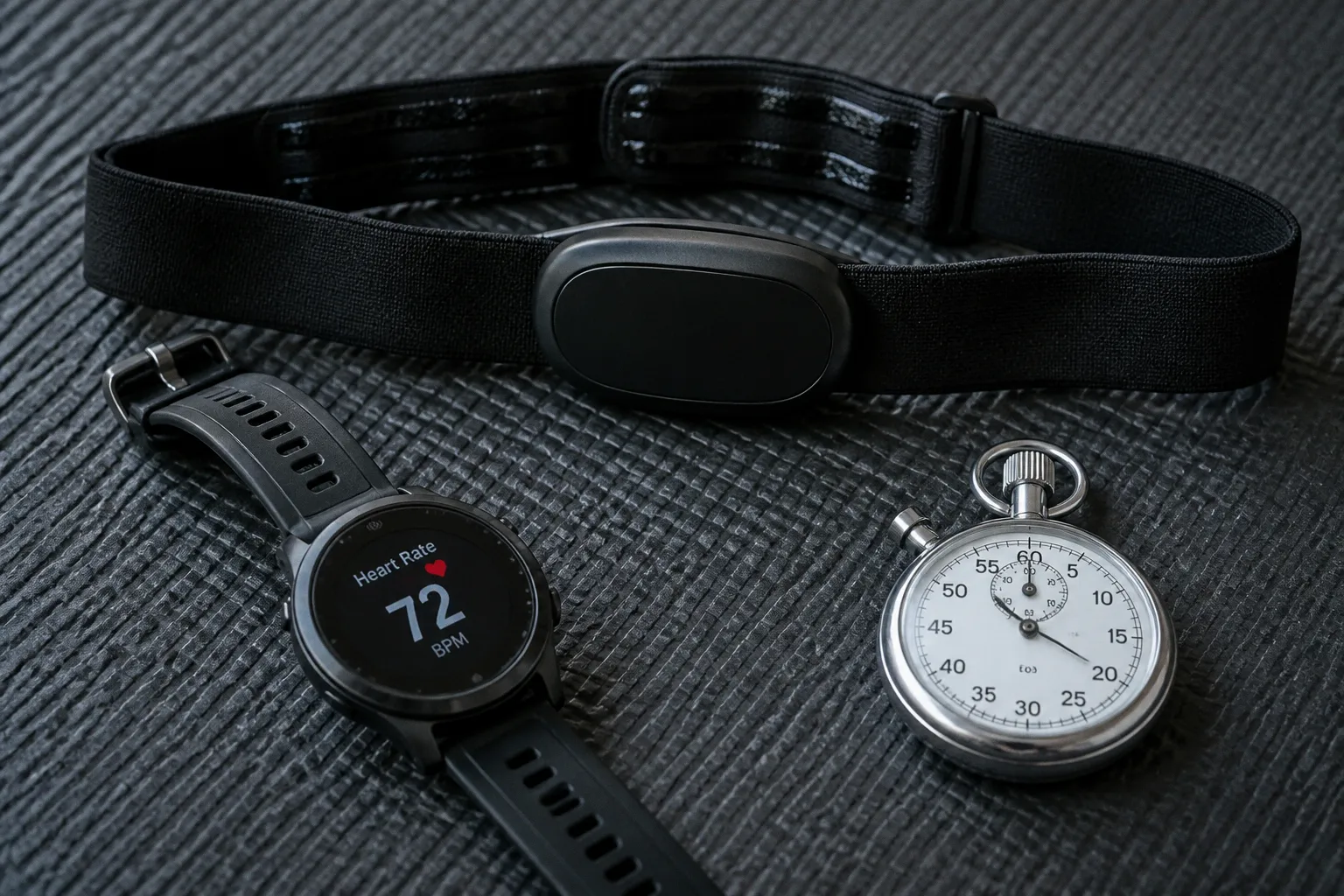
That frustration is not always a device failure. It often comes from choosing the wrong sensor technology for the movement you are doing. The main heart rate monitor types for workouts use one of two paths: electrical measurement through a chest strap, or optical measurement through a wrist, forearm, or upper-arm sensor. Both can be useful. They simply behave differently under pressure.
For steady walking or an easy run, an optical sensor may give you all the information you need. For short, intense intervals or strength circuits, an ECG chest strap is usually the more dependable choice. The best heart rate monitor for training is therefore not the one with the most features. It is the one that matches the way your body moves during your hardest sessions.
The science of pulse: ECG versus PPG
Heart rate monitors do not all measure the same signal.
A chest strap uses electrocardiography, or ECG. It detects the heart’s electrical activity through electrodes placed against the skin of the chest. Each heartbeat creates an electrical signal, and the strap interprets those signals as beats per minute.
A wrist, forearm, or upper-arm monitor generally uses photoplethysmography, known as PPG. Small LEDs shine light into the skin, while optical sensors measure changes in blood volume as the heart pumps. The device then estimates your pulse from those changes.
That distinction matters because electrical signals tend to respond directly and quickly to each heartbeat. Optical signals must be read through moving tissue, and the quality of that reading can change with movement, pressure, skin contact, and circulation.
In validation testing, the Polar H7 chest strap reached a concordance correlation coefficient of 0.996 against clinical ECG measurements across the activities evaluated. That is an exceptionally close agreement. In another exercise-monitoring comparison, chest straps recorded a mean absolute percentage error of 0.76%, compared with 3.32% for sports vests with integrated electrodes.
These numbers do not mean every chest strap is perfect. A loose strap, poor electrode contact, or dry skin can still create dropouts. They show something more useful: when the strap is fitted correctly, ECG-based tracking has a strong technical advantage for demanding exercise.
Optical sensors are not automatically inaccurate. Their performance depends heavily on context. During steady-state cardio, the signal is often stable enough to guide your effort well. During movements that repeatedly flex the wrist or tense the forearm, the sensor has a more difficult job.
The right heart rate monitor is not the one that wins every comparison. It is the one that stays trustworthy during the training you actually do.
Why chest straps remain the strongest choice for HIIT
High-intensity interval training creates a difficult environment for heart rate tracking. Your effort rises quickly, rests are short, and the difference between one training zone and another can matter. If the device reacts late, the number on the screen may describe what happened several seconds ago rather than what your heart is doing now.
A chest strap sits close to the source of the signal. It does not need to interpret blood-flow changes through a moving wrist. That makes it particularly useful for:
- Short running intervals where heart rate rises rapidly.
- Bike sprints and hard rowing efforts.
- Metabolic circuits with quick transitions between exercises.
- Strength sessions where you want to observe cardiovascular demand between sets.
- Structured zone training, especially when staying below or above a specific threshold matters.
- Workouts performed with a watch or gym console that supports live heart rate data.
Chest straps and standalone heart rate monitors commonly transmit real-time data through Bluetooth or ANT+. That allows the strap to send your pulse to a sports watch, indoor bike, treadmill, rowing machine, or training app without requiring the watch’s optical sensor to do the measuring.
For interval work, the practical benefit is responsiveness. You can finish a hard effort, move into recovery, and see the change in real time instead of waiting for a wrist sensor to settle. This is especially valuable when your program uses work-to-rest ratios or when you are trying to control intensity rather than simply collect a workout summary.
There is also a coaching advantage. If the monitor responds consistently, you can learn how a particular pace, resistance level, or circuit affects you. That gives your training data a stable reference point. Without that consistency, it becomes harder to tell whether your fitness is changing or the sensor is simply behaving differently from one session to the next.
The trade-off: contact and comfort
Chest straps require a little more setup than a smartwatch. The electrodes need skin contact, and the strap must be snug enough to stay in place without restricting breathing. Lightly moistening the electrode areas before training can help create a reliable connection, particularly at the beginning of a session when the skin is dry.
Fit is not a minor detail. If the strap shifts during burpees, rowing, or repeated trunk flexion, the data can become noisy. If it is too loose, you may see gaps or sudden implausible spikes. If it is excessively tight, the discomfort may make the device difficult to wear consistently.
This is where sustainability enters the decision. A technically excellent monitor that you stop wearing is not a useful monitor. If chest straps make you avoid tracking altogether, an optical armband or watch may offer a better balance between accuracy and adherence.
The limits of wrist-based optical sensors
The wrist is convenient, but it is a busy place during exercise. It bends, rotates, grips, presses into equipment, and changes tension as you move. Those conditions can interfere with PPG readings.
Wrist-based optical sensors are particularly vulnerable to motion artifacts. The device is attempting to detect subtle changes in blood volume while the surrounding tissues are moving. Forearm muscle flexing, heavy wrist movement, and repeated impact can make the pulse signal harder to separate from the movement signal.
That is why a watch may perform well during walking or jogging but struggle during:
- Weightlifting, especially pressing, pulling, and gripping exercises.
- Rowing, where the wrist repeatedly changes angle and the forearm works hard.
- Burpees, mountain climbers, and other fast floor-based movements.
- Kettlebell circuits with frequent wrist rotation.
- Boxing or striking drills.
- Exercises where the watch shifts because the wrist is flexed or loaded.
- Cold-weather training, when reduced circulation can affect the optical reading.
Skin and device contact also play a role. Dark or tattooed skin can affect how some optical systems read reflected light, although performance varies between devices and conditions. This is not a reason to dismiss PPG technology. It is a reason to avoid treating one wrist reading as universal truth across every person, workout, and environment.
The most common problem is not a dramatic failure. It is lag. The watch may show a reasonable number eventually, but only after the hardest part of the interval has passed. For general activity tracking, that may be acceptable. For pacing a 30-second sprint or judging recovery between rounds, it can change the meaning of the data.
When a wrist monitor is still a sensible choice
Optical wrist sensors can be very practical for steady-state exercise. Walking, easy jogging, relaxed cycling, and other sustained activities usually create a more predictable signal. The watch is also convenient for people who want one device to track heart rate, movement, sleep, notifications, and everyday activity.
In treadmill-running comparisons, an Apple Watch III recorded a concordance correlation coefficient of 0.96 against ECG. Other tested optical devices, including the Fitbit Ionic, Garmin Vivosmart HR, and TomTom Spark 3, showed lower but still meaningful agreement, with a reported coefficient of 0.89 in the same broad category of comparison.
The lesson is not that one brand always wins. It is that optical accuracy can be strong in some activities and less stable in others. Fitness tracker sensor accuracy is situational. The same device may be useful for monitoring a long easy run and less convincing during a fast strength circuit.
For daily use, a wrist monitor may be the better option when:
- You want the lowest-friction experience.
- Most of your cardio is steady and continuous.
- You care about broad trends more than second-by-second precision.
- You do not want to wear a chest strap during travel or casual workouts.
- You are building the habit of monitoring effort for the first time.
The goal is not to create perfect data. The goal is to create data that supports better decisions without making training feel like a laboratory appointment.
Armbands offer a useful middle ground
If you want more stable optical tracking without moving to a chest strap, an armband can be a strong compromise.
An optical armband worn on the forearm or upper arm avoids many of the wrist-flexion problems that affect watches. The sensor is still using PPG, but the placement gives it a quieter surface and often more consistent contact. It can be more comfortable than a chest strap while responding more reliably than a wrist device during mixed training.
This makes an armband worth considering for people who combine several training styles:
- Strength training with frequent gripping.
- Indoor cycling and moderate intervals.
- Circuit training with upper-body movement.
- Travel workouts using resistance bands and portable equipment.
- Sessions where a chest strap feels intrusive but a wrist sensor is inconsistent.
An armband does not magically become an ECG monitor. It remains an optical device, so it can still be affected by circulation, fit, movement, and the quality of the sensor. But it places the technology in a more favorable location for many workouts.
The fit should be secure, not crushing. If the band slides toward the elbow or rotates during exercise, the reading may become unstable. Upper-arm placement can also be more comfortable under long sleeves or activewear, but it is worth checking that the fabric does not press the sensor away from the skin.
For some athletes, the armband is the most sustainable daily solution: more dependable during training than a watch, less noticeable than a chest strap, and compatible with the same Bluetooth or ANT+ ecosystem.
Chest strap versus wrist heart rate monitor: a practical comparison
The chest strap vs wrist heart rate monitor decision becomes clearer when we compare the actual training experience rather than treating accuracy as a single universal score.
| Training factor | ECG chest strap | Optical wrist monitor | Optical armband |
|---|---|---|---|
| Signal source | Electrical activity from the heart | Blood-volume changes under the skin | Blood-volume changes under the skin |
| Response during hard intervals | Typically fast and consistent when fitted correctly | May lag during rapid intensity changes | Often more responsive than wrist placement |
| Strength training | Strong option for tracking cardiovascular demand | More vulnerable to gripping and forearm flexion | Usually a better optical choice |
| Steady-state cardio | Highly reliable, though not always necessary | Convenient and often sufficient | Reliable middle ground |
| Comfort and simplicity | Requires wearing a separate strap | Easiest for everyday use | Moderate setup with low wrist interference |
| Best use | HIIT, structured zones, rowing, cycling, demanding circuits | Walking, easy running, general activity trends | Mixed training and travel-friendly workouts |
| Main drawback | Can feel intrusive or require careful fit | Motion artifacts and delayed readings | Still subject to optical-sensor limitations |
| Connectivity | Commonly supports Bluetooth and ANT+ | Depends on the watch or tracker | Often supports Bluetooth or ANT+ |
This table is not a ranking. It is a route map.
If your training has a clear performance target, chest-based ECG measurement gives you the cleanest path. If your priority is consistency of use and broad feedback, a wrist monitor may be the better companion. If you sit between those priorities, an armband deserves serious attention.
Match the sensor to the way you train
The most useful question is not, Which sensor is most accurate? It is, When do I need accuracy most?
Different workouts create different demands. We can make the decision more practical by looking at the type of information you need from your heart rate monitor.
For HIIT and sprint intervals
Choose a chest strap when the session is built around rapid changes in effort. The closer the workout is to repeated all-out bursts, the more valuable fast response becomes.
If your plan says to reach a high intensity for a short interval and recover until your heart rate drops to a certain range, delayed wrist data can make the session harder to interpret. You may be working from outdated numbers, especially during short intervals.
For strength training
Strength workouts are not automatically heart rate workouts, but many modern sessions include circuits, supersets, loaded carries, or short rest periods. In those cases, a chest strap can capture the cardiovascular demand more consistently.
A wrist device may struggle when you are gripping a barbell, holding a dumbbell, or flexing the forearm repeatedly. An armband is often a more comfortable optical alternative, particularly if you do not need ECG-level responsiveness.
Remember that heart rate is only one part of strength training feedback. It does not tell you whether your technique was sound, whether the load was appropriate, or whether a set reached the intended level of muscular fatigue. Use the reading as context, not as a verdict on the quality of the session.
For running and walking
For walking and easy, continuous running, a wrist monitor is often enough. These activities tend to produce rhythmic movement and a relatively stable pulse signal. The simplicity of checking your wrist can make it easier to manage effort, especially outdoors or while traveling.
For tempo runs, hill repeats, and track intervals, the case for a chest strap becomes stronger. The more precise your pacing strategy, the more useful a fast and stable heart rate response can be.
For cycling and rowing
Cycling is often friendly to chest straps and armbands because the wrist can remain relatively still, depending on the position and style of riding. Indoor cycling platforms can also use live data from Bluetooth or ANT+ sensors, making a chest strap practical if you train from a structured class or app.
Rowing is more complicated for wrist sensors. The repeated wrist angle and forearm engagement can create noise, particularly during hard strokes. A chest strap is usually the safer choice when heart rate zones are central to the session.
For travel workouts
Travel changes the priority. You may be using resistance bands, a compact fitness kit, bodyweight circuits, or a hotel gym with unfamiliar equipment. In that setting, the best monitor is usually the one you will pack, wear, and connect without friction.
A wrist watch is convenient for general movement and steady cardio. An armband can be useful when you are doing band rows, push-ups, squats, and circuits where wrist flexion is constant. A chest strap makes sense if you are following a precise conditioning plan and want reliable interval feedback wherever you train.
A sustainable tracking habit beats a theoretically perfect device left in a drawer.
How to read the number without overreacting
Heart rate data is useful, but it needs a little restraint. One strange spike does not necessarily mean your body suddenly changed. It may be a contact issue, a movement artifact, or a temporary interruption in the signal.
Look for patterns across sessions:
- Does the reading rise smoothly during a steady warm-up?
- Does it respond when the workout intensity changes?
- Does it drop during recovery in a way that matches how you feel?
- Are unusual spikes tied to specific exercises such as rows, burpees, or heavy gripping?
- Does the device show gaps when the strap or band shifts?
- Are you comparing similar workouts under similar conditions?
Perceived effort still matters. Breathing, muscle fatigue, heat, stress, sleep, hydration, and recent meals can all affect how a session feels. A heart rate monitor adds information; it does not replace your ability to notice what is happening in your body.
This is particularly important when using zone-based training. Heart rate zones are estimates, and the quality of the input affects the usefulness of the output. If the sensor consistently lags during intervals, do not force your entire workout around a number that arrives late. Use pace, resistance, breathing, and effort as supporting signals.
For general wellness, a device that helps you notice trends may be enough. For performance training, the quality and timing of the signal deserve more attention.
A simple buying framework for your next device
Before choosing between ECG and optical heart rate sensors, narrow the decision with four questions.
1. What is the hardest session you do regularly?
If the answer is sprint intervals, intense circuits, or demanding rowing, choose based on that session rather than your easiest workout.
2. Do you need live data or a broad summary?
Live zone control favors a chest strap or responsive armband. A general daily trend can be handled well by a wrist device.
3. Where does your current tracker fail?
If you see lag during wrist-heavy movements, changing watch brands may not solve the underlying problem. A different sensor location may.
4. What will you wear consistently?
Comfort, setup time, battery habits, and connectivity all influence adherence. A monitor that fits your routine will produce more useful information than one that is technically stronger but rarely used.
Compatibility deserves a close look before buying. Your monitor should communicate with the watch, app, or gym equipment you rely on. Bluetooth and ANT+ are common standards, but support can vary between devices and platforms. If you train with a particular indoor bike or coaching app, check that it can receive live data from your preferred sensor.
Battery style and maintenance also shape the experience. Some monitors use replaceable coin-cell batteries, while others are rechargeable. Exact battery life varies widely by model, so it is better to evaluate the charging or replacement routine you can realistically maintain than to choose from a generic promise of long battery life.
Clean the sensor according to the manufacturer’s instructions, allow the strap or band to dry, and check the fit before intense work. Small habits protect the quality of the signal and extend the life of the equipment.
The best heart rate monitor for training depends on the job
There is no single winner across every workout.
For high-intensity intervals, structured heart rate zones, rowing, and strength circuits with frequent wrist movement, an ECG chest strap is the most dependable route when worn correctly. For walking, easy running, everyday activity, and steady-state cardio, an optical wrist monitor can be convenient and sufficiently accurate. For mixed workouts, travel training, and people who want a balance of comfort and performance, an optical armband often fills the gap.
If you are undecided, start with your next meal’s equivalent in training: choose one small, useful improvement rather than rebuilding your entire system. For your next workout, wear the sensor that best matches the session, note whether the number responds when your effort changes, and compare it with your breathing and perceived exertion.
That simple observation will tell you more than a feature list. When your tracking method supports your training instead of distracting from it, you have found the right path.