Maintain Muscle on the Road: Portable Training Strategies for Travel
Travel disrupts mechanical loading patterns. Hotel rooms lack barbells. Compliance collapses within 72 hours when programming demands infrastructure the traveler cannot access.
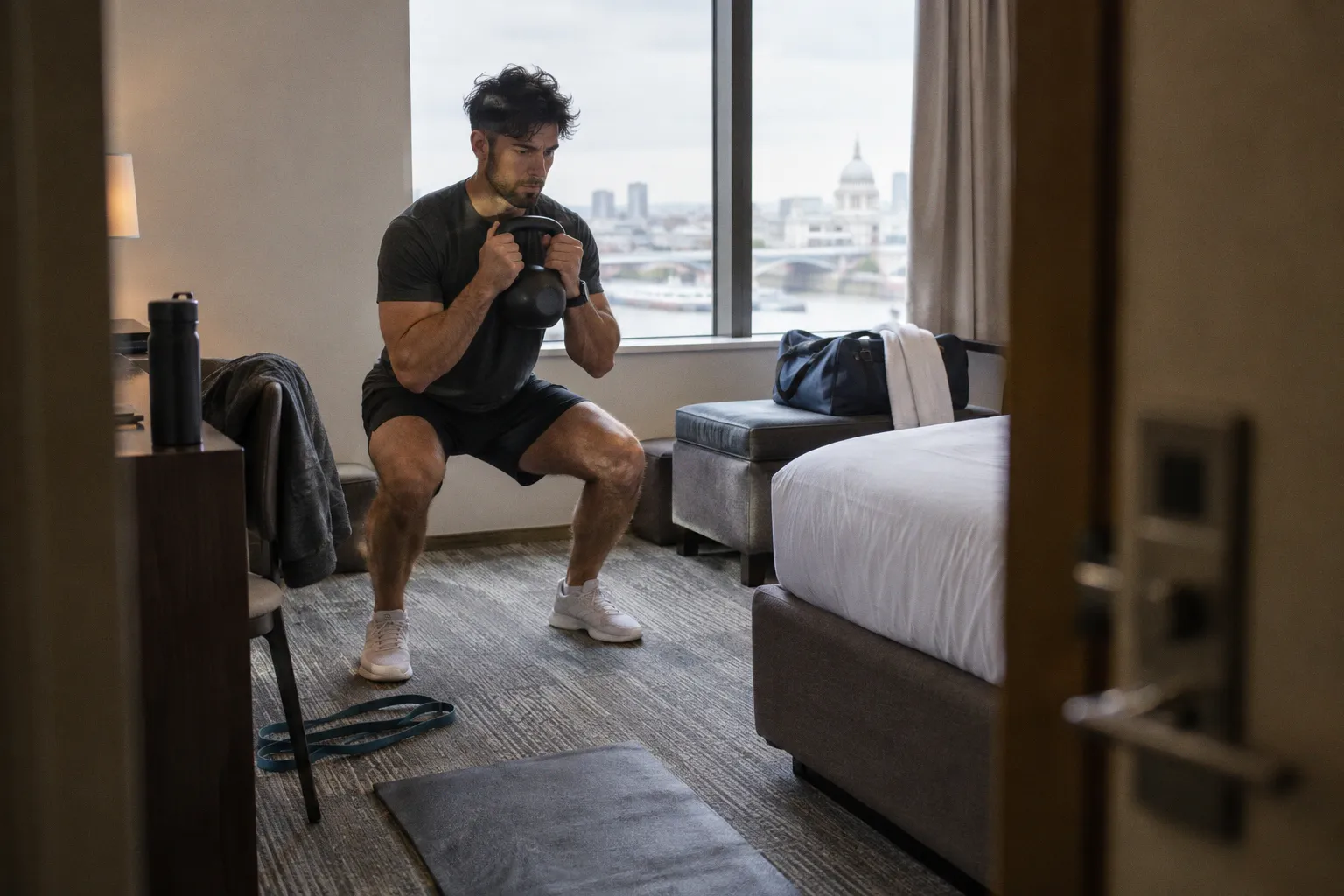
According to mensfitness.co.uk, a protocol exists that removes the dependency on fixed equipment while preserving the neuromuscular stimulus that drives adaptation.
The Problem: Equipment-Locked Programming
Strength training adherence fails when the program requires load that is not transportable. A standard home setup demands dedicated square footage and bolted-down resistance. Travel compresses that footprint to a carry-on.
The physiological cost is not trivial. Skeletal muscle protein synthesis drifts toward baseline within roughly two weeks of unloading. Neural drive patterns decay on a faster timeline. Lifters who abandon loading for ten days return measurably weaker, not merely deconditioned. Strength is a skill. Skills extinguish under disuse.
The solution is not willpower. The solution is a program that strips the dependency on fixed resistance and substitutes mechanical tension strategies that travel with the body itself.
What the Source Addresses
mensfitness.co.uk has published a travel-compatible protocol built around bodyweight mechanics and portable loading. The framing is logistics, not discipline. The principle is that the stimulus must move with the lifter when the environment refuses to cooperate.
Adjacent coverage reinforces the same principle from a different angle. Men's Journal has detailed a 30-minute bodyweight session designed to replicate the mechanical demands a racer encounters on HYROX-style event day. The relevant variable is movement pattern specificity under fatigue, not raw tonnage. HuffPost has narrowed in on the limited category of home equipment that meaningfully shifts workout capacity beyond what calisthenics alone can deliver. Single tools, multiple loading angles, zero excuses.
The throughline across these pieces is minimum effective dose. One piece of portable equipment plus a floor plus a wall covers most of the demand curve a gym covers.
Implementation Protocol
Four constraints govern a travel program that actually works:
- Load is variable, not fixed. A kettlebell pressed at 30 pounds produces a different force curve than a barbell at 135. The program must acknowledge altered mechanics rather than pretend the stimulus is equivalent.
- Volume is compressed, not eliminated. Twenty minutes of high-tension work beats zero minutes. The adaptation threshold sits lower than most lifters assume.
- Frequency is non-negotiable. Three sessions across seven days, even at fifteen minutes each, preserves neuromuscular patterning better than one maximal effort followed by six days of stillness.
- Progression is tracked by tension, not weight. Slower eccentrics, paused reps, and single-limb variations raise mechanical demand without raising external load.
The goal is not to replicate your home program in a hotel room. The goal is to preserve the mechanical input your physiology requires to retain what you built. Travel is an environmental variable. The training must adapt to it — or the adaptation stops.