Travel Workout Gear: A Packing Checklist Before Your Trip
The suitcase is already straining at the seams with hotel-sized shampoo bottles and three pairs of shoes you won't actually wear.
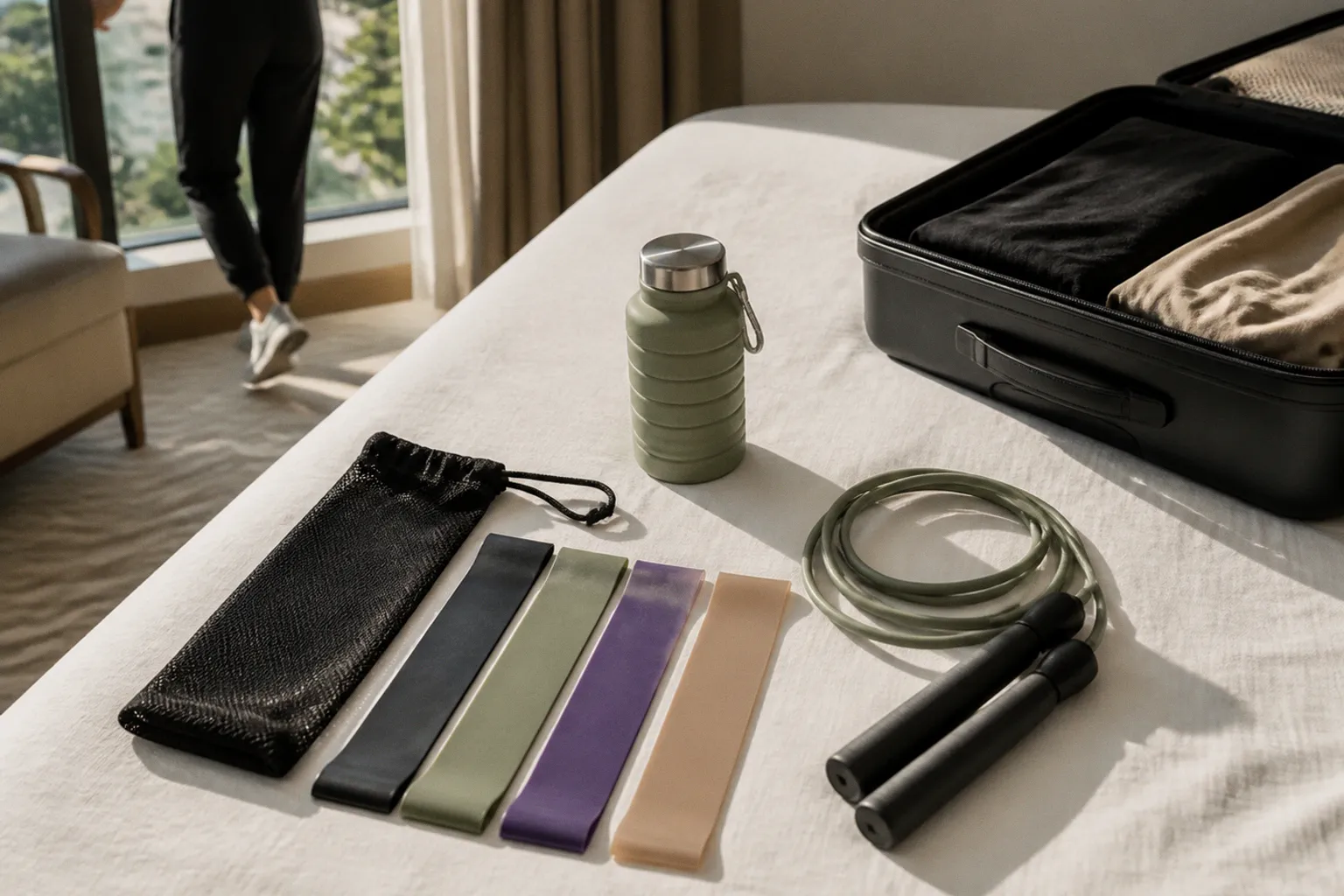
The last thing you need is a 15-pound dumbbell set wedged between your underwear and that paperback you've been "meaning to finish." And yet somehow, every traveler I know either goes full Gear Acquisition Syndrome — dragging a yoga mat, a kettlebell, AND a pair of hex dumbbells through the terminal — or just throws in the towel (pun intended) and skips workouts for ten days straight.
Both approaches are garbage. I've done both. After enough trips spent hauling equipment I never used, or watching my conditioning fall off a cliff because I didn't bring a single resistance tool, I figured out what actually fits in a carry-on, clears TSA, and still lets you train like you mean it. Here's the packing checklist I wish someone had handed me ten years ago.
TSA Compliance: Navigating Carry-On Restrictions for Fitness Gear
If it can knock someone unconscious, TSA treats it like a weapon. That means your favorite metal bar is staying home.
Every fitness traveler eventually stands at the security checkpoint doing mental math: Will this thing beep? Will they make me throw it away? Is it worth the embarrassment?
Here's the blunt reality. TSA's job is keeping bludgeons and sharp objects off planes, and they don't care whether you call your resistance bar "ergonomic." Soft elastic resistance bands and loop bands are allowed in both carry-on and checked luggage because they're squishy, contain no hazardous materials, and pose no strike hazard. Period. No drama, no agent pulling you aside to inspect your seven-pack of tube bands.
The moment you graduate to a rigid metal bar — those screw-together resistance systems like the X3 or Serious Steel — you have a problem. TSA agents routinely flag these as blunt objects, and "but it's exercise equipment" doesn't move the needle. These things go in checked luggage, full stop. If you've ever tried to argue with a TSA officer about the biomechanical benefits of variable resistance training, you know how that conversation ends. It ends with your bar in a plastic bin and your dignity checked separately.
A quick rule of thumb: if the gear is rigid, dense, and could theoretically be swung at someone's head, pack it where you can't reach it quickly. If it's soft, stretchy, and folds down to the size of a deck of cards, you're golden.
| Gear Type | Carry-On Status | Reason | What to Do |
|---|---|---|---|
| Elastic resistance bands / loops | Allowed | Soft, no hazardous materials | Toss anywhere in your bag |
| Foldable travel yoga mat | Usually allowed | Soft, compressible | Verify airline size rules first |
| Jump rope (cord or beaded) | Usually allowed | No rigid components | Detach handles if possible |
| Speed rope with metal cable | Varies by agent | Cable can flag inspection | Use coated cable or check it |
| Foam roller (rigid) | Policy varies | Bulky items may draw scrutiny | Check current TSA and airline rules before packing |
| Screw-together resistance bar | Prohibited in carry-on | Blunt object under TSA rules | Checked luggage required |
One more thing worth knowing: TSA leaves the final call on whether folded mats or bulky soft items count toward your airline's baggage allowance up to the individual carrier. So before you pack that 24-inch travel mat, double-check with your airline. Nothing worse than getting a $75 gate-check fee on what you assumed qualified as a "personal item."
The Science of Portable Resistance: Why Bands Match Conventional Weights
Here's a sentence that should end every "bands versus weights" debate forever, but probably won't: a 2019 meta-analysis published in SAGE Open Medicine found that elastic resistance training produces strength gains comparable to conventional resistance training across both upper and lower limbs.
Read that again. Comparable. Not "good enough for travel." Not "slightly worse but convenient." Comparable.
The lifters who insist bands are a toy are usually the ones who've never trained under time pressure in a hotel room. They've never had to choose between a 50-pound suitcase and a 50-pound dumbbell. When your gear has to ride shotgun with your laptop and your conference badge, resistance bands stop being a compromise and start being the smartest tool in the bag.
Pros of going band-only on the road:
- Five bands fit in a quart-size ziplock and weigh basically nothing
- Variable tension across the range of motion actually builds stabilizing muscles that a fixed-path dumbbell ignores
- You can deadlift, squat, row, press, curl, and face-pull with one kit
- No TSA drama, no checked-bag fees, no sore shoulders from hauling a hex pair through the terminal
Cons, because there are always cons:
- Peak tension on a band is at the top of the movement, which inverts how a free weight loads the muscle. Some lifters find it weird. You adapt.
- No easy way to load a true 1RM. If your training depends on grinding heavy singles, bands won't replace a barbell.
- Cheap tubes snap. Buy reputable brands with reinforced eyelets, or you'll find a latex snake coiled around your socks mid-trip.
The verdict after a decade of testing every band setup from $8 Amazon specials to $200 mounted systems: a mid-priced set of loop bands plus a tube band with handles covers most hotel-room workouts. You don't need the boutique brand. You need bands that don't snap on rep four and handles that don't dig into your palms.
High-Efficiency Cardio: Maximizing Calorie Burn in Small Hotel Spaces
You have three cardio options in a hotel: the hotel gym (often a single treadmill and a rack of 5-pound dumbbells), the road (uneven sidewalks, weather, awkward stares), or a jump rope in your room (neighbors will hate it, but your heart rate doesn't care).
The jump rope wins on calorie burn per minute and per square foot. Depending on your intensity and body weight, a jump rope burns roughly 10 to 16 calories per minute. That's a range, not a guarantee — heavier jumpers and higher-intensity sessions push toward the top end, lighter folks and casual single-unders sit closer to the bottom. Either way, twenty minutes of skipping burns more calories than an hour of walking on a hotel treadmill while scrolling through the lobby's free wifi.
Gear list for hotel-room cardio that won't get you evicted:
- A quality speed rope with a coated or woven cable. Beaded ropes are louder and easier on the knees but will punish your shins if you slip.
- A door anchor if you want to do suspension work without a tree branch. Most band systems include one.
- A small towel, because you're going to sweat, and hotel carpets absorb everything.
A ten-minute jump rope session — thirty seconds on, thirty seconds off, repeated for ten rounds — will smoke your cardiovascular system harder than most "fat-blasting" hotel gym routines. It also takes up zero floor space, requires zero setup, and disappears into a side pocket of your carry-on.
If you're skipping because of joint pain, you're probably jumping too high. Stay low, drive the rope with your ankles, and let the cable do the work. A properly set jump rope handle should reach your armpits when you step on the cord. Anything longer wastes energy.
Stairwells count, too. Ten round trips up and down a hotel stairwell is a brutal conditioning finisher and zero-cost cardio. Just don't do it barefoot, because hotel stairwells are a hygiene nightmare.
Weight-Conscious Essentials: Selecting Mats and Tools Under Two Pounds
The gear that earns a spot in your bag is the gear you can lift with one hand without thinking about it. As a rough cutoff, anything under two pounds is "carry it." Anything over five pounds needs a justification. Most of the fitness industry ignores this rule, and that's why most travelers quit training on day three of a trip.
A good travel yoga mat changes the game. The Manduka eKO SuperLite weighs just over two pounds and folds down small enough to fit inside a purse or laptop satchel. That's the gold standard for travel mats. There are cheaper alternatives in the one- to two-pound range, but most "travel" mats sacrifice some cushioning to hit that weight, so expect a thinner mat than your home setup.
What you put on the mat matters more than the mat itself. Here's a tight packing list that has held up across dozens of trips:
1. One pair of loop resistance bands (light, medium, heavy)
2. One tube resistance band with door anchor and handles
3. One jump rope — beaded or coated cable
4. One travel yoga mat under 2.5 lbs, ideally foldable
5. One lacrosse ball or peanut roller for soft tissue work
6. One lightweight long-sleeve and one pair of training shorts that pack small and dry fast
Total weight lands somewhere around four to six pounds for the entire kit. That fits in a personal item alongside a laptop. No checked bag required, no airport baggage carousel, no standing around waiting for your sweat-soaked hotel towel to come around the belt.
A quick note on activewear: moisture-wicking fabrics are not a wellness trend, they're the only way to avoid sitting in a damp shirt for the flight home. Merino base layers pack tiny, don't stink after three wears, and dry on a hanger overnight. Polyester blends are cheaper but hold odor. Cotton is dead weight for travel training.
Hydration Protocols for Travel Workouts: Timing Your Intake for Peak Performance
You can bring the best kit in the world, but if you're dehydrated on day two of a conference in Phoenix, the workout is going to feel twice as long and half as productive. Hydration on the road is the most underrated variable in travel fitness, and the American Council on Exercise actually publishes numbers on this. Here is the framework I follow, adapted from their recommendations:
- 17 to 20 ounces of water, 2 to 3 hours before exercise
- 8 ounces right before or during your warm-up
- 7 to 10 ounces every 10 to 20 minutes during the workout itself
- 8 ounces within 30 minutes of finishing
That's the textbook. Real travel adds two wrinkles. First, airplane cabins are brutal — humidity sits around 10 to 20 percent, which dehydrates you faster than your normal climate. If you're flying the day before your first workout, drink an extra 16 ounces on the plane and again when you land. Second, hotel tap water is hit or miss. Buy a bottle at the airport, or carry a filtered bottle if you're picky. The goal isn't perfection, it's showing up to the workout already ahead on fluids.
A travel-friendly add: electrolyte packets. Not the neon sugar bombs marketed as "fitness drinks." A simple mix with sodium, potassium, and a touch of magnesium dissolves in any water bottle and saves you when the hotel gym thermostat is set to "meat locker" and you're sweating through your only clean shirt.
The Verdict
The best travel workout kit is the one you actually pack. Everything else is wishful thinking.
After a decade of overpacking, underpacking, and once (only once, thankfully) trying to fit a foldable squat rack into a checked bag, here's the honest verdict: the gear that travels best is gear that solves three problems at once. TSA-safe. Under two pounds per item. Actually useful in a 10-by-12 hotel room.
The kit that meets all three:
- A mid-priced set of loop bands
- A tube band with handles and a door anchor
- A quality jump rope
- A travel yoga mat under 2.5 lbs
- A lacrosse ball or peanut roller
- Merino or synthetic activewear that dries overnight
- A water bottle and a few electrolyte packets
That list clears security, fits in a personal item, and lets you train every major movement pattern plus cardio plus recovery work. The day you stop debating whether to bring your gear and just bring it is the day your travel training stops being a casualty of logistics.
Pack light, train heavy, hydrate like a grown-up. That's the whole game.