Massage Gun Buying Mistakes That Waste Money
Most of the massage guns sitting on Amazon right now are vibrating paperweights with a marketing budget. The spec sheet glows with impressive-looking numbers while the actual percussive therapy never gets much beyond the surface of your skin.
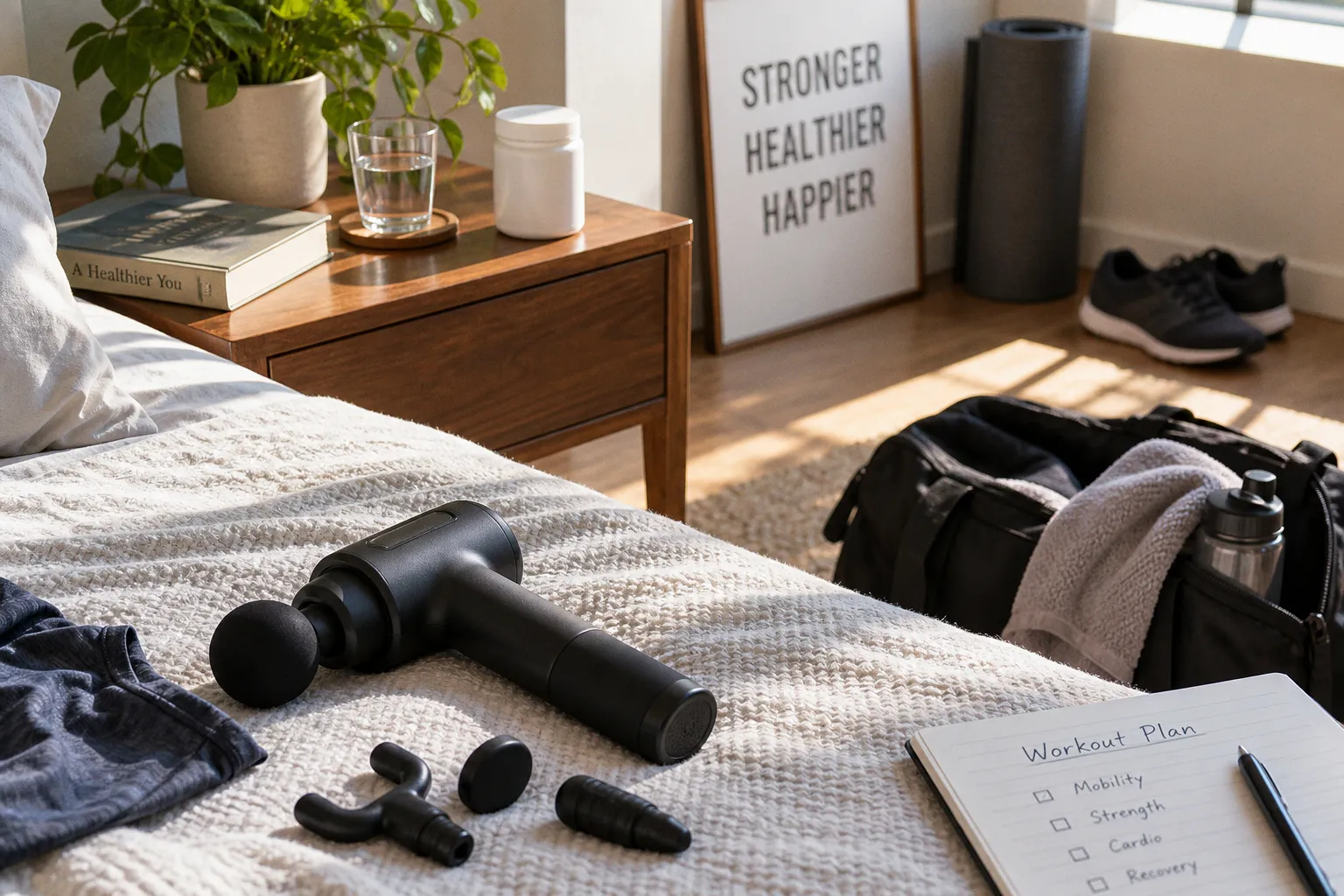
So instead of buying a tool that loosens you up after a hard session, you end up with a buzzy gadget that delivers ten minutes of light tactile vibration and then gives up as soon as you apply pressure.
That is the central mistake: shopping for a massage gun as if it were a cosmetic gadget. Color, attachment count, app support, and a huge RPM number are easy to display. Motor performance, stroke depth, pressure handling, ergonomics, and long-term reliability are harder to communicate, so they often get buried or omitted.
If you are shopping for one right now, start with the specifications that tell you what the device can physically do. Everything else comes after that.
The Amplitude Number Hiding in the Fine Print
The fastest way to spot a massage gun built to underperform is simple: check whether the product page tells you its amplitude.
Amplitude is the distance the massage head travels forward and back during each stroke, measured in millimeters. It is one of the clearest differences between a device that delivers meaningful percussive pressure and one that mainly buzzes the skin.
The useful ranges generally look like this:
- Around 8 to 10 mm: mostly surface-level vibration. This can feel pleasant before or after a workout, but it has limited reach.
- Around 10 to 12 mm: moderate travel, suitable for warm-ups, light soreness, and general recovery.
- Around 14 to 16 mm: deeper stroke length for people who want more substantial work on large muscle groups.
That does not mean the biggest amplitude is automatically right for every person or every body part. A deep stroke can be too aggressive around sensitive areas, and more force is not the same as better recovery. But if a device advertises itself as a serious percussion therapy tool while refusing to disclose amplitude, that omission matters.
RPM is the number most likely to dominate the listing because it looks impressive. A device moving at 3,000 RPM with an 8 mm stroke is not automatically working deeper than a slower model with a 16 mm stroke. It is delivering more impacts in the same period, but each stroke has less travel.
Depth comes primarily from amplitude. Frequency is a separate control.
If the spec sheet does not list amplitude in millimeters, the manufacturer is betting you will not ask what the head actually does.
There is also a practical reason to avoid obsessing over maximum amplitude alone. You will not use a massage gun on your neck, forearm, or a tender area with the same pressure you use on a quad. A useful device should offer enough range to be versatile, not just one aggressive setting that makes every session feel like a punishment.
Stall Force Is Where Weak Motors Tap Out
Stall force is the amount of pressure you can apply to the head before the motor slows dramatically or stops. It is one of the most useful specifications in a percussion massager comparison because it describes what happens when the device meets resistance.
Budget devices often fall somewhere in the lower range, while stronger consumer and professional-oriented models can maintain their movement under substantially more pressure. The exact number matters less than the basic relationship: a low-stall-force motor may feel fine in the air and disappointing against a dense muscle.
The problem shows up first on the muscle groups that need more pressure:
- quads and hamstrings;
- glutes;
- calves;
- lats;
- upper back and traps.
You press the head into the muscle, the motor bogs down, and the device stops doing the thing you bought it to do. Instead of maintaining a consistent stroke, it turns into a vibrating handle held against your skin.
As a rough buying framework:
- Below 30 pounds of stall force: more likely to stall when you lean into large muscle groups.
- Around 30 to 40 pounds: adequate for many general users and most everyday body areas.
- Around 45 pounds and above: better suited to people who want to apply firm pressure without the motor checking out.
These numbers are not a substitute for judgment. Manufacturers do not always measure stall force under identical conditions, and some listings use optimistic testing methods. Treat the figure as one part of the picture. If there is no stall-force information at all, combine that omission with the other specifications: missing amplitude, vague battery claims, no warranty detail, and an unusually low price are not reassuring together.
A massage gun does not need to be powerful enough to pin you to the floor. It does need enough reserve power that normal pressure does not stop the head.
RPM Is Marketing; Amplitude Is the Physical Reach
Massage gun speed gets described in several ways, and product listings happily blur them together. Some use revolutions per minute, or RPM. Others use percussions per minute, or PPM. The labels are not interchangeable in a meaningful buying decision, but both are used to create the impression that a device is more capable than it may be.
Many consumer devices advertise speeds somewhere between 1,000 and 3,200 cycles or impacts per minute. That range can be useful, but maximum speed is rarely the deciding factor. Most people will spend more time in the middle of the range than at the highest setting, especially when working on smaller or more sensitive areas.
There is an entire sales pitch built around the idea that faster means better. Faster means more impacts per minute. It does not necessarily mean deeper impacts, stronger pressure, or better recovery.
Think of the specifications as answering different questions:
| Specification | What it tells you | What it does not tell you |
|---|---|---|
| Amplitude | How far the head travels in each stroke | Whether the motor can maintain that stroke under pressure |
| RPM or PPM | How frequently the head moves | How deep each stroke reaches |
| Stall force | How much pressure the motor can resist | Whether the device feels comfortable in your hand |
| Noise level | How disruptive the device may be during use | Whether the motor is powerful enough |
| Battery capacity | How long the device may run between charges | How long the battery will remain healthy |
A product with a wide speed range, decent amplitude, and enough stall force is more useful than one with an eye-catching maximum RPM and weak performance everywhere else.
Three thousand RPM on an 8 mm stroke is a fast, expensive vibrator.
That is the trap in this category. You buy on speed and end up with a buzzing flashlight.
Physical Weight and Weight Distribution Are Different Problems
The weight of a massage gun matters, but not in the simplistic way many listings suggest. A lighter device is not automatically more comfortable, and a heavier device is not automatically more powerful. What matters is the total weight, where that weight sits, and how long you plan to hold the tool.
A 2.5-pound gun with the motor and battery concentrated near the head can feel much heavier than the same-weight device with a more balanced center of gravity. Head-heavy designs create leverage against your wrist. During a short session, that may be tolerable. During a ten-minute treatment on your quads or upper back, it can become the feature you notice most.
Battery drain does not make a massage gun meaningfully lighter. The physical weight of the device remains essentially the same as the battery loses charge. What changes is the available runtime and, on some models, the power the motor can sustain. Keep those issues separate:
- Physical weight affects how tiring the device is to hold.
- Weight distribution affects how much torque reaches your wrist and forearm.
- Battery performance affects how long the gun operates and whether it maintains output.
- Grip shape and vibration damping affect how comfortable the tool feels in use.
That distinction sounds technical, but it is easy to apply. A lighter gun can be a good choice for someone who self-massages often or has limited grip strength. A slightly heavier gun can still feel better if its mass is centered and the handle is comfortable.
The straight-handled design, usually shaped like a pistol grip with a long vertical body, dominates the budget category. It looks ergonomic in product photos. In practice, it can force your wrist into awkward angles when you try to reach your mid-back, rear delts, or the opposite side of your body.
Triangle-shaped handles, sometimes marketed as T-handles or multi-grip handles, give you more than one way to hold the device. That lets you push the head straight into the muscle without twisting your forearm as much. If you plan to self-massage the upper back with any frequency, this is not merely a luxury feature. It is a practical solution to a common design problem.
Do Not Ignore Vibration in the Handle
Motor vibration that travels into the handle can make a session unpleasant even when the head itself performs well. Cheap devices often transmit enough vibration through the grip to leave your fingers tingling before the target muscle feels relaxed.
Better damping does not mean the device will be silent. A percussion motor makes noise and creates movement by design. The question is whether the handle remains manageable at the settings you actually use.
If you can handle a device before buying it, run it at a high setting and pay attention to your fingers, thumb, and wrist. If the grip immediately feels harsh, that sensation usually becomes more irritating over a longer session, not less.
Cheap vs. Expensive Massage Guns: What You Actually Get
The cheap-versus-expensive massage gun debate is usually framed as a question of branding. The more useful question is what the extra money buys.
At the budget end, the compromises are often found in the motor, battery, housing, grip, and quality control. A low-cost device may still feel fine for occasional light use, but it becomes a poor bargain when you need consistent pressure or use it several times a week.
| Parameter | Budget, roughly $40–$100 | Mid-range, roughly $100–$250 | Premium, $250 and above |
|---|---|---|---|
| Typical amplitude | Often 8–10 mm | Often 10–13 mm | Often 14–16 mm |
| Stall force | Commonly around 20–30 lb | Commonly around 30–40 lb | Often 40–50 lb or more |
| Speed range | Frequently emphasized and sometimes inflated | Usually broad enough for general use | Often more controlled than extreme |
| Handle design | Usually straight, with limited damping | Straight or basic multi-grip designs | More balanced, with better damping |
| Attachments | Several included, with some filler | Fewer, more useful attachments | Usually a focused set of functional heads |
| Noise | Noticeable and often harsh at high speed | More manageable | Typically quieter and less intrusive |
| Long-term support | Warranty and parts support may be limited | Usually better documented | Often stronger warranty and service support |
The important point is that budget gear is not always the same product for less money. Often it is a different product: a shallow-stroke device with a weak motor, rougher vibration, and a handle that becomes tiring quickly.
Mid-range is where many shoppers should start. It is often enough for regular home use without paying a premium for features that do not change the experience. Premium makes more sense for daily users, athletes, practitioners, or anyone who values better balance, quieter operation, stronger support, and more consistent output.
The jump from budget to mid-range can be substantial. The jump from mid-range to premium is usually more about refinement than a dramatic change in basic function.
The Attachment Trap
A six-attachment massage gun is not twice as good as a three-attachment massage gun. In many cases, it is worse value. Attachment count is easy to inflate because adding several molded plastic tips costs less than engineering a stronger motor or a better-balanced handle.
The attachments that tend to earn their place are straightforward:
1. Round ball: the general-purpose option for quads, glutes, hamstrings, and other large muscle groups.
2. Bullet or cone: useful for smaller areas and focused pressure, including the feet and hands.
3. Flat head: spreads contact over larger muscles without the pointed sensation of a bullet tip.
4. Fork: can work around, rather than directly on, the muscles alongside the spine.
You do not need every novelty shape advertised in a product photo. Shark fins, shovels, dolphins, and other specialized tips may have a narrow use, but they should not distract you from the fundamentals. A smaller attachment set paired with a capable motor is usually more useful than eight heads attached to a device that struggles under pressure.
There is one safety point worth keeping in view: a massage gun is not meant to be dragged directly over the spine, front of the neck, joints, or areas with numbness and acute pain. More attachments do not make poor technique safer. Use the broad head on large muscle groups, keep the pressure controlled, and stop if the sensation changes from tolerable pressure to sharp or abnormal pain.
Features to Avoid When They Add More Cost Than Value
Some features are not inherently bad. They are simply poor reasons to buy a particular massage gun.
Built-in Bluetooth and App Control
App control can be useful if it genuinely helps you select speed, timing, or a routine. For many users, however, it adds another layer to a tool that already has a power button and adjustable speed control.
A massage gun does not need a phone connection to work. If the app is the main reason a device costs more, look closely at the motor, amplitude, stall force, grip, and warranty before paying for it.
Heated Massage Heads
Heat can feel pleasant, but a heated attachment does not automatically turn a weak percussion device into a better recovery tool. On lower-cost models, added heating hardware can create more complexity, increase power demands, and contribute to thermal shutoffs.
Treat heat as an optional comfort feature, not proof that the device is more effective. The motor and ergonomics still matter more.
Screens Full of Numbers
A digital display may show speed, battery percentage, pressure, or a changing animation. That can be convenient, but it is not a substitute for meaningful specifications. A screen cannot compensate for an underpowered motor, shallow amplitude, poor balance, or a handle that makes your wrist ache.
An Oversized Carrying Case
A large case filled with every possible attachment looks substantial in a product photo. It tells you almost nothing about performance. If the case is the most impressive part of the package, return to the basic questions: How far does the head travel? How much pressure can the motor handle? Can you hold the device comfortably?
How to Read a Listing Without Getting Played
Before buying, reduce the product page to the information that can actually change your decision. Look for:
- amplitude in millimeters;
- stall force or a credible pressure rating;
- the actual speed range, not just the maximum number;
- total weight;
- handle shape and where the motor is positioned;
- battery runtime and charging details;
- warranty length and access to replacement parts;
- noise information measured under a stated condition;
- a small set of useful attachments rather than a pile of novelty tips.
Be cautious with phrases such as deep tissue, professional strength, silent motor, and ergonomic design when they appear without supporting details. They are descriptions, not measurements.
Also check whether the specifications describe the device itself or only the packaging. Some listings advertise the number of speed levels, attachments, or battery cells while avoiding the performance information that would tell you whether the tool can maintain pressure.
A good listing does not have to promise that the device will fix every sore muscle. It should make clear what the hardware is designed to do.
The Bottom Line
Here is the practical test for any percussion massager: if the listing hides amplitude and stall force, close the tab. It does not matter how many attachments it includes, how many RPMs it claims, or what color the carrying case is.
The four factors that determine whether a massage gun is worth your money are:
1. Amplitude in millimeters. Around 10 mm or less is generally shallow. A range beginning around 12 mm gives you more useful reach for larger muscles.
2. Stall force. A device below 30 pounds is more likely to give up when you apply firm pressure to the glutes, quads, and back.
3. Physical weight and balance. Choose a weight you can hold comfortably, but pay equal attention to whether the motor makes the device head-heavy.
4. A handle that works with your wrist. A triangle or multi-grip design is often better for solo use than a basic straight handle.
Noise, battery life, and attachments still matter. They are just secondary to the parts that determine whether the massage gun can deliver consistent pressure in the first place.
A cheap massage gun is not automatically a bargain. If it has a weak motor, shallow stroke, harsh handle vibration, and poor balance, the low price may only delay a second purchase. Spend once on a device whose important internals the manufacturer is willing to explain, and you are much more likely to keep using it after the novelty wears off.
FAQ
What amplitude should I look for in a massage gun?
Is higher RPM better in a massage gun?
What is stall force in a massage gun?
Does a heavier massage gun work better?
How many massage gun attachments do I need?
More products
 Motion EnergyUSD49