Master the Push-Up: Why Core Stability Beats Arm Strength for More Reps
Fit&Well reports that Pilates instructor Tatiana Schloessman increased her push-up capacity from a few repetitions to about 50 by changing the movement strategy.
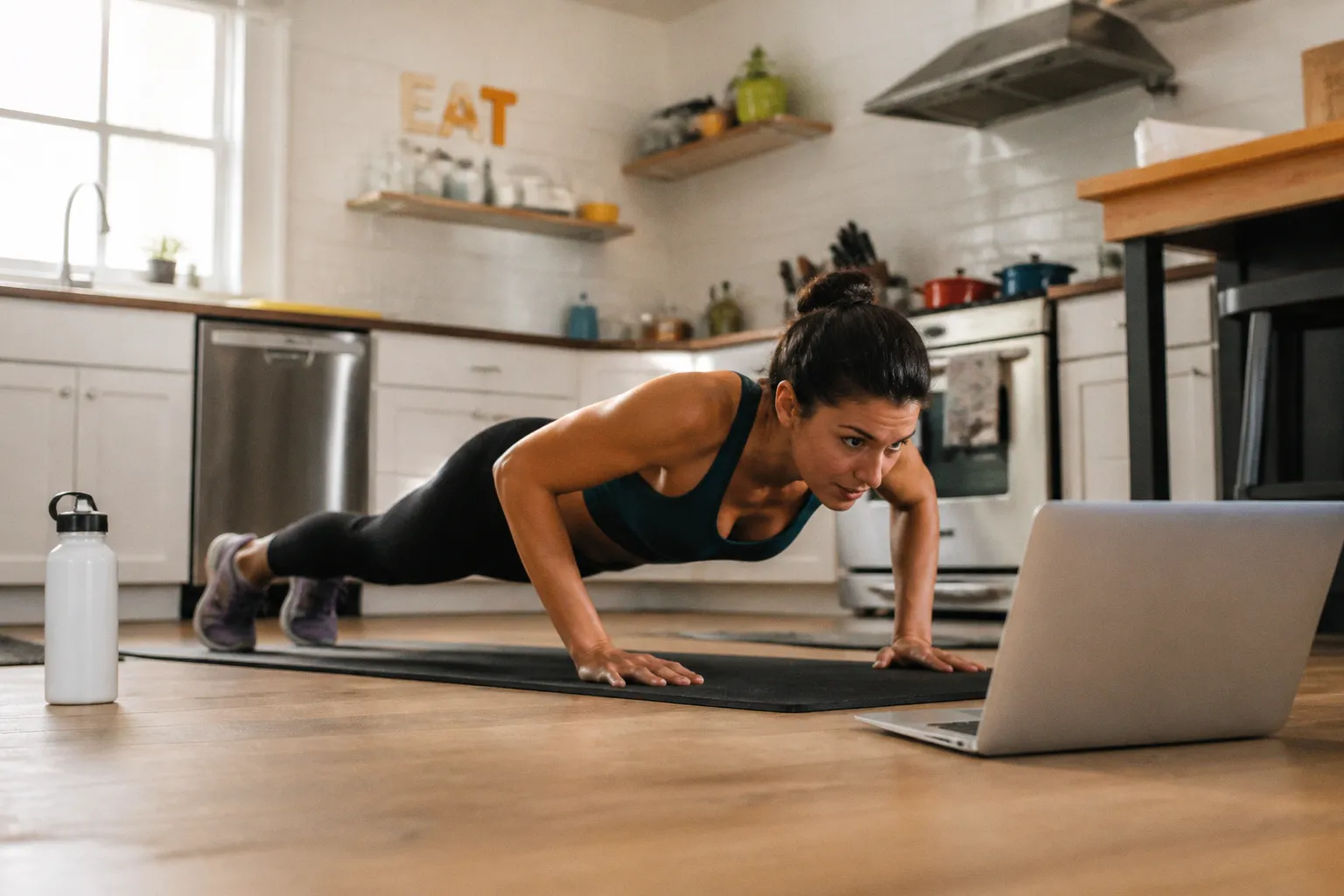
Her key adjustment was not more aggressive arm training. It was treating the push-up as a full-body task, with the trunk producing stiffness while the upper limbs transmit force. For anyone stalled at the floor, the relevant variable is mechanics—not motivation.
The limiting factor is usually force transfer
A push-up is performed in the sagittal plane, but the main technical failure is often visible at the trunk. When the lower back collapses, the body no longer behaves as a single rigid segment. Force leaks through spinal extension, the hips lose position, and the shoulders and elbows must manage a larger share of the load.
Schloessman describes using a high-plank setup and consciously bracing the abdominal muscles. Her instruction is specific: maintain core engagement and prevent the lower back from collapsing. This is not a cue to “feel the burn.” It is a requirement for preserving alignment under load.
The movement should be treated as a coordinated chain:
- Hands and feet contact the floor.
- The trunk remains braced rather than sagging.
- The elbows track slightly back.
- The elbows stay approximately 45 degrees from the body.
- The hips remain low instead of lifting or folding.
- Breathing continues without abandoning the brace.
This position reduces unnecessary torque at the shoulder and keeps the pressing action distributed across the chest, triceps, shoulders, and trunk. It also makes technical errors easier to identify. If the hips rise, the body is avoiding the required range. If the lumbar spine extends, the trunk is no longer transferring force efficiently.
Regression is a load-management tool
A full push-up requires the upper body to move a substantial percentage of total body mass. If the current strength level is insufficient, repeating poor repetitions does not solve the problem. It reinforces the motor pattern that must later be removed.
Schloessman recommends using regressions that preserve the same general muscle groups and movement demands while reducing the percentage of body weight being pushed. One option is the incline push-up. The elevated hand position makes the exercise more achievable and allows the athlete to practice alignment, core engagement, total-body tension, and breathing.
The second progression should also be performed only when the body position can be controlled. The stated technical conditions remain unchanged:
- Elbows slightly back.
- Elbows angled about 45 degrees from the torso.
- Hips held low.
- Back prevented from caving.
- Repetition stopped when alignment is lost.
The point of a regression is not to create an easier-looking exercise. It is to lower external demand while keeping the relevant pattern. That is how strength develops without allowing compensation to become the dominant strategy.
Schloessman says she initially wanted to exceed 20 push-ups and eventually reached about 50 after changing her approach. That result is her reported experience, not a universal target or expected adaptation. The transferable point is narrower: pressing strength is constrained by trunk control when the trunk cannot maintain a rigid platform.
Protocol for implementation
Use the following sequence for each session:
1. Establish a high-plank position or an appropriate regression.
2. Brace the abdominal wall before initiating the descent.
3. Keep the lower back from collapsing.
4. Drive the elbows slightly back at roughly 45 degrees.
5. Maintain low hips and continuous breathing.
6. End the set at the first clear loss of alignment.
7. Progress toward the floor only when the current variation remains technically stable.
Do not measure progress by forced repetitions completed with lumbar extension or altered hip position. Count only repetitions that preserve the same mechanical standard. Proper technique builds usable strength. Poor technique builds a compensatory habit.