Resistance Bands vs Suspension Straps for Travel Workouts
Packing for a trip often exposes a simple problem: the equipment that looks most useful at home is usually the equipment you do not want to carry through an airport.
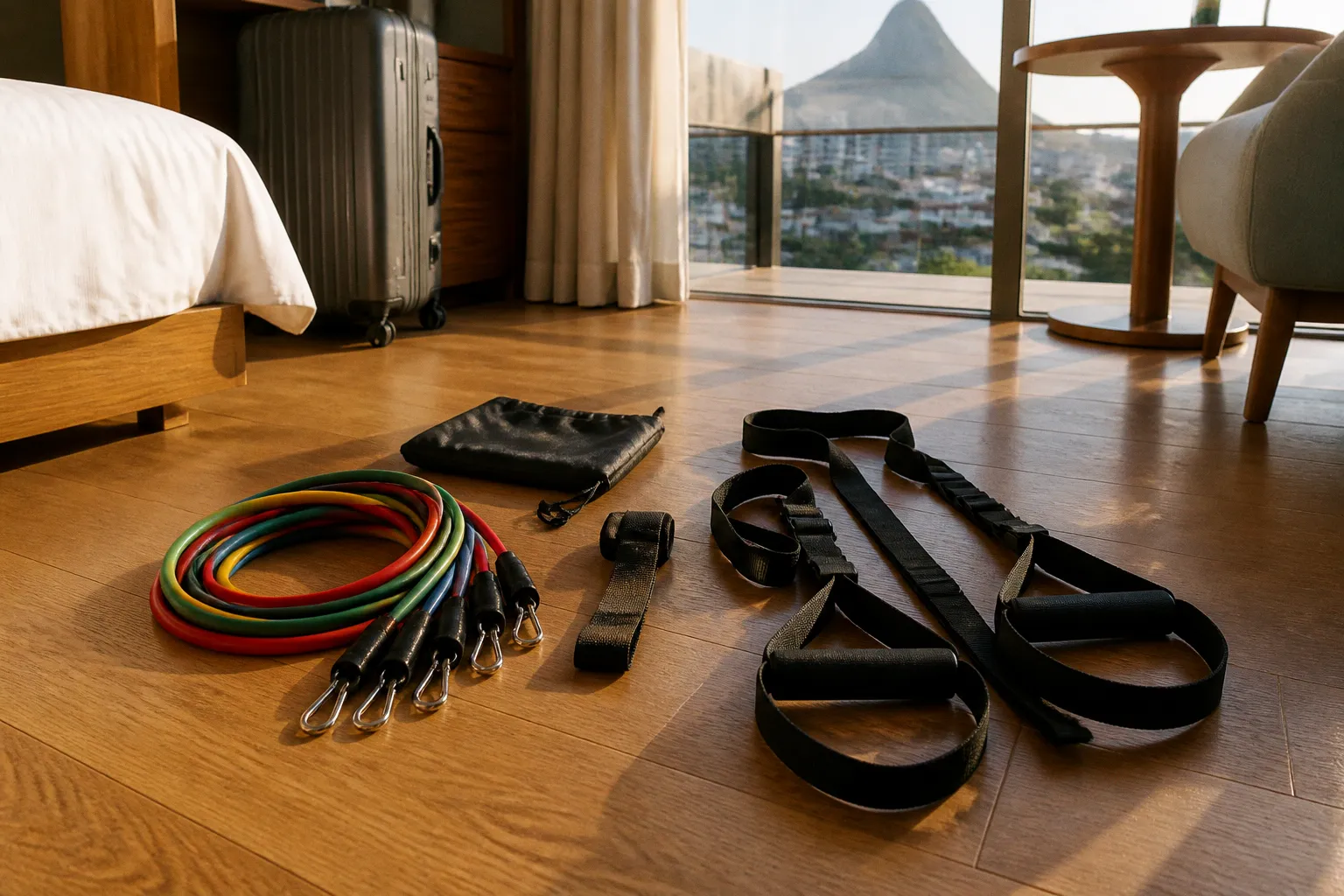
Dumbbells are heavy, cable machines are unavailable, and hotel gyms can range from surprisingly complete to one lonely treadmill in a basement corner.
That is why the choice between resistance bands vs suspension straps for travel matters. Both can support effective strength training in a small space, but they create resistance in different ways, ask different things of your body, and come with very different requirements for setup and safety.
The best option is not the one with the most impressive exercise library. It is the one you can pack, anchor, control, and use consistently when your schedule is already less predictable than usual.
The real difference: elastic tension versus body weight
Resistance bands create force as the material stretches. The farther the band lengthens, the more tension it generally produces. That means the resistance is often lighter at the beginning of a movement and more challenging near the end.
Suspension trainers work differently. They use your body weight as the primary load, with straps connected to an anchor point. You change the difficulty by changing your body angle, your foot position, or the amount of weight you place through the handles.
Neither system is automatically better for building strength or muscle. Both can provide enough tension to make a movement productive when the exercise is well chosen, the range of motion is controlled, and the set is challenging enough. The useful question is not which one is superior in theory. It is which resistance profile fits your travel workouts and your training experience.
| Factor | Resistance bands | Suspension straps |
|---|---|---|
| Main source of resistance | Elastic tension created as the band stretches | Body weight adjusted through body angle |
| Anchor requirement | Many exercises require no anchor; some use a door anchor or fixed point | Requires a sturdy overhead, door, tree, or pull-up-bar anchor |
| Packing options | Mini loops can weigh under 0.5 lb; full kits are heavier | A basic travel suspension kit may weigh about 1.5 lb |
| Typical entry price | Often about $15–$50 | Authentic systems commonly range from $100–$200 |
| Best strength | Simple, flexible, low-space workouts | Full-body movements and bodyweight progressions |
| Main limitation | Resistance can feel uneven and may be hard to measure precisely | Setup and anchor safety are non-negotiable |
| Learning curve | Usually approachable for beginners | Requires more control, balance, and setup awareness |
| Hotel-room practicality | High, especially with mini loops and long bands | High only when a reliable anchor is available |
That comparison points to an important distinction: portability is not just about weight. It is also about what the equipment needs from the environment.
A band can travel with you and still be useful on the floor beside the bed. A suspension trainer may weigh less than a full tube-band kit, but it becomes useless if the available door, tree, or bar cannot safely support your body weight.
The lightest piece of travel workout gear is not the winner if it depends on an anchor you cannot safely use.
What resistance bands do well on the road
Resistance bands are usually the easier entry point for travel strength training because they offer several ways to train without changing the room.
A mini loop can add resistance to squats, glute bridges, lateral walks, split squats, and other lower-body movements. A longer loop or tube band can support rows, presses, curls, triceps work, good mornings, and assisted mobility drills. A full five-tube kit with handles, a door anchor, and a carrying bag is more versatile, while a simple loop set is lighter and easier to keep in a personal bag.
The variety matters because travel workouts often need to adapt around fatigue, limited floor space, and unfamiliar schedules. You may have enough energy for a full-body session one day and only want a short lower-body circuit the next. Bands make that adjustment relatively simple.
The strongest advantage: fewer environmental demands
For many band exercises, you need only your body and a small patch of floor. That makes bands especially practical for:
- Hotel-room strength workouts with no gym access
- Warm-ups before a run, hike, or long day of walking
- Short activation sessions after sitting on a plane or train
- Lower-body training when upper-body pulling options are limited
- Beginner-friendly workouts where load and balance need to stay manageable
You can stand on a band for presses or curls, loop it around your thighs for hip work, or hold it in both hands for movements where the band provides resistance through the full range. The setup is quick, and the risk of damaging the room is generally lower when you are not attaching anything to a door.
That last point deserves emphasis. A band does not automatically require an anchor. In fact, many of its most useful travel exercises are anchor-free. The moment you add a door anchor, you introduce a new safety variable: the door, hinge, frame, anchor placement, and direction of pull all matter.
The challenge of variable resistance
Elastic resistance is not identical to lifting a dumbbell. With a dumbbell, gravity provides a fairly consistent external load throughout a movement, although leverage changes how difficult each part feels. With a band, the material itself changes tension as it stretches.
This can be helpful. A squat or press may become more demanding near lockout, allowing you to work through a strong range without making the first part of the movement excessively heavy. But it can also make exercise selection and progression less intuitive.
If you are used to writing down a dumbbell weight, bands may feel vague. The color of the band is not a universal measurement, and the same band can feel dramatically different depending on where you stand, how far you stretch it, and whether you double it.
For progress, use more than the label. Track:
- The band used and whether it was doubled
- Your stance or starting position
- Repetitions completed with clean form
- The pause or tempo used
- How close the final repetitions were to technical fatigue
This gives you a more useful record than pretending a band has one fixed weight.
Where suspension trainers earn their space
Suspension straps are appealing because they can turn bodyweight exercises into highly adjustable strength movements. A row becomes easier or harder through your body angle. A chest press changes as you move your feet. A split squat can become more stable when one foot uses a strap, while a plank or knee-tuck variation adds a significant demand to the trunk.
This makes suspension trainers particularly useful for travelers who already enjoy bodyweight training and want more options than the floor alone can provide.
Constant gravitational load, adjustable difficulty
A suspension trainer does not become heavier as the strap stretches. Instead, the gravitational challenge is scaled through position. The more horizontal your body is during a row or press, the greater the proportion of your body weight you are asking the muscles to move. Step back or stand more upright, and the same exercise becomes easier.
That adjustment can be very precise once you understand it. You can begin with a manageable angle, complete controlled repetitions, and gradually move your feet to increase the challenge. This makes the system useful for both strength work and regression.
However, body angle is not the only variable. Suspension movements also ask you to stabilize the straps, manage balance, and control unwanted rotation. A row may challenge your upper back, arms, and trunk at the same time. A push-up variation may feel much more demanding than a standard floor push-up even when the visible movement looks similar.
For that reason, suspension trainers tend to reward body awareness. They are not necessarily difficult because they are heavy. They are difficult because the body must produce force while staying organized in an unstable setup.
The anchor is part of the equipment
This is where many travel comparisons become too casual. A suspension trainer is portable, but it is not anchor-independent.
Depending on the system, you may need:
- A structurally sound overhead point
- A sturdy door that closes in the correct direction
- A door anchor designed for the specific equipment
- A pull-up bar that is rated for the load
- A healthy, stable tree branch in an appropriate location
- Enough clearance to move without hitting furniture or walls
A hotel door can look solid and still be a poor choice. The direction of force, the condition of the frame, and the way the door closes all affect the setup. Universal hotel-door weight limits for suspension anchors are not something we can safely assume, so the decision must come from the equipment instructions and the actual condition of the anchor point—not optimism.
Before loading the straps, test the setup gradually. Keep your body close to a supported position at first. Check for slipping, movement, fraying, or pressure against the door. If the anchor shifts, stop. No workout is worth turning a travel day into an injury-management day.
Weight, price, and the portability trade-off
The numbers make the choice more interesting than the usual assumption that suspension straps are always lighter.
A basic travel suspension kit such as TRX GO weighs approximately 1.5 lb. A full five-tube resistance band kit with handles, door anchor, and bag may weigh around 3.25 lb. That difference is noticeable when you are packing for a carry-on-only trip, especially if you also carry shoes, toiletries, and work equipment.
But simple mini loop sets can weigh under 0.5 lb. If your plan is focused on lower-body training, mobility, and brief activation work, a small band set can be dramatically lighter than either a full band kit or a suspension system.
Price follows a similar pattern. Entry-level resistance band sets commonly sit in the $15–$50 range, while authentic suspension strap systems generally cost about $100–$200. The more expensive option may offer better hardware, adjustment mechanisms, handles, and durability, but the higher price does not remove the need for a safe anchor.
Think of the purchase in terms of the training you will actually perform:
- Choose mini loops if you want the smallest possible kit for glutes, legs, warm-ups, and mobility.
- Choose long bands or tubes if you want more upper-body variety without relying on a fixed anchor.
- Choose a full band kit if you want handles and a door anchor but still prefer a lower purchase price.
- Choose suspension straps if you already use bodyweight progressions and have dependable anchor options on your regular trips.
A compact kit that matches your habits will outperform a more capable system that stays in the suitcase.
Portability has two measurements: how much space the equipment takes, and how much cooperation it demands from the room around you.
Which system works better for common travel workouts?
The best comparison becomes clearer when we place both tools against real travel situations rather than abstract features.
In a small hotel room
Resistance bands usually have the advantage. You can perform a full session beside the bed without anchoring anything:
1. Band squat or split squat
2. Band Romanian deadlift or good morning
3. Standing band press
4. Bent-over band row
5. Glute bridge with a mini loop
6. Dead bug, plank, or side plank without equipment
The session can be adjusted by changing the band, stance, range of motion, or tempo. You may not replicate every barbell movement, but you can train the major movement patterns with minimal setup.
Suspension straps can also work well in a hotel room, but only if the anchor is suitable and the room provides enough clearance. They are not an automatic upgrade. A strap system attached to an uncertain door creates more risk than training with a lighter, anchor-free band.
When you want pulling exercises
Suspension trainers often feel more natural for rows and bodyweight pulling variations. The handles provide a clear path, and you can change the angle to control difficulty.
Bands can still train the back effectively, particularly with standing rows, seated rows, pull-aparts, straight-arm pulldowns, and face-pull variations. The practical issue is anchoring. If you have no reliable fixed point, your band row options may be limited to positions where you can create resistance without attaching the band.
A full band kit with a well-designed anchor expands your options, but it also brings you back to the safety question. The convenience of a door anchor is useful only when the door setup is appropriate.
When you are new to strength training
Bands are generally easier to approach. You can start with movements that keep both feet on the floor, learn how to control the band, and progress without adding instability immediately.
Suspension trainers can be scaled down, but the straps may introduce balance demands before you feel confident with the basic movement. That is not a reason to avoid them. It is a reason to treat them as a skill-based tool rather than a piece of equipment that automatically makes every exercise better.
Start with supported variations. Keep the body angle conservative. Practice rows, assisted squats, and incline presses before moving to more unstable single-leg or plank-based options.
When your workout needs to feel athletic
Suspension straps offer a wide menu of integrated movements. They can combine strength, balance, trunk control, and coordination in one exercise. This is attractive for travelers who enjoy sessions that feel dynamic rather than segmented.
Bands can support athletic training too. Lateral walks, resisted marches, split-stance presses, anti-rotation work, and band-resisted acceleration drills can be useful, depending on the space and surface. The difference is often less about the tool and more about how thoughtfully the session is programmed.
A high-quality travel workout does not need to be complicated. It needs to cover enough movement patterns, create an appropriate challenge, and leave you capable of enjoying the rest of the day.
Progression: how to keep getting stronger without heavier weights
Travel equipment becomes frustrating when every workout feels like a random circuit. Progress still needs a structure, even when the tools are small.
With resistance bands, progress can come from several directions:
- Move to a stronger band or increase the stretch at the starting position.
- Use a longer range of motion while keeping tension controlled.
- Add repetitions within a planned range.
- Slow the lowering phase or add a pause at the hardest point.
- Reduce rest between sets only when the goal includes conditioning.
- Shift from a bilateral movement to a split-stance or single-leg variation.
With suspension straps, progression is often more positional:
- Change the body angle to increase the percentage of body weight involved.
- Move the feet farther from the anchor during rows or presses.
- Add a pause at the top of the row or the bottom of a press.
- Increase the range of motion only if your shoulders and trunk remain controlled.
- Progress from bilateral to staggered or single-leg variations.
- Add repetitions while maintaining the same angle and tempo.
The key is to change one main variable at a time. If you alter the angle, repetitions, tempo, and rest all at once, you lose the ability to tell what actually made the session harder.
We also want to distinguish muscular effort from poor positioning. Shaking, breath-holding, and losing joint alignment are not reliable signs of productive progression. They are usually signs that the current variation has exceeded your ability to control it.
The safety details that deserve more attention
Portable workout gear is convenient precisely because it can be used in informal spaces. That also means we have to bring our own standards.
With bands, inspect the material regularly. Look for cracking, thinning, tears, or damage near handles and attachment points. Latex and similar materials can deteriorate with age, heat, friction, and repeated stretching. Do not keep using a band simply because it has not snapped yet.
Give yourself enough space that a released band will not strike your face or another person. Keep the band aligned with the intended path. Avoid wrapping it around sharp furniture edges, rough metal, or unstable objects. If you use a door anchor, close and test the door exactly as directed by the manufacturer.
With suspension straps, inspect webbing, stitching, handles, buckles, and anchor points. Make sure the straps are not twisted in a way that changes their movement or rubs against a sharp edge. Test the anchor before placing your full body weight into it, and keep other travelers away from the area while you train.
A good rule for both systems is simple: if the equipment, anchor, or surface behaves unexpectedly, the session is over. Modify the workout instead of negotiating with a setup you do not trust.
Travel also changes your recovery needs. Long flights, poor sleep, heat, unfamiliar food, and a packed itinerary can all affect how hard you should train. A short, controlled session may be the most useful choice on a day when a maximal effort would leave you depleted.
A practical decision path
If you are still choosing between suspension trainers vs resistance bands, use your normal travel pattern as the deciding factor.
Resistance bands are the better fit when:
- You want the lowest entry cost.
- You need exercises that work without an anchor.
- You prefer simple setup and quick transitions.
- You are new to resistance training.
- Your main goals include general strength, mobility, activation, and maintaining routine.
- You want to pack only a mini loop or a small set of long bands.
- You expect to train in rooms where furniture and doors cannot be trusted as attachment points.
Suspension straps are the better fit when:
- You already feel comfortable with bodyweight training.
- You enjoy rows, presses, planks, split squats, and integrated movements.
- You have regular access to reliable anchor points.
- You are willing to spend more for a specialized system.
- You want to adjust difficulty primarily through body angle.
- You value a full-body training tool that can challenge stability as well as strength.
There is also a sensible hybrid approach. A mini loop set and a suspension trainer solve different problems. The loops are nearly weightless and useful for warm-ups, lower-body work, and activation. The straps provide more demanding full-body options when a safe anchor is available. You do not need both, but the pairing can be practical for frequent travelers who train in varied environments.
Building a balanced session with either tool
Whichever system you choose, organize your workout around movement patterns rather than equipment novelty.
A compact full-body session might include:
1. Knee-dominant work: squats, split squats, assisted squats, or reverse lunges.
2. Hip-dominant work: good mornings, Romanian deadlifts with a band, hip hinges, or single-leg bridges.
3. Push: standing band press, band chest press, suspension push-up, or incline press.
4. Pull: band row, pull-apart, suspension row, or straight-arm band pull.
5. Trunk control: plank, side plank, dead bug, anti-rotation press, or controlled knee tuck.
6. Optional conditioning: marching, step-ups, carries with luggage only if the load and space are safe, or a brisk walk outside.
You can perform the exercises as straight sets or as a circuit. The choice should match the purpose of the workout. Straight sets make it easier to focus on strength and technique. Circuits save time and can raise the general training demand, but they may become more breathless than muscular if rest is too short.
For a travel week, consistency is often the more realistic target than chasing a personal record. Two or three brief sessions can preserve the rhythm of training while leaving room for sleep, walking, meals, and the reason you traveled in the first place.
The choice comes down to friction
Resistance bands vs suspension straps for travel is not a contest between a basic tool and an advanced one. It is a decision about friction.
Bands create less friction around setup, price, and room compatibility. They are especially strong when you want dependable, anchor-free workouts that can happen almost anywhere. Their variable tension takes some getting used to, but it becomes manageable when you track the setup and progress deliberately.
Suspension straps create more friction around anchoring and technique, but they reward that investment with highly adjustable bodyweight training and a rich selection of full-body movements. They make the most sense when you know where you will anchor them and already have the control to use them well.
For most travelers, a small resistance band set is the practical starting point. It is affordable, adaptable, and easy to bring into a real day rather than an idealized training plan. If your travel environment reliably supports safe anchoring and you enjoy bodyweight strength work, suspension straps may be the more satisfying long-term choice.
For your very next meal and your next trip, keep the win small: choose the lightest tool that supports the workouts you will genuinely do, then pack it where you can reach it. The most effective portable workout gear is the gear that makes movement easier to begin.