Dead Bug vs Plank: Which Builds Better Deep Core Strength?
If you have spent any amount of time scrolling fitness content, you have probably run into a passionate argument about whether the plank or the dead bug is the "true" core exercise.
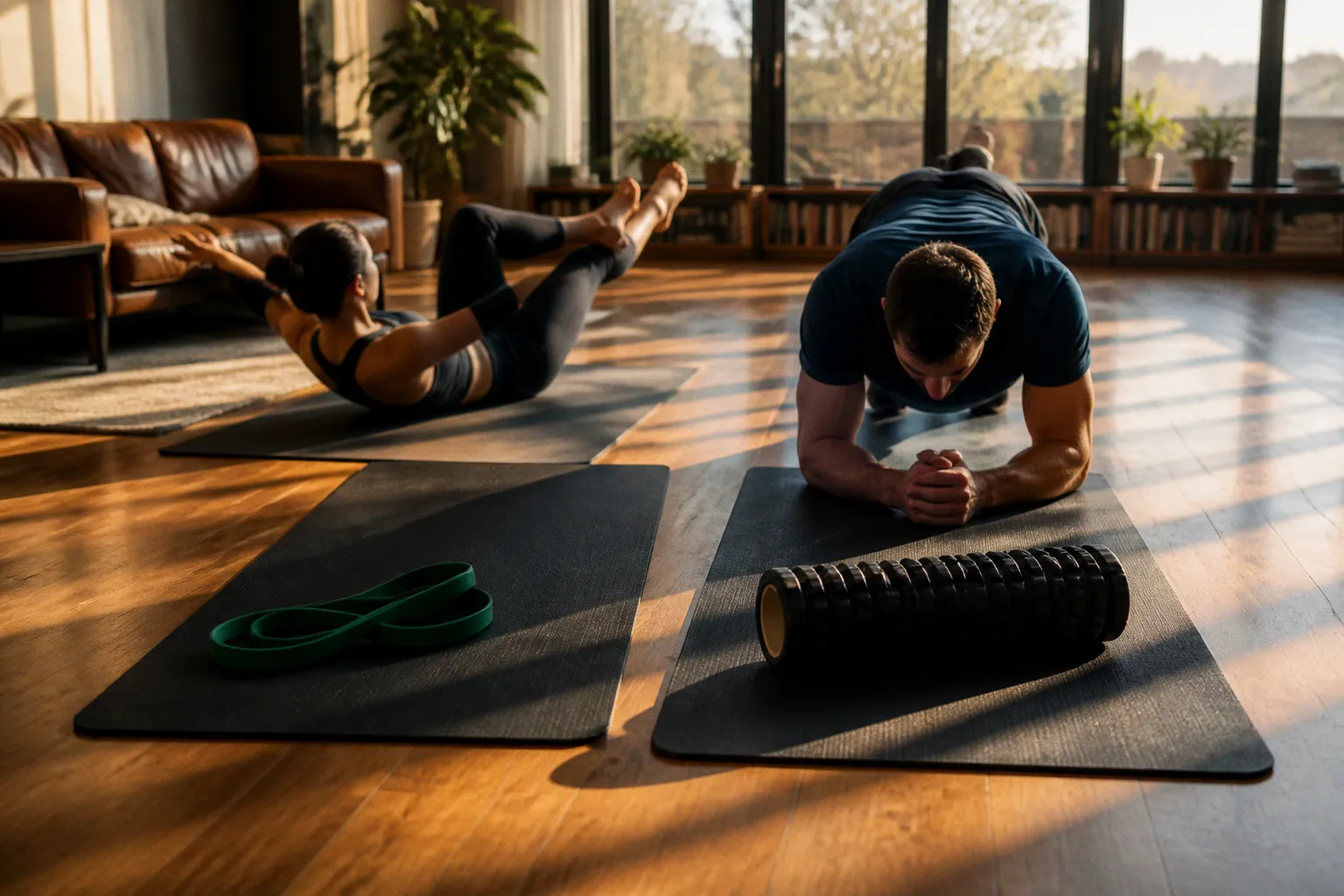
We hear it from clients all the time — someone has been dutifully holding 60-second planks three times a week, swearing they can feel their abs working, yet their lower back still complains the moment they pick up anything heavier than a laundry basket. Meanwhile, a friend swears by dead bugs and claims their posture has never felt more solid. The confusion is real, and it usually comes down to one thing: these two exercises are not trying to do the same job.
Here is the good news: you do not have to crown a winner. Both the plank and the dead bug build deep core strength, and a 2024 ultrasound study found no significant difference in total muscle thickness across major deep core muscles when comparing dead bugs, side planks, bird dogs, and beast crawls during dynamic contractions. The real question is which movement fits your body, your goals, and that stubborn lower back of yours. Let's walk through how each one works, when to reach for it, and how to weave them together so you stop second-guessing every core day.
Core strength is not a single skill — it is a relationship between your brain, your breath, and the small stabilizers that keep your spine safe while everything else moves.
The Mechanics of Deep Core Engagement: Hollowing vs. Bracing
Before we compare the two exercises, it helps to understand what we are actually training. Your "deep core" is not just the visible six-pack. It is a layered system that includes the transversus abdominis (the deep corset muscle), the internal obliques, the lumbar multifidus along the spine, and the pelvic floor. These muscles work together like a pressurized cylinder around your lumbar spine, and they have two main ways of switching on.
The first way is bracing — the global engagement you feel during a plank, where you bear down through your entire midsection as if bracing for a punch to the stomach. This co-contracts the whole anterior chain, including the rectus abdominis and external obliques, building isometric endurance you can lean on during heavy lifts or long holds.
The second way is hollowing — the deep, drawing-in maneuver where you gently pull your lower belly toward your spine, almost like zipping up a tight jacket. This is the pattern the dead bug is built around. A 2024 PMC ultrasound study found that hollowing produced muscle thickness increases in the transversus abdominis, internal obliques, and lumbar multifidus ranging from roughly 22% all the way up to 106%, compared to about 18% to 87% during bracing. The takeaway is not that one approach is "better" than the other — it is that hollowing lights up those deep stabilizers in a particularly focused way, while bracing distributes the load across the entire girdle.
When you understand this difference, the plank-versus-dead-bug debate starts to feel less like a rivalry and more like a menu. One plate is hearty and stable; the other is precise and pinpointed. Most of us benefit from eating off both.
Why the Dead Bug Excels at Dynamic Anti-Extension
Let's talk about what the dead bug actually does, because the name alone tends to confuse people. You lie on your back, bring your arms straight up toward the ceiling, and lift your legs into a tabletop position — knees stacked over hips, shins parallel to the floor. From there, you slowly extend one arm back and the opposite leg forward, hovering just above the ground, while pressing your entire lower back firmly into the floor. You return to the start and switch sides.
That last detail — pressing the lower back into the floor — is the whole game. It forces your deep core to resist spinal extension, meaning your low back wants to arch up off the ground as your limbs reach away, and your job is to keep it pinned down. This is called dynamic anti-extension, and it is one of the most functional strength skills you can build. Every time you reach overhead for a box, swing a kettlebell, or chase a toddler, your spine wants to arch under load. The dead bug trains the exact muscles that say "no, not today."
Because you are moving your limbs through space, the dead bug also challenges coordination between your arms, your legs, and your trunk. Your brain has to organize a moving system without losing the brace on your spine — which is precisely what real life demands. Most of our clients start with 3 sets of 8 to 12 reps per side, moving slowly, breathing through each rep, and stopping the moment their lower back lifts off the floor. That is your form check built into the movement itself.
The Role of Planks in Building Anterior Chain Endurance
The plank, by contrast, is an isometric hold. You support yourself on your forearms and toes (or hands and toes), keeping your body in a straight line from head to heels, and you stay there. There is no limb movement, no reach, no scramble for coordination — just a sustained conversation between your entire anterior chain and the floor.
What the plank builds brilliantly is global endurance. The rectus abdominis, the external and internal obliques, the quadriceps, the serratus anterior — they all co-contract and hold you in place. This kind of bracing capacity is what keeps you upright in a heavy front squat, stable at the top of a push-up, or composed at the end of a long run when your trunk wants to flop. It is also why the plank has been a staple of physical therapy and athletic conditioning for decades, and why we still program it for nearly every client we work with.
There is, however, an asterisk worth naming. A plank done with a sagging pelvis or an over-arched low back stops being a core exercise and starts being a back-compression exercise. The cue we use most often is "long plank": imagine you are being gently stretched from both ends, your tailbone reaching toward your heels while the crown of your head reaches forward. Beginners often start with 10-second holds and build toward 20 seconds, prioritizing clean form over minute-long marathons. A sloppy 90-second plank is doing less for your core than five crisp 15-second holds with a properly stacked rib cage.
Navigating Spinal Health: When to Choose Floor-Based Stability
Here is where the comparison gets practical, especially if you have ever felt your lower back twinge halfway through a plank. The dead bug has two structural advantages for sensitive spines: it removes spinal loading entirely (you are already on the floor), and it removes any wrist compression, which makes it accessible during early postpartum recovery, after a wrist injury, or on days when your shoulders simply do not want to bear weight.
If you have a history of disc issues, chronic lower back pain, or are returning to training after pregnancy, the dead bug is almost always the smarter entry point. It lets you train deep core strength in a position where your spine is fully supported, and the movement itself teaches you to feel and resist extension before you ever load it with weight. Many physical therapists now use it as a regression before progressing patients toward loaded carries and planks, because the skill transfers so cleanly into upright life.
That said, planks are not off the table forever. Once your back has settled and your bracing pattern feels automatic, adding plank variations — side planks, forearm planks, long-lever planks with arms extended — becomes a powerful endurance tool. The key is sequencing: build the deep, dynamic control first, then layer the global static hold on top. We have seen this order make the difference between clients who plateau and clients who finally feel their core "wake up" during heavy lifts.
Choose the movement that meets your spine where it is today — not the one your favorite influencer swears by.
Programming for Results: Integrating Both Movements into Your Routine
So how do we actually put this together? Below is the framework we walk our clients through when they want both deep core control and global endurance without overthinking every training session. The goal is sustainability, not a six-day abs ritual that burns you out by Thursday.
| Training Phase | Primary Focus | Suggested Movement | Sets × Reps / Holds | Frequency |
|---|---|---|---|---|
| Foundation (Weeks 1–3) | Deep control, hollowing pattern | Dead bug | 3 × 8–10 reps per side | 3× per week |
| Build (Weeks 4–6) | Layer bracing endurance | Dead bug + forearm plank | Dead bug 3 × 10–12 reps; plank 3 × 15–20 sec holds | 3× per week |
| Strength (Weeks 7+) | Integrate both patterns under load | Plank variations + loaded carries | Plank 3 × 30–45 sec; farmer's carry 3 × 30 sec | 2–3× per week |
A few practical notes that often get glossed over. First, breathing matters enormously in both exercises. During a dead bug, exhale fully as you extend your limbs — this naturally recruits the deep stabilizers and protects your lower back. During a plank, breathe slow and controlled through your nose and mouth, resisting the urge to hold your breath, because breath-holding spikes intra-abdominal pressure in ways that can aggravate existing back issues rather than strengthen them.
Second, do not chase soreness. Deep core work is neurologically demanding, and your nervous system often fatigues before your muscles do. If your form starts breaking down — lower back lifting, hips rotating, shoulders hiking — that is your cue to stop, not push through. Rest a couple of minutes, hydrate, and reassess the rep range next set.
Third, vary the intent. Some days, treat your dead bugs as a coordination drill: slow, deliberate, almost meditative, focusing on the breath and the press of your spine into the floor. Other days, treat your plank as a posture reset: stack your ribs over your pelvis, soften your glutes slightly to keep your pelvis neutral, and hold with quiet effort. The exercise itself does not change — your attention to it does, and that is what builds the deep, sustainable strength you actually feel during everyday life.
Your Next Move at the Mat
Here is the small, actionable win we want you to take into your very next training session. Pick the movement that matches your current reality. If your lower back has been cranky, or you are postpartum, or your wrists are taped up — start with the dead bug. Three sets of eight slow reps per side, breathing out as you extend, pressing that lower back into the floor like you are stamping an envelope. That is your entire workout for the day, and it absolutely counts.
If your back feels solid and you are craving a new challenge, layer in a forearm plank on the same day. Three sets of 15-second holds with a long body and a quiet breath. Forget the stopwatch worship; focus on the quality of every single second.
Either way, you are building a stronger, smarter core — not by picking sides, but by understanding what each move actually does. That is the kind of training that lasts past the next fitness trend, and your spine will thank you for it long after the workout ends.
FAQ
Which is better for core strength: the plank or the dead bug?
Why does my lower back hurt during planks?
How does the dead bug exercise work?
Can I do dead bugs if I have back pain?
How long should I hold a plank?
More products