Glute activation mistakes that ruin your workout efficiency
Most lifters burn the first 30 to 60 minutes of every session on glute activation drills. They cycle through bodyweight squats, banded clamshells, donkey kicks, and side-lying pulses until the area feels "warmed up." None of this produces hypertrophy.
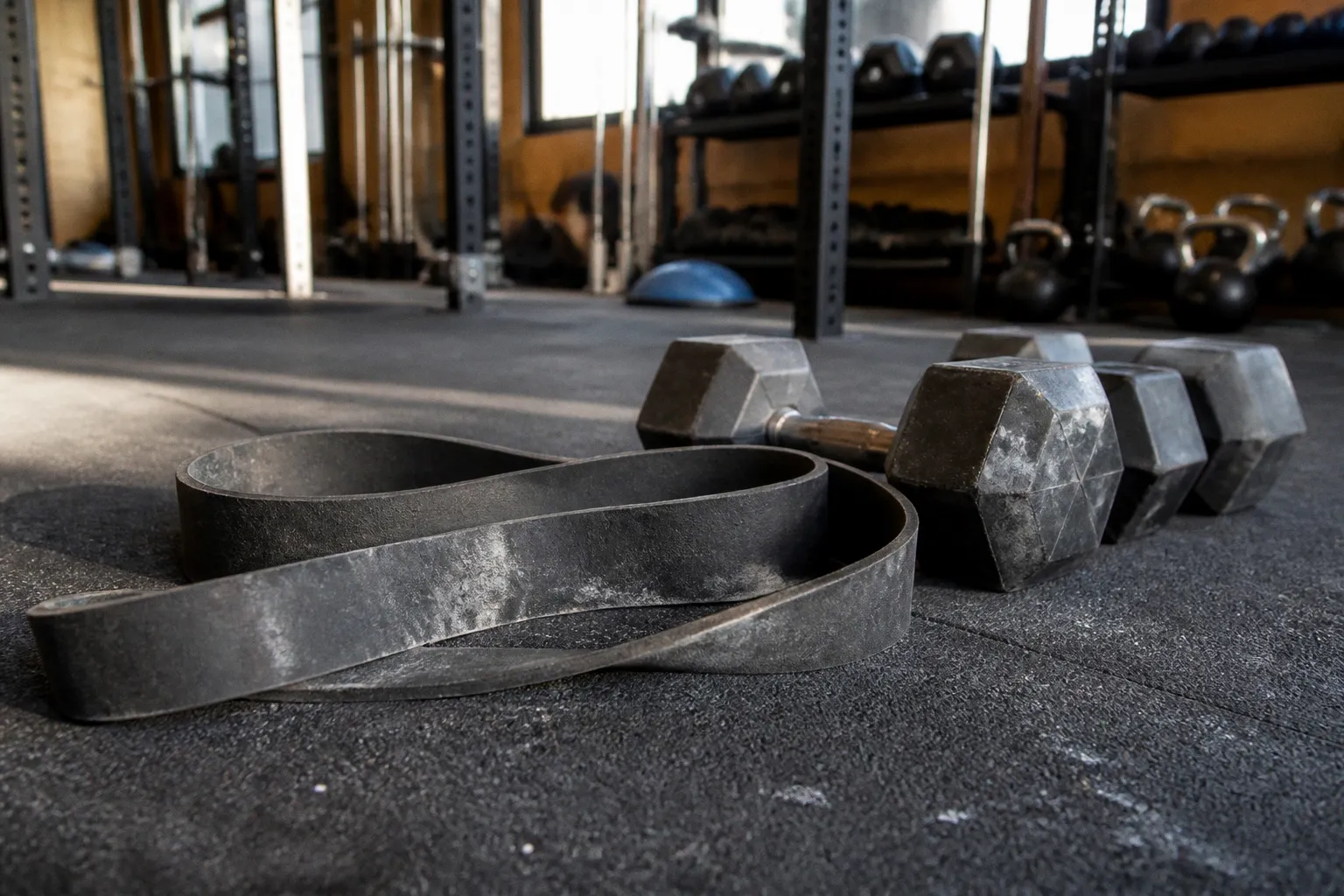
The real cost of a 60-minute warm-up
None of it produces measurable strength. The output is fatigue, soreness, and a depleted tank for the loaded work that follows.
Activation is a preparatory tool. It exists to prime the neuromuscular system for high-force output, not to function as a workout in itself. A block of 8 to 12 minutes is sufficient for most trainees. Anything longer crosses the line from preparation into junk volume — high-repetition, low-load contractions that drive metabolic stress without delivering the mechanical tension required for tissue remodeling. The metabolic cost is real. The adaptive return is not.
The industry markets extended activation circuits as fat-melting, shape-sculpting, posture-correcting sessions. The physiology does not support these claims. Muscle growth responds to mechanical tension: high force production across a usable range of motion. Repetitions performed with a light band until the muscle shakes meet none of these criteria.
Hypertrophy requires mechanical tension close to technical failure. Light contractions performed until they "feel hard" produce fatigue, not adaptation.
Pelvic position governs load distribution
Anterior pelvic tilt is the dominant structural fault in glute-focused trainees. When the pelvis rotates forward, the hamstrings and lumbar erectors enter a shortened position with a mechanical advantage. Hip extension still occurs. The contribution of the gluteus maximus drops. The lumbar spine absorbs the residual force.
This pattern is not a "weak glute" problem. The cause is structural positioning. The gluteus maximus can produce force, but its line of pull becomes inefficient once the pelvis rotates out of neutral. The medius and minimus lose leverage as soon as the pelvis drops laterally or rotates under load. The target tissue is not the limiter. The geometry is.
Symptom: lower back soreness after a glute-dominant session. Cause: the pelvis has unloaded the target tissue and redirected demand into the lumbar erectors and hamstring complex. The fix is structural, not supplementary.
A positioning protocol before any loaded hip extension:
- Stack the ribcage over the pelvis. Initiate posterior pelvic tilt before the movement begins, not mid-rep.
- Brace the abdominal wall at roughly 20% of maximal voluntary contraction. Full vacuums and aggressive bracing shift the load off the hip.
- Drive the knees toward the line of the little toe during bilateral squats to recruit the medius.
- Set the shoulder position on the bench before any hip thrust variation. The spine must remain in contact with the surface throughout the full range.
- Single-leg work demands contralateral hip stability. If the unloaded hip drops during a step-down, the working glute is functionally unloaded.
Static stretching of the hip flexors for 30 to 120 seconds before activation reduces overactivity in the iliopsoas and rectus femoris. This is preconditioning. It is not the activation itself. The activation block begins only after the pelvis sits in neutral under tension.
Localized fatigue is not hypertrophy
The "burn" sensation during a set is a marker of metabolite accumulation. Lactate, hydrogen ions, and intramuscular pressure rise during sustained low-load contractions. None of these signals indicate that tissue remodeling is occurring. None of them correlate with myofibrillar protein synthesis at any meaningful level.
Hypertrophy is driven by mechanical tension: high force production, sustained over a sufficient range, with sufficient proximity to failure to disrupt contractile proteins. A bodyweight pulse set produces minimal external force. The muscle works. The tissue does not grow.
This is the most expensive mistake in recreational glute programming. Trainees pursue the pump. They perform 50, 80, even 100 repetitions of light band exercises, terminating only when the area is shaking and hot. They exit the gym convinced they have trained hard. Strength data, hypertrophy data, and visible tissue change all disagree with that conclusion.
Effective working sets terminate 0 to 2 reps before technical failure. The final repetition must be performed with proper form. It must also be difficult. If three clean reps remain at the end of the set, the load was insufficient. If form degrades before the prescribed rep range ends, the load was excessive. The training zone is narrow. Most trainees stop too early because the burn has not arrived yet.
The three-muscle problem
The glute complex contains three primary muscles: gluteus maximus, gluteus medius, and gluteus minimus. A standard bilateral squat, hip thrust, or conventional deadlift loads the maximus primarily. The medius and minimus, responsible for femoral stabilization in the frontal and transverse planes, receive almost no stimulus from sagittal-plane bilateral movement.
Programs built entirely on bilateral hip extension ignore roughly half of the muscular system they claim to develop. The maximus grows. The pelvis remains unstable during gait, single-leg stance, and any rotationally demanding task. Knee valgus, hip drop, and compensatory lumbar rotation persist regardless of how much bilateral hip extension volume the trainee accumulates.
Direct loading of the medius and minimus is non-negotiable. These muscles require abduction, external rotation, and single-leg stabilization work. Band tension alone is insufficient. Bodyweight pulses are insufficient. The tissue needs progressive resistance applied across its line of pull.
| Exercise Pattern | Primary Muscle Loaded | Plane of Motion |
|---|---|---|
| Bilateral back squat, hip thrust, conventional deadlift | Gluteus maximus | Sagittal |
| Banded side-lying clamshell, seated abduction machine | Gluteus medius | Frontal |
| Fire hydrant, banded standing external rotation | Gluteus minimus | Frontal and transverse |
| Single-leg Romanian deadlift, step-down, Bulgarian split squat | Gluteus maximus + medius stabilization | Sagittal + frontal |
| Cable hip extension with active external rotation cue | All three, multi-planar recruitment | Multi-planar |
Selection from this table depends on the trainee's structural limiters. Maximus-dominant programs that exclude medius and minimus work produce visible shape change alongside persistent frontal-plane instability. Maximus-dominant programs that include 4 to 6 weekly sets of medius and minimus work produce visible shape change alongside measurable improvements in gait, balance, and lower-limb alignment under load.
Mechanical tension is the primary adaptive driver
Progressive overload is not a programming slogan. It is the mechanism. A glute training plan that uses the same band tension, the same bodyweight drills, and the same step-up height for twelve consecutive weeks delivers a stable stimulus. The tissue responds to a stable stimulus by remaining stable.
The corrective sequence:
1. Track external load every session. Band tension rating, dumbbell weight, barbell load. Increase by the smallest available increment every 1 to 2 weeks for primary movements.
2. Track proximity to failure on every working set. End the set at 0 to 2 reps in reserve with clean form. Anything easier is under-stimulus. Anything harder is form breakdown.
3. Train the full complex. Maximus work twice per week. Medius and minimus work at least once per week.
4. Cap total glute volume at 4 to 6 hard sets per session, performed after the primary compound movement is complete.
5. Eliminate activation circuits longer than 10 minutes. Use that recovered time for additional loaded work.
The variables that drive adaptation are external load, proximity to failure, range of motion quality, and total volume. All four are controllable. All four are measurable. None of them require a 60-minute warm-up to manipulate.
Implementation protocol
Glute training fails when the wrong variables are prioritized. The session order:
- 8 to 12 minutes: activation block. Posterior pelvic tilt drills, lateral band work, single-leg balance. Stop when coordination is clean and the pelvis is neutral under tension. Not when the area is fatigued.
- 20 to 30 minutes: primary loaded movement. Hip thrust, barbell back squat, trap bar deadlift, or barbell Romanian deadlift. Progress load weekly. Stay 0 to 2 reps from failure.
- 10 to 15 minutes: accessory work targeting the medius and minimus. Cable hip abduction, side-lying clamshell with progressive resistance, single-leg step-downs with external load.
- 4 to 6 total working sets of direct glute hypertrophy work per session, after the compound movement is complete.
- Cool-down is optional. Mobility work is structural maintenance, not a growth stimulus.
The session ends. The trainee leaves with a trained system, not a depleted one. The next session opens with a slightly heavier load or one additional set. The cycle runs for 8 to 12 weeks. At the end of the cycle, deload for one week or pivot the program variables — exercise selection, rep range, loading scheme.
Glute development is a mechanical problem. Solve it mechanically.