Essential Pilates Equipment to Optimize Your Home Workout Biomechanics
According to Prevention, certified Pilates instructor Nicolle Lopez-Ellis and Jade Winter, CEO of Studio Pilates International, have outlined the minimum equipment stack required to execute at-home…
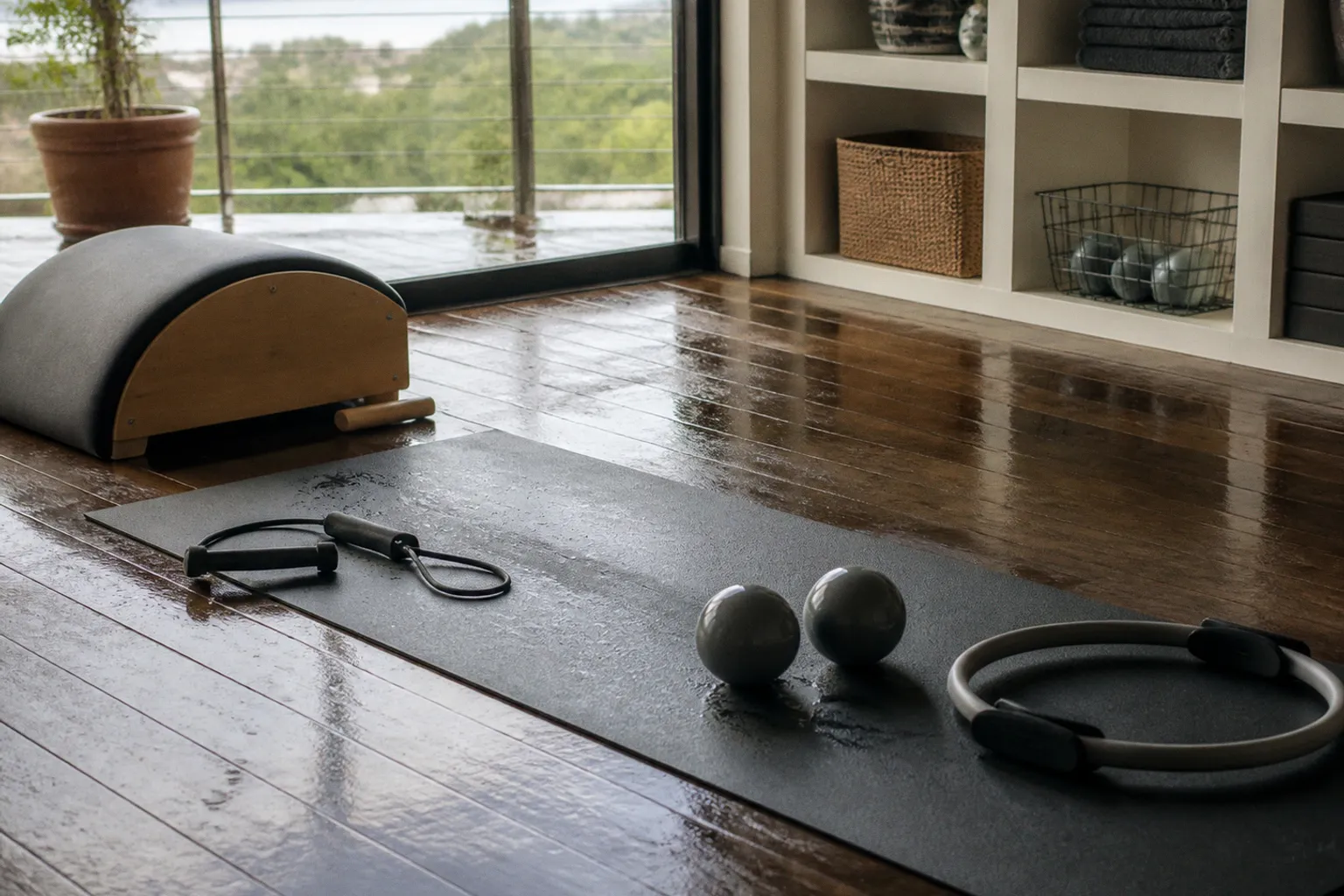
According to Prevention, certified Pilates instructor Nicolle Lopez-Ellis and Jade Winter, CEO of Studio Pilates International, have outlined the minimum equipment stack required to execute at-home Pilates with proper biomechanical loading. The piece matters for strength-trained readers because most home setups default to gear engineered for unrelated movement patterns—yoga mats designed for static holds and dumbbells weighted for hypertrophy rather than motor control—which compromises joint alignment and undermines the resistance parameters that make the method work.
Mat Specifications and Compressive Load
Spinal articulation in Pilates drives compressive load through the vertebral column and the ulnar weight-bearing surfaces during kneeling, prone, and side-lying sequences. A standard yoga mat, typically 3mm or thinner, transmits that load directly to the floor and forces the thoracolumbar stabilizers to absorb impact the surface should be handling. Lopez-Ellis specifies a minimum of 4mm of cushioning to protect these structures during repetitive transitions where spinal flexion and extension stack under bodyweight.
Higher-density options at 12mm fold into a wedge that doubles as wrist support during plank-based work, while maintaining a stable base of support for standing transitions and footwork patterns. Firmer profiles suit practitioners who require ground reaction feedback over joint protection during supine sequences—the trade-off is proprioceptive acuity versus peak compressive dampening. Budget options below $30 cover the cushioning threshold for a travel or small-space setup.
Resistance Loading and Motor Control
Pilates operates on a low external load, high intramuscular recruitment model. Loading above 5 pounds in any single limb disrupts the stabilization requirement of the deep core and shifts demand toward global movers. That conversion turns a motor control drill into a strength-endurance task. The intent of the exercise changes.
Lopez-Ellis specifies 3 to 5 pounds for hand weights and ankle or wrist wearables. Wearable formats eliminate grip fatigue and maintain segmental alignment during lateral raises, leg series, and arm circles where a held dumbbell would shift the center of mass and recruit the obliques compensatorily. Adjustable stacks that transition between 2, 4, and 6 pounds on a single base allow linear progression without equipment redundancy—useful when the goal is progressive overload without changing the movement template. The principle: external resistance should scale neuromuscular demand without overriding the motor control ceiling of the local stabilizers.
Implementation Order
Establish the foundation before adding tools. Mat, fitted apparel that does not restrict scapular depression or end-range hip flexion, and non-slip socks to prevent sagittal plane slippage during unilateral standing work. Bands, Pilates balls, rings, and wearable weights enter the protocol only after the practitioner demonstrates clean pelvic positioning and scapular stability under bodyweight demand.
Equipment does not substitute for motor pattern acquisition. It amplifies a stable system or exposes an unprepared one. Add load when the unloaded variation is automatic, not before.