Home gym equipment: which setup fits your space and goals?
The most common mistake in a small home gym is not buying too much equipment. It is buying equipment that solves the wrong problem. A set of light dumbbells may look tidy, but it will not support progressive strength work for long.
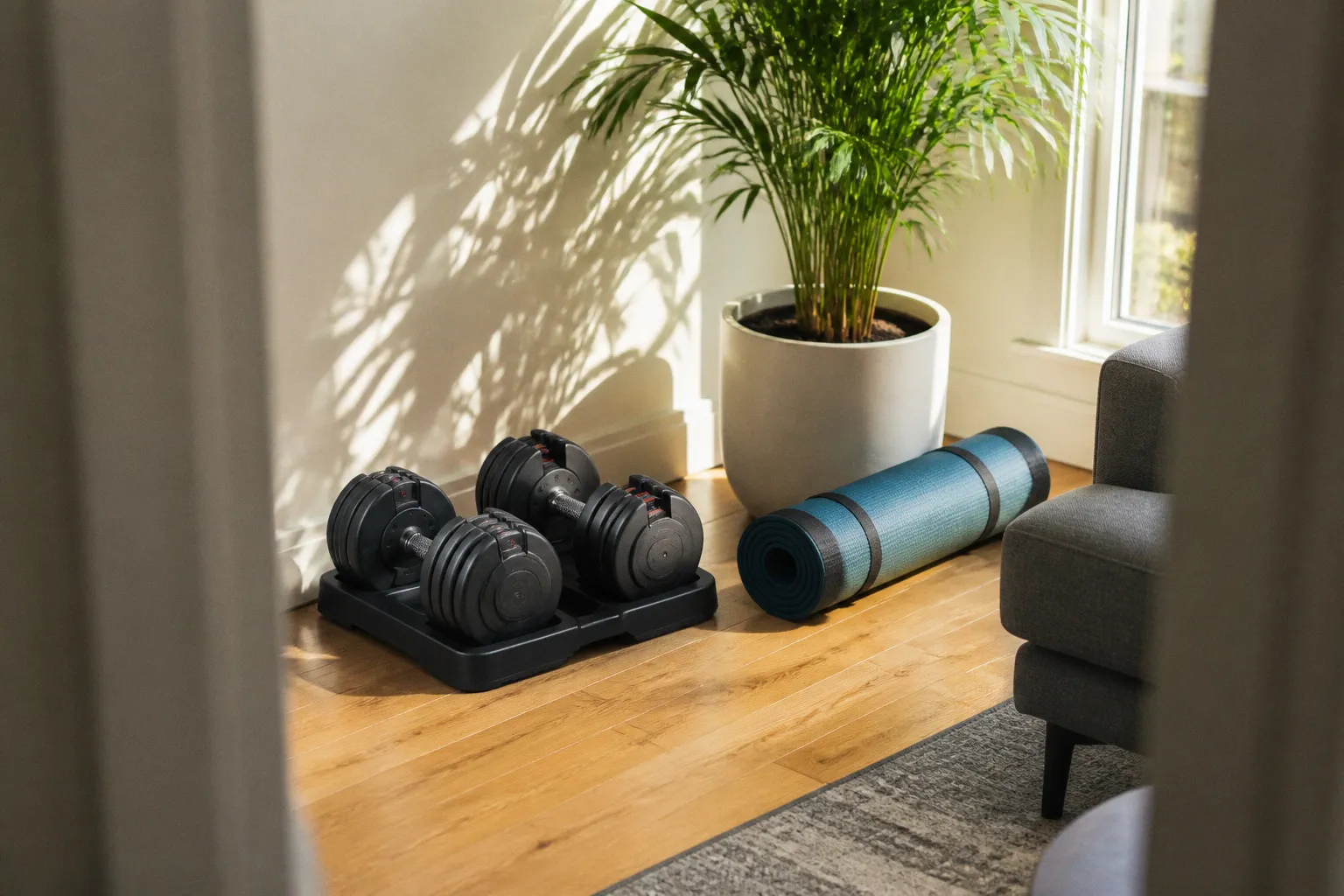
A large cable station may offer impressive versatility, but it can turn a bedroom, hallway, or apartment corner into a permanent construction project.
The best home gym equipment options for small spaces begin with a simpler question: what do you want to train consistently, and how much room can your setup occupy when you are not training? Once we answer that, the choice becomes much more practical. We can build around adjustable resistance, add one stable training surface, and keep the rest of the kit portable.
A compact gym does not automatically mean a limited gym. Adjustable dumbbells, resistance bands, and a folding bench can cover strength, mobility, and conditioning in surprisingly little space. The goal is not to recreate a commercial gym at home. It is to create a setup that removes friction between you and the next workout.
Start with the workout you can repeat
Space is only one part of the decision. Your training goals determine which equipment deserves your limited floor area.
If your priority is general strength and body composition, you need equipment that lets you train the major movement patterns:
- Squatting and lunging
- Hip hinging
- Horizontal pushing and pulling
- Vertical pushing and pulling
- Carrying and bracing
- Rotational and anti-rotational core work
You do not need a separate machine for every pattern. You need enough adjustable resistance to make the exercises progressively more challenging, plus a safe surface for movements such as pressing, rowing, split squats, and hip thrusts.
For mobility and low-impact conditioning, resistance bands may be enough to build the foundation. They are particularly useful when you travel, train in a small room, or need to make a workout quieter for neighbors. For heavier strength work, adjustable dumbbells offer a more stable load and a clearer path for progression.
The useful distinction is this:
- Your equipment collection is everything you own.
- Your training system is what you can set up quickly, use safely, and progress with over time.
We want the second one. A room full of gear is not the same as a well-designed home gym.
The strongest small-space setup is not the one with the most pieces. It is the one that makes the next workout obvious.
Before buying anything, write down the workouts you realistically intend to perform. If you train before work, equipment that takes ten minutes to assemble may become a daily excuse. If you travel regularly, a portable kit may deliver more value than a heavier home-only solution. If you want to train with substantial resistance, storage and floor stability deserve more attention than visual minimalism.
The core options for a compact home gym
There are four practical routes for building a small-space training area. They can overlap, but each one solves a different problem.
1. Adjustable dumbbells: the most versatile anchor
Adjustable dumbbells are usually the best starting point for a minimalist home gym setup. A single pair can replace many traditional dumbbell pairs, depending on the model and its available weight range. One commonly cited design can replace up to 15 pairs while sitting on a tray measuring roughly 15.75 by 8 inches.
That footprint is smaller than a small side table, yet the training possibilities are broad. We can use adjustable dumbbells for:
- Goblet squats and front-loaded squats
- Romanian deadlifts
- Reverse lunges and split squats
- Floor presses and bench presses
- One-arm rows
- Overhead presses
- Farmer carries
- Loaded core exercises
Some popular adjustable models begin around 5 pounds and reach approximately 52.5 pounds per hand. Other systems go considerably higher, with advanced options reaching roughly 80 to 125 pounds per hand. This matters because a compact setup does not necessarily force you to stay with light resistance.
The trade-off is handling. Adjustable dumbbells may require changing plates or selecting a setting between exercises. The shape can also feel less natural than a traditional dumbbell, especially during movements where the weight rests close to your body. If several people share the equipment, resetting the load can become another small point of friction.
For most people, that friction is manageable when the alternative is storing an entire rack of dumbbells. A pair of adjustable dumbbells gives you the clearest balance between training variety, load progression, and storage efficiency.
2. Resistance bands: the portable layer
Resistance bands are the most flexible choice when storage space, travel, or noise is the main concern. A complete band set can fit in a drawer or small travel bag, and it can support both strength and mobility work.
Bands are especially useful for:
- Glute activation and hip training
- Rows and pulldowns
- Chest presses with a secure anchor
- Shoulder stability work
- Lateral walks and lower-body accessories
- Assisted stretching
- Warm-ups and movement preparation
Their resistance is variable rather than constant. In practice, the band becomes more challenging as it stretches, so the hardest part of a movement may occur near the end of the range. That can be useful, but it feels different from lifting a dumbbell or barbell through the same exercise.
Bands also require more attention to setup. A door anchor must be positioned securely, and the band should be inspected for wear before use. The exact resistance is not always as easy to quantify as a dumbbell setting, which can make progression less straightforward. We can still progress by using a thicker band, increasing range of motion, slowing the tempo, adding repetitions, or reducing rest periods.
A band set is rarely the only equipment I would choose for someone whose primary goal is heavy strength development. It is, however, one of the smartest additions to almost any small-space gym because it fills gaps that dumbbells do not. It is easy to travel with, quick to deploy, and useful on days when your joints or energy need a lower-impact approach.
3. A folding bench: more exercise variety without permanent furniture
A bench changes what dumbbells can do. It supports pressing from a stable position, creates a platform for step-ups, and makes movements such as chest-supported rows and hip thrusts more comfortable.
A foldable weight bench is particularly practical in an apartment or shared room. Many models offer several incline and decline positions, with up to seven backrest positions in common multi-angle specifications. When the workout is finished, the bench can fold flat for under-bed or closet storage.
The bench is worth adding when:
- You prefer structured strength workouts
- You want to train the chest, shoulders, and back from several angles
- Floor pressing feels uncomfortable or restrictive
- You need a stable platform for seated exercises
- You can store it safely without blocking walking space
A bench is not automatically necessary. Floor-based training can build substantial strength, and a bench will not improve a program that lacks progressive resistance or consistency. It earns its place when it expands your movement options enough to justify the storage footprint.
The practical question is not whether a bench is useful. It is whether you will leave it open, fold it after each workout, or gradually turn it into a laundry surface. Choose based on your actual habits, not an idealized version of your routine.
4. Compact cable and Smith stations: a complete but less portable solution
All-in-one cable and Smith machines combine several functions in one structure. Depending on the design, they may include a squat rack, cable crossover, and pulley system within a footprint of approximately 20.9 to 21 square feet.
That is efficient compared with building each station separately, but it is still a serious commitment. A compact machine can become the center of a home gym and provide a broad range of exercises:
- Squats and split squats
- Cable rows and pulldowns
- Presses
- Face pulls
- Triceps extensions
- Leg and glute accessories
- Smith-machine pressing and lower-body work
This type of setup makes sense when strength training is a major part of your lifestyle and you have a fixed area where the machine can remain assembled. It is less suitable when you live in a rental, move frequently, or need to clear the room for other activities.
We also need to separate the machine’s footprint from its practical clearance. The listed floor area does not account for the space required to load plates, move around the frame, extend cables, or perform exercises safely. A machine can technically fit into a corner and still be awkward to use.
This is the most complete option in our comparison, but not necessarily the best option for a small room. Versatility has value only when the equipment remains accessible.
A side-by-side comparison
The following comparison focuses on how each setup behaves in real homes, not just what it can do on paper.
| Setup | Best for | Space and storage | Main strength | Main limitation |
|---|---|---|---|---|
| Adjustable dumbbells | Full-body strength and progressive resistance | Very compact; trays can occupy roughly 15.75 x 8 inches per pair | Replaces many traditional dumbbell pairs | Weight changes and shape may take some adjustment |
| Resistance bands | Travel, mobility, low-noise workouts, and accessories | Fits in a drawer or small bag | Extremely portable and versatile | Resistance is harder to quantify and depends on setup |
| Folding bench plus dumbbells | Structured strength training with more exercise variety | Folds flat for closet or under-bed storage | Adds pressing, support, and incline options | Requires stable storage and enough clearance when open |
| Compact cable or Smith station | Dedicated strength training in one fixed location | About 20.9–21 square feet before exercise clearance | Combines several stations in one frame | Less portable and demands a permanent training area |
| Bands plus adjustable dumbbells | Balanced small-space training | Compact and easy to adapt | Covers heavy, light, horizontal, and variable resistance | Still requires thoughtful programming rather than random exercise selection |
For many households, the most balanced combination is adjustable dumbbells plus resistance bands. If the room allows it, a folding bench is the next useful addition. A cable or Smith station becomes a better fit when you have a dedicated space and already know that you will train consistently with it.
Match the setup to your available footprint
A small space does not need to be measured with perfect precision, but we do need to understand how the room will function during a workout. Mark the area with painter’s tape or simply place a yoga mat on the floor. Then consider both the storage footprint and the movement footprint.
A compact gym can work in an area of roughly 15 to 25 square feet when the equipment is versatile and the workout is planned around standing, kneeling, and floor-based movements. That does not mean every exercise will fit safely in the same area. Overhead pressing, band work, and loaded carries may require additional clearance.
Use these practical space categories as a starting point:
A drawer, closet, or suitcase
Choose resistance bands, a jump rope if noise and ceiling height allow it, and small mobility tools. This is the most realistic setup for frequent travelers or anyone who cannot leave equipment visible.
The best portable home fitness kits comparison is not about the number of accessories included. It is about whether the kit supports a complete session. A few bands with different tension levels, a secure anchor, and a small amount of floor space may be more useful than a large bundle of isolated accessories.
A corner of a bedroom or living room
Adjustable dumbbells are usually the strongest anchor here. Add a folding bench only if you can store it without moving other furniture every time you train.
This arrangement works well for full-body workouts built around squats, hinges, presses, rows, lunges, and carries. It also makes it easy to keep the equipment visible, which can support consistency without turning the room into a gym showroom.
A dedicated 15–25 square foot training zone
You can combine adjustable dumbbells, bands, and a folding bench with enough room for floor work. This gives you a wide exercise menu while keeping the setup relatively quiet and easy to reset.
The key is to protect the movement area. Storage should sit at the edge of the zone, not in the middle of it. If each workout begins with clearing clothes, rearranging chairs, and searching for a band anchor, the effective size of your gym becomes much smaller.
A garage, basement, or permanent training room
A compact cable or Smith machine becomes more reasonable here, particularly if you want to train with cables regularly and have enough clearance around the frame. You may still want bands and dumbbells for warm-ups, unilateral exercises, and days when you want a faster session.
A dedicated room gives you more freedom, but it does not remove the need for a plan. Bigger equipment can make a workout feel more official; it cannot decide your weekly training volume, exercise selection, or recovery strategy.
Measure the space twice: once for where the equipment sits, and once for how your body moves around it.
The details that decide whether equipment gets used
Specifications matter, but daily friction matters more. A piece of gear can be excellent and still fail in your home if it is difficult to access, noisy, unstable, or inconvenient to store.
Storage and setup time
Ask how many actions are required before your first working set. If the dumbbells are buried under seasonal storage, the bench is behind three boxes, and the bands are tangled in a drawer, the equipment is not truly available.
A good setup has a short path from storage to training. Adjustable dumbbells should have a designated location. Bands should be stored loosely enough that they do not become a knot. A folding bench should have a clear place to stand or lie flat.
This is not about being perfectly organized. It is about preserving your energy for the workout instead of spending it on logistics.
Floor protection and noise
Dumbbells and machines transmit force into the floor, especially during deadlifts, rows, and loaded carries. A mat can reduce noise and protect the surface, but it does not solve every structural concern.
The supplied research does not establish universal floor weight limits for upper-floor apartments, and there is no single answer that applies to every building. If you are placing a heavy machine or substantial load upstairs, the building’s construction, the equipment’s distributed weight, and local guidance all matter.
For shared walls and downstairs neighbors, bands and controlled dumbbell work are usually easier to manage than dropping weights or performing high-impact conditioning. Quiet training is still effective training. We can create intensity through tempo, pauses, unilateral exercises, and well-planned sets.
Load progression
Your equipment should give you more than one way to make training harder. With adjustable dumbbells, that may mean increasing the load. With bands, it may mean changing band tension, increasing range of motion, adding repetitions, or slowing the lowering phase.
Do not judge a setup only by its heaviest setting. A useful home gym supports progression at several levels:
- More resistance
- More repetitions with the same resistance
- Better control and range of motion
- More demanding exercise variations
- More work completed in the same amount of time
- Improved consistency across the week
This is where many minimalist home gym setup options either succeed or fail. Minimalism is helpful when it removes clutter. It becomes limiting only when the equipment cannot adapt to your progress.
Stability and adjustment
A folding bench should feel stable at every angle you intend to use, not only when it is flat. Check the locking mechanism and the surface beneath it. The exact structural load capacity of every unbranded bench cannot be assumed from appearance alone, so the manufacturer’s stated rating and construction details matter.
For adjustable dumbbells, pay attention to how securely the plates or weight blocks lock into place. For bands, inspect the material and anchor points regularly. A compact item is not automatically a safe item; small equipment still carries force when used under tension or load.
Exercise clearance
The machine or bench may fit, while your arms, legs, and cables do not. Leave enough room to move through the exercises you actually plan to perform.
Think through:
- Overhead clearance for presses
- Side-to-side room for lateral movement
- Cable travel and attachment positions
- Space behind a bench for incline work
- A clear path for carrying weights
- Distance from walls, mirrors, doors, and furniture
A setup that restricts your range of motion is not space saving. It is simply under-sized.
Three practical setup routes
Rather than treating equipment as a shopping list, we can build the gym in stages. This keeps the investment aligned with your training and lets your habits guide the next purchase.
Route one: the smallest effective setup
Start with a resistance band set and a clear floor area. This is enough for full-body circuits, mobility sessions, travel workouts, and lower-impact training.
A simple session might include a banded squat, a row, a hip hinge, a chest press, a lateral walk, and a controlled core movement. You can adjust the tension and tempo as you become stronger.
This route is appropriate when:
- You need to store everything in a drawer
- You travel often
- You are rebuilding consistency
- Noise is a concern
- Your priority is movement quality and general fitness
It is not a lesser form of training. It is a deliberately narrow setup with a low barrier to use.
Route two: the balanced apartment gym
Add adjustable dumbbells to the bands. This gives you more stable loading and makes progressive strength work easier.
Use dumbbells for the primary exercises and bands for warm-ups, accessory work, mobility, and travel. This combination is often enough to support a complete training week without requiring a dedicated room.
For example, we might organize the week around:
1. A lower-body session using squats, Romanian deadlifts, and split squats
2. An upper-body session using presses, rows, overhead presses, and band pull-aparts
3. A full-body session using lunges, carries, dumbbell hinges, and banded core work
The exact schedule can change. What matters is that the equipment supports a repeatable pattern rather than a different random workout every day.
Route three: the dedicated strength corner
Add a folding bench to adjustable dumbbells and bands. This is the most versatile setup before moving into a fixed machine.
You gain supported rows, incline presses, seated presses, step-ups, and hip thrust variations. The bench also makes it easier to use different body positions without turning every exercise into a balance challenge.
This route suits you if you already enjoy resistance training and want more exercise options without committing to a full station. Store the bench flat after the session, and keep the dumbbells accessible so the room can return to its usual purpose.
Route four: the fixed all-in-one station
Choose a compact cable or Smith station only when you have a permanent training area and a clear reason to use its features.
This can be an efficient solution for someone who wants cable resistance, a rack, and guided barbell work in one structure. It can also be excessive if your training could be handled equally well with adjustable dumbbells and a bench.
Before committing, map the full working area, not just the machine’s stated footprint. A station that occupies approximately 21 square feet may need additional space for entry, cable movement, plate loading, and exercise execution.
Common buying errors in small spaces
The most expensive mistake is usually not choosing the wrong brand. It is building a setup around appearance rather than behavior.
Buying for an aspirational routine
If you currently train twice a week in a small room, a large station will not automatically turn you into a daily lifter. Start with the format you can use now. Equipment can support a habit, but it cannot create recovery, time, or motivation on its own.
Choosing variety instead of progression
A kit with dozens of attachments may offer many exercises but little resistance progression. We would rather have a smaller number of tools that make our key movement patterns stronger over time.
Ignoring the reset
If putting everything away takes longer than the cool-down, the setup may not survive a busy week. Choose storage that keeps the equipment protected but visible and reachable.
Treating compact as universally safe
A lighter-looking or smaller product can still fail if it is poorly secured, overloaded, or used with insufficient clearance. Bands need sound anchors. Benches need stable locks. Machines need a firm installation surface and enough surrounding space.
Buying duplicates too early
A second bench, a separate rack, or a large collection of small accessories may feel like progress, but it often adds clutter before the core system is being used consistently. Build the foundation first, then add the tool that solves a specific limitation.
A simple decision path
If you are still comparing options, use your main constraint as the first filter:
- Very little storage: choose resistance bands and a compact mobility tool.
- Small apartment corner: choose adjustable dumbbells, then add a folding bench if you need more exercise variety.
- Frequent travel: choose bands with a secure anchor and a small, repeatable workout plan.
- Heavy strength priority: choose adjustable dumbbells with a suitable upper weight range, or a fixed cable/Smith system if you have permanent space.
- Shared walls or downstairs neighbors: prioritize controlled resistance training, mats, and quiet exercise selection.
- Several people using the gym: choose equipment that adjusts quickly and stores in a clearly defined location.
- A dedicated room: consider a compact all-in-one station, but calculate clearance around the machine before purchase.
The best compact home workout gear is the gear that serves your current training while leaving room for progression. We do not need to buy every possible tool in advance. We need to protect the space, the budget, and the habit.
Build the next workout before you buy the next accessory
A home gym becomes useful when it supports a rhythm. Start with the smallest setup that can deliver the training effect you want, then expand only when you can name the limitation.
If bands are no longer challenging enough for your main lower-body exercises, adjustable dumbbells may be the right next step. If dumbbell pressing and rowing feel restricted, a folding bench may earn its space. If you are training consistently in a dedicated room and need cable work, an all-in-one station may finally make sense.
For your very next workout, choose one squat or lunge, one hinge, one push, one pull, and one core exercise. Use the equipment you already own, record the resistance and repetitions, and notice what genuinely limits the session. That observation is more valuable than another hour of browsing.
The right home gym equipment options for small spaces are not defined by how much they can display. They are defined by how easily they help you train, recover, and come back tomorrow. Start compact, progress deliberately, and let your real routine—not a showroom version of it—decide what belongs in the room.