Foam roller density: finding the right firmness for your recovery
Walk into any gym or scroll through any fitness marketplace and you'll find the same old sales pitch dressed up in new colors: the black foam roller is the “serious” one. The firm one. The one for athletes who actually train.
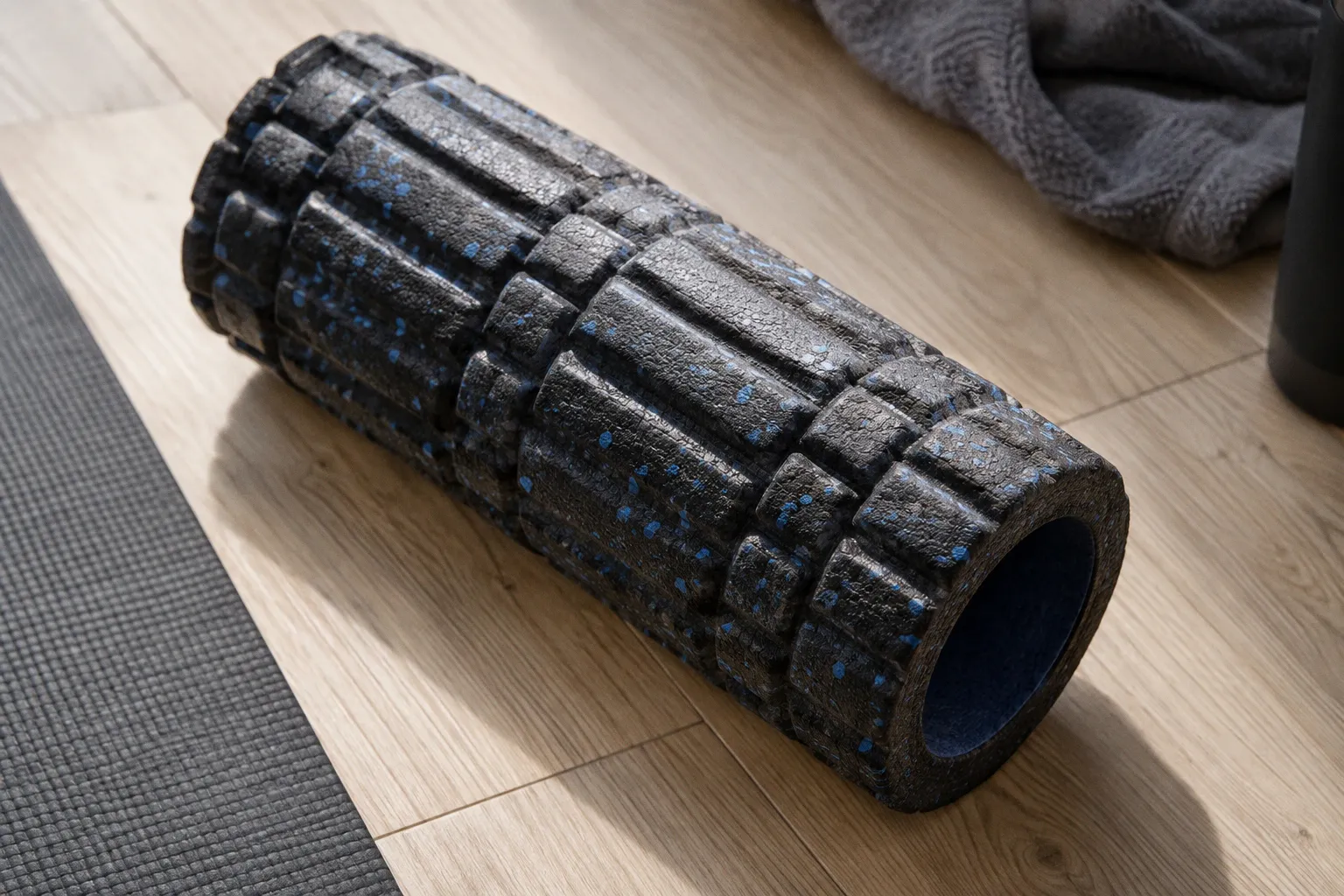
Meanwhile, the white roller sitting on the rack looks like a pool noodle with delusions of grandeur.
The marketing has done its job. Most people grab the black cylinder without thinking, assuming hardness equals effectiveness, and spend the next six months wondering why their IT band feels like it's being tenderized by a crowbar.
Here's the inconvenient truth: density alone doesn't determine whether a foam roller works. It determines how much pressure the tool can deliver, how that pressure feels, and whether you can tolerate using it consistently. There is a world of difference between challenging and counterproductive.
The fitness industry has convinced an entire generation that recovery should hurt. That pressure equals progress. That if you're not grimacing, the tool isn't doing its job. That thinking is wrong, and a closer look at foam rolling shows why.
The Science of Self-Myofascial Release: Why Density Matters
Self-myofascial release, the technical term commonly used for foam rolling, works through sustained pressure applied to soft tissue with your own body weight. The practice may temporarily improve range of motion and change how restricted or tense an area feels. The roller itself is only one part of the equation. Pressure, duration, movement speed, body position, and the area being treated all matter.
Density enters the picture because it influences how much the roller compresses beneath you. A soft roller yields more readily, spreading your body weight over a broader contact area. A firm roller resists compression, which can make the pressure feel more concentrated. That often creates a stronger sensation, but a stronger sensation is not automatically a better physiological result.
In theory, more pressure should mean more release. In practice, the body has opinions about being pushed around, and those opinions matter. If the pressure is too intense, the nervous system may respond by increasing protective tension. You end up bracing against the roller instead of relaxing into it. The session feels punishing, but the tissue is not necessarily receiving more useful work.
Research comparing different foam roller densities has found that soft, medium, and firm rollers can all produce short-term improvements in measures such as knee range of motion. The important point is not that every roller performs identically in every situation. It is that a harder roller does not automatically create a superior outcome simply because it creates more discomfort.
So what is density actually for? Comfort, pressure control, and matching the tool to the tissue you are working on. A heavier person, a particularly dense muscle group, or someone who wants stronger feedback may prefer a firmer surface. A beginner, a smaller person, or someone working around sensitive areas may get more from a softer roller because they can stay relaxed and use it regularly.
Density doesn't make a foam roller effective. It makes a foam roller tolerable—or impossible to tolerate.
That distinction is more important than the color of the foam or the language on the packaging. A roller that produces moderate pressure you can manage several times a week is usually more useful than one that forces you to tense your entire body after thirty seconds.
Decoding Foam Roller Materials: EPP vs. EVA Construction
Most foam rollers fall into two broad material families: expanded polypropylene, or EPP, and ethylene-vinyl acetate, usually called EVA. The material does not tell you everything about a roller's firmness, but it gives you useful information about how the surface may behave under load and how the roller may hold up over time.
EPP: firm, resilient, and shape-stable
EPP is a lightweight, closed-cell foam commonly used in firmer rollers. It has a relatively rigid feel, rebounds quickly after compression, and generally retains its shape well with repeated use. That makes it popular for rollers designed for regular, high-pressure work.
A firm EPP roller can feel very direct because less of your body weight is absorbed by the foam. It is often a good match for large muscle groups such as the quadriceps, glutes, hamstrings, and calves, provided the pressure remains manageable. It can also be useful for people who find softer rollers too forgiving to provide meaningful feedback.
Shape retention is one of EPP's main advantages. A well-made EPP roller tends to resist permanent dents and flat spots better than a softer foam construction. That does not make it indestructible. Excessive heat, poor storage, concentrated loading, and low-quality manufacturing can still affect its condition. It simply tends to remain structurally consistent for longer.
EVA: more flexible, more cushioned
EVA is also commonly used in closed-cell foam products, including foam rollers. It generally flexes more under body weight than EPP, giving the roller a softer, more cushioned feel. That can make it a sensible choice for beginners, gentle recovery sessions, and areas where a hard surface feels unnecessarily aggressive.
The softer response of EVA is not the same thing as poor construction. An EVA roller can be perfectly appropriate for regular use, especially when its firmness, shape, and outer surface suit the person using it. The trade-off is that EVA usually compresses more under load and may show wear or permanent deformation sooner than a comparable EPP roller, particularly when it is subjected to heavy, concentrated pressure.
There is no universal timeline for that wear. Some EVA rollers hold their shape well for a long time; others develop dents or flattening earlier depending on the foam formulation, the roller's construction, the user's body weight, and how it is stored. The useful distinction is not that EVA inevitably fails after a certain number of months. It is that EVA generally flexes more, while EPP tends to retain its shape longer.
Material and density are related, but they are not interchangeable
Manufacturers often use EPP in firmer designs and EVA in softer or more flexible designs, but material alone does not determine firmness. Different formulations, foam structures, wall thicknesses, cores, and outer layers can change how a roller feels. Two rollers made from EVA may have noticeably different pressure profiles, just as two EPP rollers may not feel identical.
Actual foam density is sometimes expressed in pounds per cubic foot, or PCF. Retail packaging rarely makes this information easy to find, and there is no universal consumer-facing system that makes one brand's “medium” directly comparable with another brand's “medium.” Color coding is also a convention rather than a reliable standard. White, blue, green, and black may suggest different firmness levels, but they do not guarantee them.
When shopping, treat material as one clue rather than a verdict. The more useful questions are:
- Does the roller compress noticeably when you press into it?
- Does it rebound after pressure is removed?
- Is the surface smooth, ridged, or covered with raised knobs?
- Is the cylinder stable enough that you can control your body position?
- Does the size suit the muscle groups you plan to work?
A textured surface can make a roller feel more intense even when its underlying foam is not especially firm. A narrow roller can concentrate pressure more than a wide one. A roller with a hollow or structured core may feel different from a solid foam cylinder. Density matters, but it is part of a larger pressure system.
The Truth About Firmness: Debunking the “Harder Is Better” Myth
Let's talk about the lie. Somewhere along the line, the fitness world decided that if something doesn't hurt, it isn't working. That belief has produced more abandoned recovery routines and bruised quadriceps than anyone needs.
Foam rolling depends partly on your ability to remain relaxed under pressure. Press too hard, too quickly, and the body may do the opposite of relaxing: it guards. Muscle guarding is a protective response in which the tissue tightens to reduce movement or shield an area from perceived threat. A hard roller applied aggressively to a tender spot can trigger exactly this response.
Now you have a tensed, braced muscle that refuses to soften beneath the roller. The session becomes endurance theater. You are proving that you can tolerate pain, not necessarily improving the quality of your recovery.
Bruising is another obvious warning sign. Foam rolling should not leave you marked as though you lost a fight with a baseball bat. Mild tenderness after working a tight area can happen, but repeated bruising, sharp pain, numbness, tingling, or lingering soreness suggests that the pressure or technique needs to change. Soft-tissue irritation is not a badge of commitment.
| Parameter | Soft Density | Medium Density | Firm or High Density |
|---|---|---|---|
| Pressure profile | Cushioned and spread over a wider contact area | Moderate pressure with a balance of comfort and feedback | More concentrated pressure with less compression |
| Beginner suitability | Usually the easiest starting point | Appropriate for many users with controlled technique | Better approached gradually |
| Sensitive areas | More forgiving, though direct pressure may still be inappropriate | Depends on the body part and the user's tolerance | Often too aggressive |
| Large muscle groups | Useful for gentle work and learning position | Versatile for quads, glutes, hamstrings, and calves | Strong feedback for experienced users |
| Shape retention | Depends on construction; softer EVA may show wear sooner | Varies by material and design | Often strong when made from resilient EPP |
| Risk of guarding | Lower when pressure is controlled | Moderate if you stay too long in one spot | Higher when used aggressively |
The industry will keep selling hard rollers because they look substantial and signal “serious training.” That is a marketing choice, not a recovery recommendation. A roller does not know how committed you are. It only responds to the pressure you place on it.
Identifying Your Ideal Density: From Soft Recovery to Deep Tissue
So which density should you buy? It depends on what you are trying to do, where you plan to use it, and how much pressure you can tolerate without bracing. There is no universal answer, but there is a sensible way to make the choice.
Start soft if you're new to foam rolling
The first few weeks are about building tolerance and learning positioning, not proving that you can survive the hardest roller in the store. A soft roller allows you to explore tender areas without immediately provoking a guarding response. It also gives you room to adjust your body weight gradually.
If you want more pressure, you can change your position before changing the tool. Shift more weight onto the roller, extend the opposite leg, slow down, or pause briefly over a muscular area. Those adjustments let you control the intensity from one session to the next.
A soft roller is especially useful if you are generally sensitive to pressure, returning to exercise after a break, or working with muscles that feel reactive after training. It may not create the dramatic sensation associated with a firm roller, but comfort is not a design flaw. It is what makes regular use possible.
Move to medium when soft feels too easy
When a soft roller no longer provides meaningful feedback and you find yourself pressing harder without getting the sensation or control you want, medium density is often the logical next step. This is the workhorse range for general recovery.
Medium rollers can provide enough resistance for the major muscle groups while remaining manageable for many users. They are useful for quads, hamstrings, calves, glutes, upper back muscles, and lats, although technique still needs to change from one region to another.
If you only want one roller, a medium option is often the most adaptable choice. It is less likely to feel immediately overwhelming than a firm roller, but it has more range than a very soft cylinder. Look for a model that remains stable beneath you and does not feel as though it is collapsing with every pass.
Consider firm only after adaptation
Firm or high-density rollers make sense in specific situations. An experienced user may prefer one for dense muscle tissue, stronger feedback on large muscle groups, or targeted work where a soft roller simply compresses too much. Some athletes also prefer a firm roller because it remains stable during bodyweight movements.
That does not make a firm roller the default choice for everyone. A hard surface can be especially unpleasant on the upper back, inner thigh, outer hip, and other areas where the tissue is less forgiving. It can also make it harder to learn basic control because the user spends all their attention managing the discomfort.
Technique matters more than tool hardness. A skilled user on a medium roller can create more useful, controlled pressure than an inexperienced user can create with a hard one. The firm roller is not a shortcut to better tissue work.
Match the roller to the body part
This is the point most buyers ignore. Different regions tolerate different densities, and the same person may reasonably prefer more than one roller.
Larger, more muscular areas such as the quads and glutes can often handle more pressure. The calves and hamstrings may tolerate medium or firm work, but only if you can control your body weight and avoid lingering on highly sensitive spots. The upper back may respond well to a moderate roller, while the neck should not be aggressively compressed with a foam roller.
Be cautious around the front and side of the neck, the spine itself, joints, bony prominences, acute injuries, swollen areas, and regions affected by numbness or nerve symptoms. A softer roller is not a permission slip to roll directly over structures that should not receive bodyweight pressure.
Some people keep two rollers: a softer model for upper-body work and gentle sessions, and a firmer one for the quads or glutes. That is not automatically overbuying. It is the same logic used when choosing different weights or resistance bands for different exercises.
Consider your training status and recovery goal
The ideal foam roller density can change with the context. A person using a roller after a demanding lower-body workout may want a gentler surface than they would use for a general mobility session. Someone returning from a period of inactivity may need less pressure than they remember tolerating in the past.
Your goal also matters. If you want a broad, calming recovery routine, a soft or medium roller may be more appropriate. If you want stronger mechanical feedback during a targeted session, a firmer model may have a place. Neither goal requires you to chase pain.
Avoiding Common Pitfalls: When Excessive Pressure Backfires
Most foam rolling mistakes are not caused by choosing the wrong color. They come from applying too much pressure for too long and interpreting discomfort as proof that the technique is working.
Staying on one spot too long
A tender area can feel as though it needs to be attacked until it gives up. That is usually a poor strategy. Spend a controlled amount of time moving slowly around the area instead of parking on the most painful point indefinitely. Many protocols use roughly a couple of minutes per muscle group, but the appropriate duration depends on the exercise, the body part, and your response.
If an area becomes more painful as you continue, stop treating that escalation as a challenge. Move away from the spot, reduce your body weight, or finish the session. More time does not automatically produce more recovery.
Rolling too quickly
Fast, aggressive passes turn the roller into a blunt instrument. They make it harder to notice how your body is responding and can encourage you to bounce over tender areas. Slow, deliberate movement gives you better control over pressure and position.
Try moving at a pace that allows you to breathe normally. If you cannot relax your jaw, shoulders, or hands while rolling, the pressure may be too high. The roller is not a power tool. It is a pressure tool. Slow down.
Treating pain as the target
A useful session may include mild discomfort, especially when you are working on a tight or sensitive muscle. Sharp pain, burning, electric sensations, numbness, or a feeling that the area is being bruised are different signals. Do not force your way through them.
The same applies to pain that changes how you move. If you are holding your breath, twisting away from the roller, or clenching every muscle around the area, adjust your position. The goal is controlled pressure, not a contest between you and a cylinder of foam.
Rolling directly over the spine
Rolling directly along the vertebrae with a firm roller is a bad idea. The spine has bony prominences and sensitive structures that should not be compressed aggressively. If you want to work the muscles along the back, angle the roller slightly to one side and target the paraspinal muscles rather than the vertebrae themselves.
The same caution applies to joints and other prominent bones. Foam rolling is generally more appropriate for muscular tissue than for hard, exposed structures.
Ignoring the roller's condition
A roller that has developed deep dents, flat spots, cracks, or permanent deformation no longer distributes pressure evenly. Inspect it occasionally, especially if it lives in a hot car, sits under heavy equipment, or is used by more than one person.
EVA may flex more and show compression sooner than EPP, but that does not mean every EVA roller has a fixed short lifespan. The practical test is its condition. If the roller is no longer stable, has lost its shape, or creates an uneven pressure point that did not exist before, replace it. Material labels are useful, but the equipment in front of you is the final evidence.
The right foam roller is the one you'll actually use. If it is too painful to use consistently, it is the wrong roller.
The Verdict on Foam Roller Density
Density matters, but not in the way the fitness industry wants you to believe. It matters because it influences pressure, comfort, control, and durability. It does not determine your seriousness as an athlete, and it does not guarantee a deeper or better recovery response.
Soft, medium, and firm rollers can all be useful. The best choice depends on your experience, the area you are treating, the amount of body weight you can control, and whether the tool allows you to stay relaxed. A softer roller may be the better option for a beginner or for sensitive areas. A medium roller is often the most versatile single purchase. A firm roller can be useful once you have adapted and have a clear reason to want more resistance.
For many people starting from scratch, a medium-density EPP roller offers a practical balance of stability, feedback, and shape retention. That is not a universal prescription. If you are new to foam rolling or particularly sensitive to pressure, a softer EVA roller may be the smarter place to begin. If you eventually find that it compresses too much for the way you train, you can move up in firmness without treating the first choice as a failure.
Harder is not better. Tolerable is better. Consistent is better. The roller you use twice a week for years beats the professional-looking cylinder collecting dust in the closet because it hurt too much after the first session.
Choose the density that lets you breathe, control the pressure, and come back to the practice. Your muscles do not need to be punished to recover.
FAQ
Does a firmer foam roller provide better recovery results?
What is the difference between EPP and EVA foam rollers?
How do I know if my foam roller is too firm?
Should I roll directly over my spine?
How long should I spend on a single muscle group?
More products