HIIT Workout Prep: Checklist to Avoid Common Mistakes
Here's the dirty little secret about those "20-minute fat-blasting HIIT routines" flooding your feed: they're only 20 minutes if you ignore the prep. And most people ignore the prep.
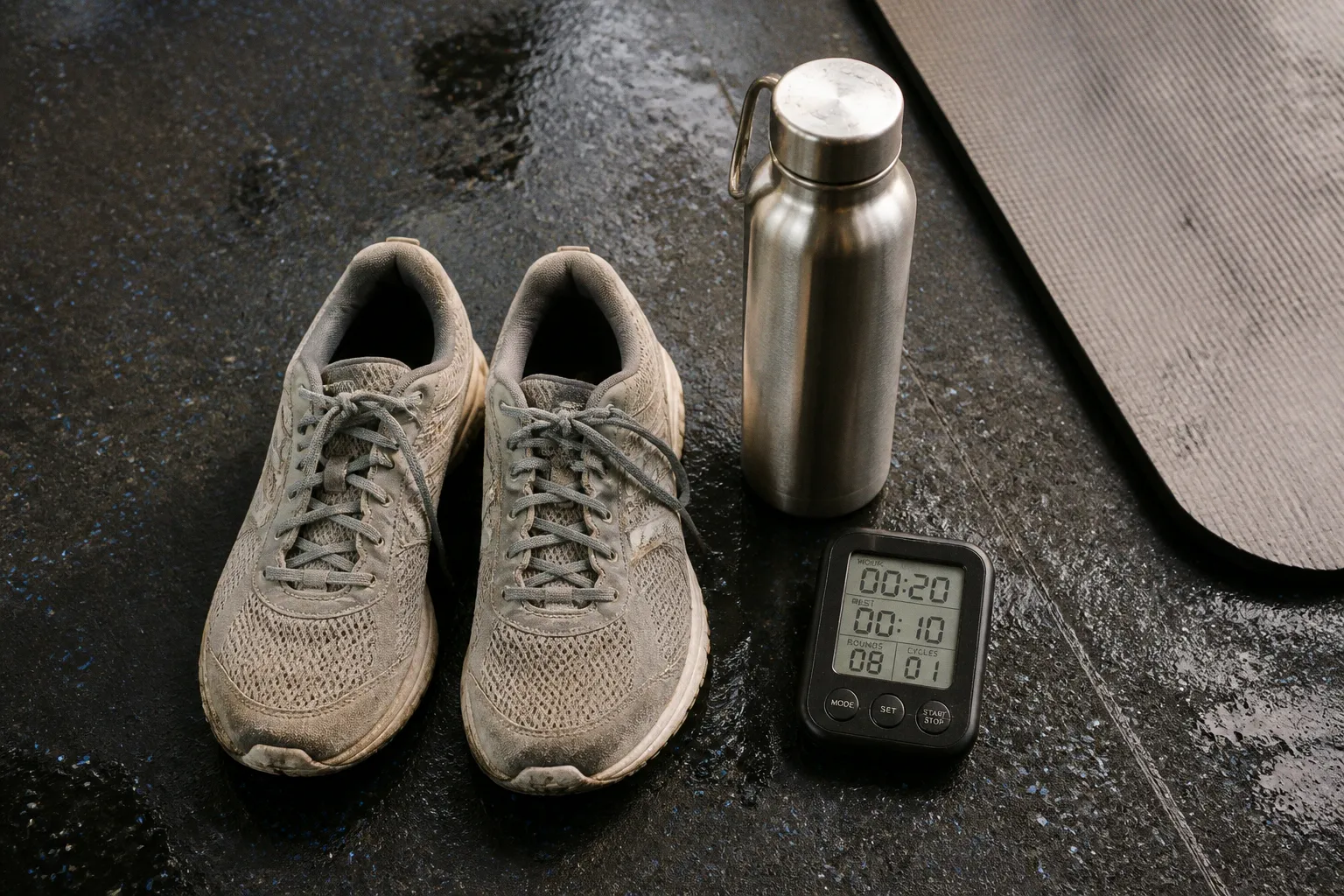
I've watched more than a few gym rats and weekend warriors blow out a hamstring, tweak a shoulder, or hit a wall of burnout because they treated the warm-up like a commercial break — something to fast-forward through before the real show.
The truth is, a proper HIIT workout preparation checklist isn't optional flavor text. It's the load-bearing wall holding up the entire structure. Skip it, and that high-intensity interval you're slamming into is landing on cold joints, under-fuelled muscles, and a nervous system that hasn't been told what's coming. That's not fitness — that's a controlled crash.
What a Pre-HIIT Warm-Up Actually Looks Like
Drop everything you learned in middle-school PE. Static stretching — holding a hamstring stretch for 30 seconds while your quad quivers — does not belong in a pre-HIIT warm-up. The evidence is blunt on this: static stretching on cold tissue can temporarily drop your peak power output and increase, not decrease, injury risk when you immediately pivot to high-intensity work. It's the gym equivalent of stretching cold taffy and expecting it not to snap.
What actually works is 5 to 10 minutes of dynamic movement. Think leg swings, arm circles, walking lunges with a torso twist, high knees, butt kicks, and bodyweight squats that move through a full range of motion. The goal isn't flexibility — it's elevated blood flow, joint mobility, and a core temperature that tells your muscles, "Hey, we're working in three minutes."
Static stretching before HIIT isn't a warm-up — it's a goodbye letter to peak power.
This kind of dynamic prep reduces muscle injuries by an estimated 30% to 50%. Let that sink in. The most injury-prone part of your workout is the 5 minutes you probably skip to save 5 minutes. That's the worst trade in fitness.
Baseline Fitness: The Prerequisite Nobody Checks
Here's where the wellness crowd gets sloppy. HIIT isn't a beginner entry point. It's an advanced tool that punishes people who show up without the foundation.
Before you touch a single Tabata round, the standard baseline is being able to sustain 65% to 75% of your maximum heart rate (the rough calculation being 220 minus your age) for a solid 30 minutes of continuous aerobic work. Translation: if you can't jog, row, or bike at a moderate-but-not-comfortable pace for half an hour without gassing out, you're not ready to spike your heart rate to 80–95% of max and call it a workout. You're just generating lactic acid and regret.
Why does this matter? Because HIIT doesn't train your aerobic base — it assumes you already have one. Without it, the intervals feel harder than they should, recovery drags longer than it should, and the cumulative wear on your joints and tendons far outpaces the actual fitness adaptation. You're paying a high price for low returns.
Can you build that base while doing HIIT? Technically, yes. Should you? Only if you enjoy being sore for a week and questioning your life choices. Most people are better off accumulating four to six weeks of steady-state cardio before they even think about intervals. Treat HIIT as the seasoning, not the entrée.
Work-to-Rest Intervals and Duration Caps
The interval structure of HIIT is where everyone gets creative, and where most people start inventing problems. The classic, evidence-backed ratios are 2:1 and 3:1 — meaning if you work hard for 20 seconds, you rest for 10 seconds, or work for 30 and rest for 15. That's the engine room of any legitimate HIIT session, and it's what separates HIIT from "moderately confused cardio."
But the work-to-rest ratio isn't the only dial. During the work interval, intensity should sit between 80% and 95% of your max heart rate. If you're halfway through a "HIIT" routine and you can comfortably hold a conversation, you're not doing HIIT. You're doing cardio with a marketing team. That's not a crime, but it's also not the protocol you're paying for.
Then there's the duration cap, which is where the wheels really come off. Most legitimate HIIT sessions run between 4 and 20 minutes of actual work, with the entire gym visit topping out around 30 minutes including warm-up and cool-down. The moment you push a HIIT session past 30 to 45 minutes, two things happen: intensity quality craters because your body simply cannot maintain 80–95% max HR for that long, and your injury risk climbs because fatigue degrades movement mechanics.
The 20-minute miracle is worthless if you spend zero of those minutes prepping your joints for impact.
So when you see a "60-minute HIIT fat-burner" on YouTube, what you're actually looking at is a 20-minute HIIT session stapled to a 40-minute warm-up and cool-down — or, more likely, a cardio workout pretending to be HIIT to ride the algorithm. The promise of "more" is rarely a promise of better. It's usually just a promise of more soreness.
The Frequency Trap and Recovery Reality
People love to ask how often they should do HIIT. The honest answer: less than you think, and definitely not every day.
Most trainees should cap it at 2 or 3 non-consecutive sessions per week. That's it. HIIT is metabolically expensive and neurologically draining. Your muscles, connective tissue, and central nervous system all need real recovery time to actually adapt. Stack back-to-back HIIT days and you don't get fitter — you get a cortisol-soaked, overtrained mess who can't sleep and mysteriously gains belly fat while training harder than ever.
The non-consecutive part matters too. Doing HIIT on Monday, Wednesday, and Friday gives your body a recovery buffer in between. Doing it Monday, Tuesday, and Wednesday is how you end up googling "why do my knees hurt going down stairs" three weeks in. The connective tissue doesn't care about your enthusiasm. It cares about your schedule.
For the bulk of trainees, HIIT is a seasoning, not a main course. Your weekly training should still be anchored by steady-state cardio, strength work, and mobility — HIIT is the kicker, not the foundation. Treat it like the hot sauce on an already-built meal. Pour it on everything, and nothing tastes good anymore.
The Real HIIT Prep Checklist
Alright. Here's the actual checklist. Not a wellness influencer's "manifest this energy" list. A field-tested sequence based on what actually keeps you moving without wrecking your joints. If you're wondering how to prepare for a HIIT workout without falling into the usual traps, this is the floor.
1. Confirm baseline fitness. Can you hold 65–75% of max HR for 30 straight minutes of moderate activity? If no, build that base first. HIIT is not where you start; it's where you graduate.
2. Hydrate before, not just during. Chugging water mid-workout is too late. Drink 16–20 oz of water in the 1–2 hours before your session. Dehydration tanks performance faster than anything else on this list.
3. Fuel appropriately. Going into HIIT fully fasted can wreck you — lightheadedness, mid-workout nausea, early fatigue. Eat a small, carb-leaning snack 60–90 minutes before (banana, toast with honey, rice cake). Skip the heavy burrito.
4. Run the 5–10 minute dynamic warm-up. Leg swings, arm circles, walking lunges, bodyweight squats, hip openers, light skipping or marching in place. Increase heart rate, open joints, raise core temperature. No static stretching on cold muscles.
5. Verify your work-to-rest ratio. Pick a 2:1 or 3:1 protocol and stick to it. Don't freelance mid-session because "you feel good." The structure is what makes the workout HIIT.
6. Cap the work interval at 30 minutes total. Even with warm-up and cool-down, the high-intensity portion should not exceed 30 minutes. Diminishing returns kick in fast, and injury risk climbs right after.
7. Confirm you're hitting 80–95% of max HR during work phases. If you're not, you bought a HIIT label without HIIT physiology. Adjust the exercise selection, shorten the rest, or pick a tougher modality.
8. Schedule 48 hours between sessions. Two or three HIIT workouts per week, on non-consecutive days. Treat recovery as part of the program, not a bonus feature.
9. Cool down with mobility, not more intervals. Slow walking, dynamic stretching, foam rolling — whatever clears the lactate and resets your nervous system. Don't just drop into a sitting position and call it done.
10. Track how you feel two days later. If a HIIT session leaves you sore-but-functional 48 hours later, the prep worked. If you're hobbling around the office, something in steps 1–9 went sideways, and you fix it before the next session.
Final Verdict
Is HIIT workout preparation worth the extra time? Yes. Unambiguously. But the way the industry markets HIIT — stripped of warm-ups, baseline requirements, recovery time, and duration caps — is a setup. You're being sold a high-performance tool with the safety manual tossed in the recycling bin.
The prep isn't a soft add-on. It's the difference between a workout that builds durable fitness and one that just beats you up for an Instagram story. Five minutes of dynamic warm-up, a real baseline check, an honest interval structure, and a recovery plan aren't negotiable extras. They're the floor.
If you're not willing to do the prep, you're not ready for the work. And that's not gatekeeping — that's just the wear-and-tear math of doing this for another decade instead of another month.