Low-carb transition: pre-start checklist of essentials
The first three days of any low-carb transition are where most people quit. Not because the diet doesn't work, but because they walked in like a bull in a china shop.
They didn't pre-load the kitchen, didn't learn the math, didn't bother replacing the electrolytes they were about to flush out. Then the headaches hit, the energy cratered, and they blamed the diet.
Here's the truth after years of testing meal frameworks with clients: the people who actually stick with low-carb are the ones who treated the pre-start like a job interview. They came prepared. The rest bounced off the keto flu like a rubber ball off a concrete wall and went back to their sugary cereals by Friday.
This is the field-tested checklist. No fluff, no "consult your doctor" hand-wringing (if you have specific medical conditions, obviously do that), no mysticism. Just the prep work that separates the starters from the finishers.
Defining your carb threshold: from general low-carb to keto
Right off the bat, can we kill the myth that "low-carb" means one thing? It doesn't. There's a spectrum, and where you land on it determines everything from what you eat to whether your body throws a tantrum about it.
The broad category of low-carb generally puts you at under 130g of carbohydrates per day. That's the loose threshold most nutrition guidelines use. You can hit that and still eat a piece of fruit, some beans, maybe even a small portion of rice if you're strategic about it. It's a lifestyle diet, not a metabolic regime.
Then you've got the strict end of the spectrum: ketogenic territory. Here we're talking 20g to 50g of net carbs daily. That's not a suggestion — it's the target that gets your body producing ketones and shifting its primary fuel source from glucose to fat. Anything higher and you're just doing a moderately timid low-carb diet with extra steps.
The macronutrient breakdown for standard keto looks like this: roughly 70% to 80% of your daily calories from fat, 10% to 25% from protein, and 5% to 10% from carbohydrates. That's a complete inversion of the standard Western plate, and it's exactly why the first week feels like your body is running on the wrong fuel.
| Approach | Daily carb target | Macros (fat / protein / carbs) | Best for |
|---|---|---|---|
| General low-carb | Under 130g | ~30–40% / 25–35% / 30–40% | Sustainable cut, active training, food flexibility |
| Strict keto | 20g–50g net carbs | ~70–80% / 10–25% / 5–10% | Metabolic reset, fat adaptation, hard cut |
"Low-carb isn't a diet. It's a different operating system for your metabolism. Pretending otherwise is how you end up starving in a sea of avocados."
So before you buy a single ingredient, decide where you actually want to sit on this spectrum. "I'll just cut back a little" is not a plan. Pick a number. Write it down. Or don't — but don't complain when your results look like someone who just "cut back a little."
Mastering the math: how to calculate net carbs correctly
Here's where the industry loves to confuse people into submission. The phrase "net carbs" is plastered on everything from almond flour tortillas to sugar-free chocolate, and most people have no idea what it actually means.
Net carbs = Total carbohydrates minus dietary fiber.
That's it. That's the formula. Some labels also subtract certain sugar alcohols, but the fiber subtraction is the universal move. If you're staring at a nutrition label and trying to decide whether something fits your day, you look at the total carbs line, subtract the dietary fiber line, and that number is what counts against your daily budget.
Why does it work? Fiber is a carbohydrate your body doesn't actually absorb as sugar. It passes through you doing useful things for your gut and your satiety, but it doesn't spike insulin or get converted to glucose. So if a package of broccoli has 6g of total carbs and 2g of fiber, you're eating 4g of net carbs. That's why non-starchy vegetables are the backbone of every low-carb fridge — they're carb-dense by label, sparse by impact.
This is the math that lets you eat half a kilogram of spinach and still have most of your daily carb budget intact. Get comfortable with it. Burn it into your brain before you set foot in a grocery store.
A practical move: download a tracking app before you start. MyFitnessPal, Cronometer, whatever doesn't make you want to throw your phone across the room. Log everything for the first two weeks. You're not optimizing for life — you're training yourself to read food like a mechanic reads an engine. After that, you'll eyeball a plate and know roughly where it lands.
Kitchen overhaul: essential proteins, fats, and produce to stock
Now we're at the part where most people get fancy. They buy seventeen types of keto-friendly snacks, a bag of MCT oil, and a cookbook with hand-drawn illustrations of cauliflower. Then they eat three of those items and the rest goes rancid in the back of the fridge.
Don't be that person. Stock the basics. The staples.
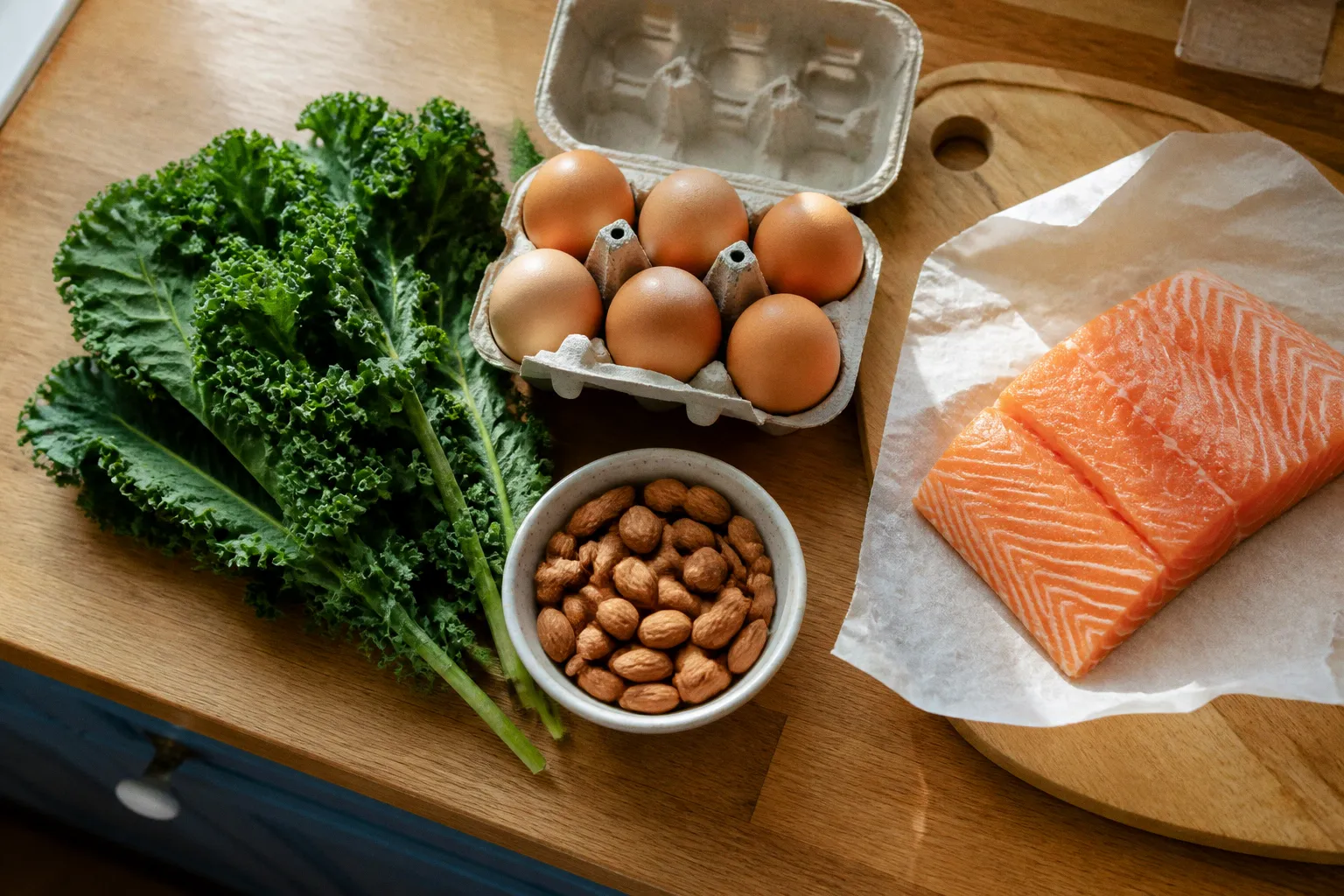
For proteins, you want versatile, cheap, and easy to cook. Eggs are the obvious anchor — cheap, nutrient-dense, infinitely flexible for breakfast, lunch, or dinner. Poultry (chicken thighs and turkey breast, mostly) gives you lean protein without blowing your fat macros. Salmon is the premium pick: high in omega-3s, fatty enough to keep you satisfied, and versatile enough to not bore you by week two. Ground beef — preferably 80/20 or fattier — is your weeknight workhorse. It absorbs flavors, cooks fast, and the fat ratio is already aligned with keto macros.
For fats, you need three anchors: olive oil for cooking and dressing, avocados for everything else (yes, including the toast you can't eat anymore), and butter or ghee for high-heat cooking. Coconut oil is fine if you like it. I don't care about the coconut oil discourse. Use what you like and move on.
For produce, it's non-starchy vegetables all day. Spinach, broccoli, cauliflower, zucchini, bell peppers, asparagus, kale, mushrooms, cucumbers. These are the bulk of your plate, your fiber source, and the reason you don't feel like you're starving. Buy them fresh if you cook daily, frozen if you don't. Frozen vegetables are picked at peak ripeness and frozen within hours — they're not the nutritional wasteland people think they are.
A small hardware note: if you don't already have a decent sheet pan, a cast-iron skillet, and a sharp knife, get them. You're going to cook at home more than you have in years. Bad tools make that a punishment. Good tools make it a habit.
Clearing the pantry: removing hidden carb traps
Here's the part nobody wants to do and everybody needs to do. Walk into your pantry right now and look at it like a recovery specialist looking at a packed gym full of equipment that doesn't serve the goal. Most of what's in there is actively working against you.
The obvious offenders: pasta, rice, bread, cereal, granola, oatmeal, flour, sugar in all its disguises (white sugar, brown sugar, coconut sugar, honey, maple syrup — your body treats them all the same). Crackers, chips, pretzels. Baked goods of any kind. Boxed meal kits with "just add meat" instructions. Most of these should go in the trash, the donation box, or — if you have the willpower I don't — the back of a high shelf you can't reach.
But the real traps are the hidden ones. These are the items that look healthy, sound healthy, and are absolutely loaded with carbs or sugar:
- "Low-fat" versions of anything (yogurt, salad dressing, peanut butter). When manufacturers remove fat, they add sugar. It's a swap, not a subtraction.
- Sauces and condiments. Ketchup, BBQ sauce, teriyaki, most pasta sauces, sweet chili sauce. Read the labels. Most of these are dense with added sugar.
- "Healthy" granola bars and protein bars. Some are fine. Many are candy bars in a yoga-pants wrapper.
- Dried fruit. Raisins, cranberries, apricots, dates. The carb density is astronomical and the sugar is concentrated.
- Flavored yogurt. Even the "natural" stuff usually stacks up sugar fast per serving.
- Plant-based milks unless explicitly unsweetened. Oat milk especially is basically liquid bread.
- Anything labeled "fat-free" or "low-calorie" that comes in a package instead of growing out of the ground.
The rule: if a label has more than five ingredients and any of them are words ending in "-ose" or "- syrup," you probably don't want it.
A practical move here: don't throw everything away in a frenzy one Saturday night. Sort it over a few days. Eat down what you have so you're not wasting money. Just stop replacing it with the same stuff when it runs out.
Mitigating the keto flu: electrolyte strategies for success
And now we arrive at the part that's going to test your commitment harder than anything else in this article.
The "keto flu" isn't a flu. It's not a virus. It's your body complaining — loudly and persistently — that you just removed its preferred fuel source. When you cut carbs drastically, your insulin levels drop, your kidneys start excreting more sodium and water, and your electrolyte balance goes sideways. The result: headaches, fatigue, brain fog, irritability, muscle cramps, and sometimes nausea. It typically hits in the first three to seven days and can last a week or two for the unlucky.
You can largely avoid it. The trick isn't exotic supplements, fancy hydration packs, or overpriced "keto recovery" products. It's electrolytes, and it's getting them from food or basic sources.
Sodium is the big one. When you cut carbs, your body flushes sodium. You need to replace it deliberately. Add salt to your food. Drink broth — bone broth, regular broth, bouillon in hot water. Don't be shy with the salt shaker. If you're active and sweating, you're losing even more.
Potassium is next. Sources include avocados (yes, again), spinach, mushrooms, salmon, and zucchini. A typical day of low-carb eating should give you enough without supplementation, but if you're cramping, that's your early warning sign.
Magnesium is the third wheel. Most people don't get enough anyway, and cutting carbs can expose the gap. Dark leafy greens, almonds, pumpkin seeds, dark chocolate (85% or higher), and fatty fish are your dietary sources. If you're getting muscle cramps or twitches that won't quit, a magnesium supplement — glycinate or citrate, not oxide — is worth considering.
"The keto flu isn't a rite of passage. It's a hydration and electrolyte problem wearing a costume. Solve the actual problem and most of it disappears."
Hydration is the unsung part. Drink more water than you think you need. Low-carb diets have a diuretic effect, and dehydration amplifies every other symptom. If your urine is dark yellow, you're already behind. Aim for pale straw-colored throughout the day.
Walk through the first week like a careful operator. Don't try to set a new training PR on day three. Don't schedule the launch during your highest-stress work week. Don't blame the diet when your body is doing exactly what biology says it will do.
The verdict
So is the prep worth it? Yes. Unambiguously yes.
The difference between a low-carb transition that lasts and one that dies in week two is almost entirely in the setup. Know your carb threshold. Know how to calculate net carbs. Stock the basics. Clear the trash from your pantry. Manage your electrolytes. None of this is glamorous. None of it produces dopamine-driven social media moments. All of it works.
If you walk into this diet like a tourist — "I'll just figure it out as I go" — you will get bounced off it by day five. The internet is full of those people, posting about how low-carb "didn't work for me" while eating suspiciously large portions of "keto" cookies.
Prep first. Then start.