White rice or brown rice for post-workout recovery?
Every fitness influencer with a blender and a podcast has told you brown rice is the "cleaner" carb. They've been saying it for years, and most of them couldn't explain glycemic index to you if you put a gun to their turmeric latte.
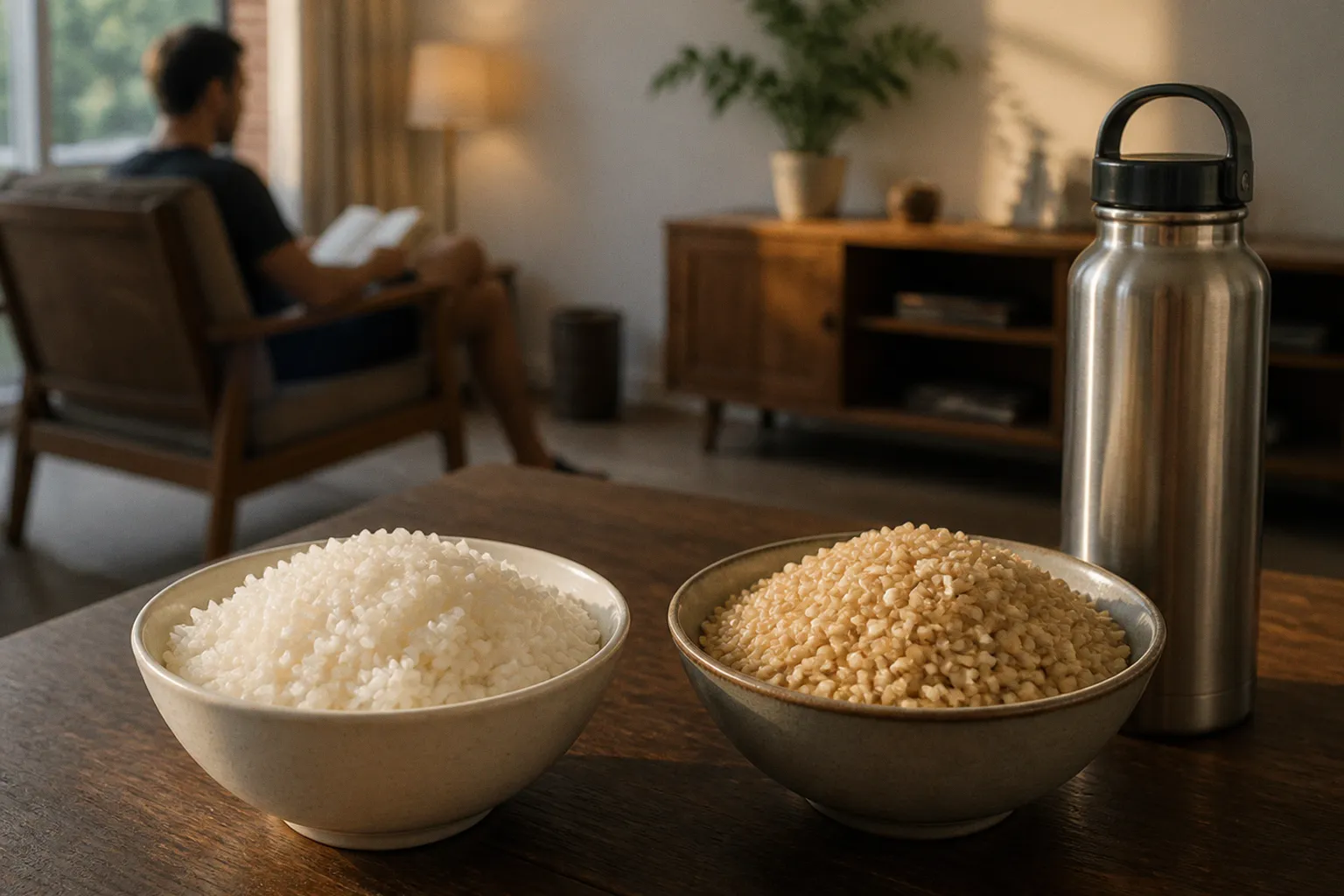
White Rice vs Brown Rice: What Actually Works for Post-Workout Recovery
White rice, meanwhile, has been treated like dietary contraband — the processed villain in a whole-food fairy tale.
Here's the part of the story they've been skipping: when it comes to post-workout recovery, the speed of carbohydrate delivery matters more than the marketing-friendly idea of "minimally processed." White rice clocks a glycemic index of roughly 72. Brown rice sits around 50. That gap isn't trivia. White rice generally digests faster than brown rice, which means its glucose reaches the bloodstream more quickly and may support faster glycogen replenishment after a hard session. And that gap has real consequences when you're trying to refill your glycogen tank before your next session.
But — and I cannot stress this enough — that doesn't make white rice some kind of anabolic superfood. It makes it a tool. And like every tool in the gym, you've got to know when to reach for it.
Why Glycemic Index Gets Oversimplified in Fitness Circles
Glycemic index measures how quickly a food raises your blood glucose on a scale of 0 to 100. Glucose itself sits at 100. Anything above 70 is considered high-GI. Anything below 55 is low-GI. White rice, at roughly 72, slots into the high category because the milling process strips away the bran and germ, leaving behind a starch that breaks down fast.
Brown rice, at roughly 50, keeps the bran layer intact. That fiber coating slows the digestion rate. The glucose curve is flatter. The insulin response is more gradual. For most of your day — for a meal eaten at lunch, or a side dish at dinner — that slower curve is perfectly fine and arguably preferable.
But the post-workout window isn't "most of your day." It's a specific physiological state where rapid glycogen replenishment is the name of the game. That's the context the wellness crowd conveniently leaves out when they're lecturing you about "choosing the real food."
Glycemic index isn't a moral scoreboard. It's a timing tool. Use it where it actually matters.
Digestion Speed Matters More Than You'd Think
You just finished a heavy squat session. Your quads feel like overcooked chicken. Core temperature elevated, blood pooled in your working muscles, sympathetic nervous system still running hot. Your digestive tract is not exactly thriving in this state.
This is where fiber becomes a problem. Brown rice brings more to the table nutritionally — more magnesium, more manganese, more B vitamins, more fiber. That's legitimately useful across weeks and months of eating. It also brings phytic acid, an anti-nutrient that can bind minerals like zinc and iron and slow their absorption. For a meal eaten four hours before training, who cares. For a meal eaten twenty minutes after your last set, that fiber load can feel like throwing sand into a gearbox.
White rice, by contrast, has been milled down to its starch endosperm. The fiber content is minimal. The residue is low. The starch granules break down fast and glucose hits the bloodstream quickly. This is exactly what a stressed gut can handle when it's been starved of blood flow for ninety minutes of hard training.
I've watched lifters force-feed themselves a "clean" bowl of brown rice and chicken immediately post-workout, then wonder why they're bloated, gassy, and miserable an hour later. That's not a moral failing. That's fiber meeting a wrecked digestive tract at the worst possible time.
The gut doesn't read ingredient labels. It reads what you actually shovel into it at 7 PM after two hours of leg work. Give it a break.
Debunking the Muscle Growth Myth That Won't Die
This is where the wellness crowd gets loud and the peer-reviewed science gets quiet. They claim brown rice is "better for muscle growth" because it's "more nutritious." It's a tidy narrative. It's also not what the controlled data shows.
A 2025 systematic review and meta-analysis by Henselmans and colleagues pooled results from eleven randomized controlled trials covering 227 participants. The research question was straightforward: does the type of carbohydrate or the difference in glycemic index actually drive muscle hypertrophy when you equalize total intake? The answer was equally straightforward. No meaningful difference.
Read that again. When total carbohydrate intake is matched across groups, the specific carb source — white rice, brown rice, sweet potato, dextrose, even jellybeans in some studies — does not move the needle on muscle growth. The body is not running a brand-loyalty program. It's running a calorie and macro accounting ledger.
So when someone tells you that brown rice builds more muscle than white rice, ask them to show you the controlled trial. I'll wait. Actually, I won't, because they're going to pivot mid-sentence to lecturing you about "food quality" and "micronutrient density" — which is a different conversation entirely, and one I'm happy to have, just not while pretending it's about post-workout recovery.
The same review also makes a broader point worth absorbing: long-term muscle growth correlates with overall diet quality and consistent total intake, not with the rice variety in your shaker bottle. Anyone telling you otherwise is selling you something — usually a sponsored "clean eating" program.
The 2-Hour Glycogen Window Is Real, But Not Magical
Your muscle glycogen stores get torched during intense training, particularly during high-volume resistance work or any kind of endurance component. Refilling them matters, especially if you're training again within 24 hours, running high-frequency splits, or pushing natties who need every recovery edge they can get.
The research is clear on one specific point: the initial glycogen restoration phase happens fast, and in that first window, it happens largely independent of insulin. Translation — your muscles are primed to absorb glucose whether or not you spike insulin through a high-GI carb. The transporters are open. Glycogen synthase is firing. The biochemistry is on your side.
The first two hours post-exercise are prime real estate for replenishment. White rice's high-GI profile slots directly into this window. Brown rice can also contribute to glycogen restoration — it just takes longer to arrive because the fiber slows digestion. If you've got three hours before your next meal anyway, brown rice works fine. If you're trying to refuel for an evening session the same day, or you're training fasted in the morning, the faster option has a real edge.
Pair your carb with protein in a roughly 3:1 or 4:1 carbohydrate-to-protein ratio. Aim for 20 to 40 grams of protein in that meal. The protein drives muscle protein synthesis, the carbs refill the glycogen tank, and the ratio keeps insulin working in your favor for nutrient partitioning. None of this requires a degree in nutrition. It requires a rice cooker, a kitchen scale, and a clock.
The 2-hour window isn't a marketing slogan. It's a physiological reality. Use it — or don't, but stop pretending it doesn't exist.
Putting It Together: When to Pick What
So where does this leave you at the grocery store? Here's how I break it down based on the actual physiology, not the hashtag wellness narrative.
| Scenario | Better Pick | Why |
|---|---|---|
| Eating within 60 minutes of a hard training session | White rice | Faster glucose delivery fits the glycogen window; low fiber reduces gut stress |
| Eating 2+ hours after training | Either works | Glycogen window is closing; fiber benefits start to outweigh speed |
| Training fasted in the morning | White rice | Replaces depleted glycogen quickly without a heavy fiber load first thing |
| Meal prepping for later in the day | Brown rice | Micronutrient density and fiber matter more when timing isn't urgent |
| Recovering from gut-distressing training (heat, dehydration, high volume) | White rice | Refined carb is gentler on a stressed digestive system |
| Bulking phase with daily calories already high | Either works | Macro total is set; rice type is a rounding error |
| Cutting phase with restricted calories | White rice | More carbs per gram of fiber; easier to hit carb targets without gut bloat |
The bigger picture most people miss: what you eat over weeks and months matters vastly more than what you eat in the twenty minutes after your last set. A training diet built around adequate protein, sufficient total calories, consistent sleep, and progressive overload will outperform any "optimal post-workout carb" debate by an order of magnitude.
The brown rice crowd isn't wrong that brown rice is a quality whole food. They're wrong that it has some unique recovery advantage over white rice in the immediate post-workout window. The white rice crowd isn't wrong that white rice is fast-digesting. They're wrong that it builds muscle better than brown rice at equal intake. Both camps are arguing past each other while missing the variables that actually drive results.
The Verdict
Buy both. Rotate based on timing. Stop pretending one is a magic recovery food and the other is nutritional garbage.
White rice is a fast-digesting carbohydrate that fits the post-workout window better than brown rice. Brown rice is a nutrient-dense whole grain that fits the rest of your day just fine. The 2025 Henselmans meta-analysis confirmed what experienced lifters already knew: total intake — not carb type — drives muscle growth when calories and macros are matched. So stop sweating the grain aisle and start counting what actually counts: total daily protein, total daily calories, weekly training volume, and sleep consistency over months.
If you've built your entire training identity around brown rice being "clean," I'm sorry to inform you the marketing worked on you. If you've built it around white rice being the only "pure fuel" that matters, same deal. Rice is rice. Use the right one at the right time, hit your macros, and get back to lifting.
FAQ
Is white rice better for building muscle than brown rice?
Why is white rice recommended immediately after a workout?
When should I choose brown rice over white rice?
Does the two-hour post-workout window actually matter?
How much protein should I pair with my post-workout rice?
More products
 GlucotideUSD79
 GlycoPezilUSD79