Macro tracking setup: checklist of essentials to gather
Most people blow their macro tracking setup before they ever log a real meal. Not because the apps are clunky. Not because the math is unfriendly.
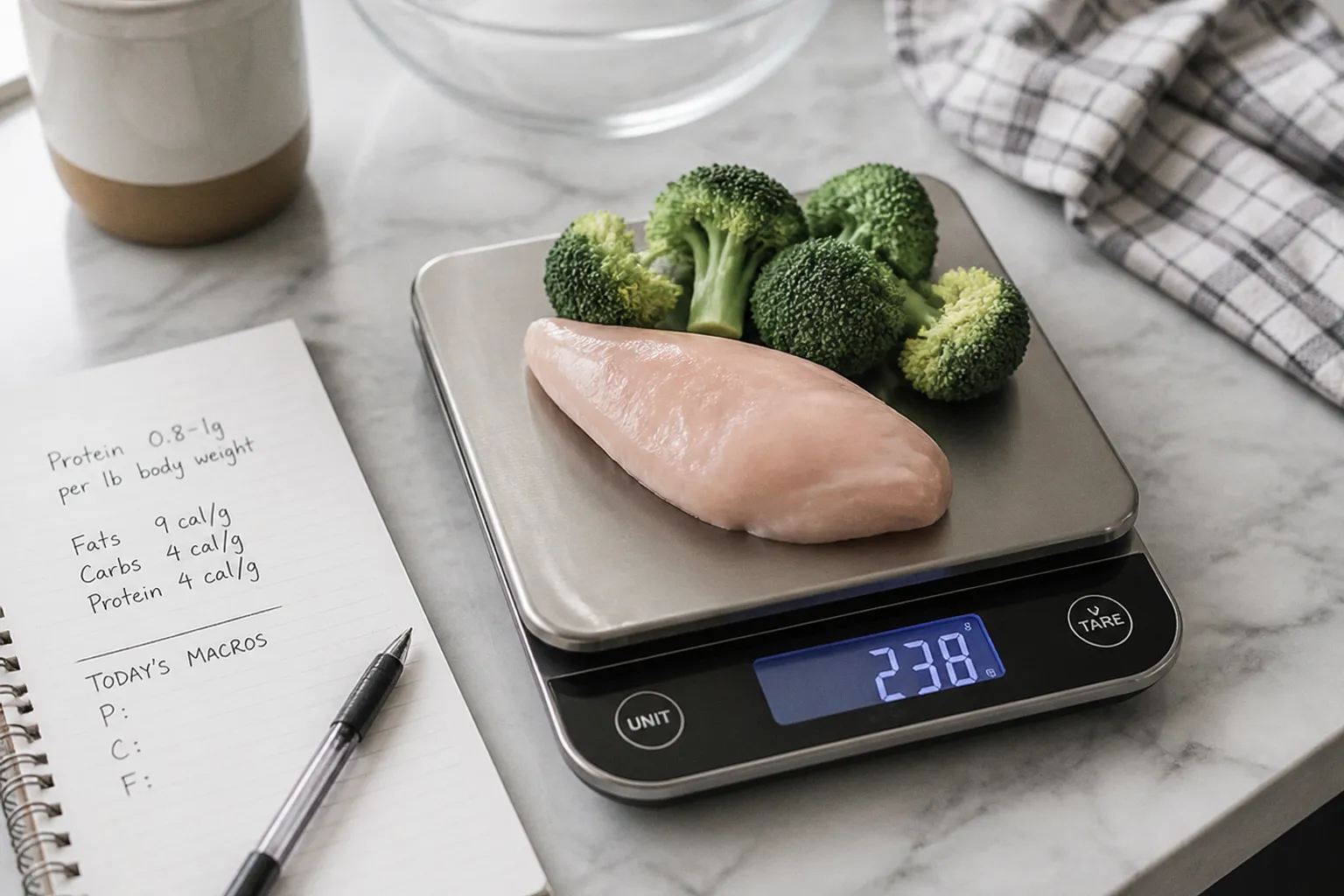
They tank it the moment they "eyeball" a chicken breast, scoop rice with a coffee mug, or skip calculating their actual energy needs and just copy some influencer's 40/30/30 split. The industry sells you the software and the hashtags. Nobody sells you the unsexy hardware and the baseline math that actually make tracking work.
This is the kit list and the calibration checklist I built after burning through two years of sloppy logging. Consider it the field manual for anyone who wants to stop guessing and start measuring. Every item below has earned its place on my counter or in my phone by saving me from another week of useless data.
A real scale and a verified app beat willpower every single day of the week.
The Scale: Your Only Non-Negotiable Piece of Hardware
Let's start with the tool that does 90% of the heavy lifting in macro tracking. It's not the app. It's not the spreadsheet. It's a digital kitchen food scale, and if you've been tracking without one, you've been running blindfolded through a room full of furniture.
A proper macro-tracking scale needs three things, and I'll skip the marketing fluff: gram precision, a tare function, and enough capacity to handle a full meal prep session. The standard precision tier is 1-gram increments, which is fine for tracking whole-food portions like chicken thighs, rice, potatoes, and oats. If you want to get genuinely useful fancy — and I mean useful, not Instagram fancy — look for a scale with 0.1-gram resolution. That extra decimal matters when you're measuring smaller items like cooking oils, nut butters, or supplements, where a 5-gram swing can dump an extra 45 calories into your day and quietly sabotage a deficit.
The tare function is the unsung hero. Press it after you place your bowl, and the scale zeroes out. Add your oats, read the weight, dump them in. Add your blueberries, read the weight, done. No mental subtraction, no spilling things onto a plate to weigh them separately, no guesswork. If your scale doesn't tare, it's a paperweight with a battery compartment.
Capacity matters more than people think. Most consumer kitchen scales top out around 11 pounds (5 kg), which sounds generous until you're weighing a full pot of meal prep rice on Sunday. If you batch cook, buy a scale rated for at least 15 pounds. I learned this the hard way after maxing out a cheap scale halfway through a chili recipe and having to weigh ingredients in two batches like some kind of nutritional accountant.
One more thing, and I cannot stress this enough: weigh your food raw whenever the recipe allows. A chicken breast loses a meaningful chunk of its weight during cooking as water evaporates — often 25% or more depending on the cut and method. If you only weigh the cooked portion, you're logging a different food than what you actually put in your mouth. Cooked weights can work if you always weigh the same food cooked the same way, but raw is the universal standard, and it's what every verified database entry uses.
Quick scale checklist
- 1-gram minimum precision (0.1g if you track oils and powders)
- Tare function, confirmed working
- At least 11 lb / 5 kg capacity (15+ lb if you batch cook)
- Flat, stable surface for accurate readings
- Fresh batteries or rechargeable — a dying scale gives drift readings that wreck your data
TDEE: The Number That Runs the Whole Show
Before you set a single macro target, you need to know how many calories your body actually burns in a day. This number is called your Total Daily Energy Expenditure, or TDEE, and it is the foundation everything else sits on. Skip this step and you're building a meal plan on vibes.
TDEE has four main components: your Basal Metabolic Rate (what you burn just existing), the thermic effect of food (calories burned digesting), your daily activity, and your exercise output. The most common and reasonably accurate starting formula for BMR is the Mifflin-St Jeor equation, which uses your weight, height, age, and sex to estimate resting calorie burn. It's not perfect — no formula is — but it's the best free baseline the industry has, and it beats the pants off a "calorie calculator" that just multiplies your weight by 14 and calls it science.
Once you have your BMR, you multiply it by an activity multiplier. Sedentary desk job, little movement outside the gym: 1.2. Lightly active, a few walks per day: 1.375. Moderately active, training 3-4 times a week: 1.55. Very active, hard training plus a physical job: 1.725. This gives you TDEE — the maintenance calorie number. From there, you subtract for fat loss, add for muscle gain, or hold steady for recomposition.
Here's where the skepticism earns its keep. Most online TDEE calculators ask for your body fat percentage. If you don't have a DEXA scan handy, your self-reported body fat is fiction. Mine was, and so is yours. Run the calculator without it, accept the ±10% margin of error, and then spend two to three weeks tracking your actual weight and calorie intake at the calculated maintenance number. If your weight holds steady, your TDEE estimate is solid. If you drop two pounds in a week, you're in a deficit. If you gain, you're in a surplus. The scale doesn't lie, even when your spreadsheet does.
The 4-9-4 Rule: Calorie Density You Actually Need
Now that you know your calorie budget, you need to understand what each macronutrient costs you in caloric terms. This isn't optional background noise. It's the engine that drives every macro split decision.
The math is brutally simple: protein carries 4 calories per gram, carbohydrates carry 4 calories per gram, and fat carries 9 calories per gram. Alcohol clocks in at 7 calories per gram, but since it's not a macro, we'll let it drink alone in the corner where it belongs.
Why does this matter? Because when you set macro targets in grams — which every serious tracking app does — you need to know how those grams convert to calories. A 150-gram protein target is 600 calories. A 70-gram fat target is 630 calories. A 200-gram carb target is 800 calories. Add them up, and you have your daily calorie total. If your protein, fat, and carb numbers don't reconcile to your TDEE goal within ±50 calories, something is misconfigured in your app, and you need to fix it before logging another meal.
The other thing this calorie-density math tells you is why fat is the macro people underestimate the most. A tablespoon of olive oil is roughly 14 grams and around 126 calories. That's nearly the same calorie hit as a hefty portion of chicken breast, but it looks like nothing on the plate. If you've been "eating clean" and stalling on fat loss, the oil bottle is usually the culprit. Weigh it. Always.
Choosing Your App: The Digital Ecosystem That Runs Your Day
The app question gets more attention than it deserves. People agonize over which tracker to download, install three of them, use none of them consistently, and conclude that macro tracking "doesn't work for them." The app doesn't matter as much as actually using it, but there are real differences between the major options.
Here's the honest breakdown based on what each platform actually delivers:
| Feature | MacroFactor | Cronometer | MyFitnessPal | MacrosFirst |
|---|---|---|---|---|
| Verified nutrition database | Strong, frequently updated | Gold standard, lab-verified entries | Largest library, but user-submitted errors creep in | Solid, curated database |
| Barcode scanner | Yes | Yes | Yes | Yes |
| Custom macro allocation | Advanced, algorithm-based adjustments | Manual but flexible | Basic presets | Simple, guided setup |
| TDEE / calorie auto-adjustment | Yes, weekly algorithm updates | No, manual | No, manual | No, manual |
| Cost model | Subscription | Free tier + premium | Free tier + premium | Free tier + premium |
| Best for | Lifters who want data-driven adjustments | Detail obsessives who want verified entries | Beginners who want a huge free database | Minimalists who want a clean interface |
The standout for serious trackers is MacroFactor because it adjusts your calorie and macro targets weekly based on your actual weight trend and logged intake. That's not magic. That's just good feedback loops. Cronometer is the choice if you care about database accuracy above all else — its nutrition entries are often pulled from verified lab data, which matters when you're logging a weird-cut steak from a restaurant that misreports macros. MyFitnessPal has the largest free database and the best barcode scanner in the business, but its user-submitted entries are riddled with errors. Cross-check anything suspicious. MacrosFirst is the underdog — simple, focused, and ideal if you don't want a social feed baked into your calorie tracker.
Whatever you pick, commit to it for at least eight weeks before switching. The data history matters more than the feature list, and bouncing between apps fragments your logs into useless pieces you can't compare week over week.
Protein: The Anchor That Holds Everything Else in Place
Of the three macros, protein is the one you set first and protect hardest. Carbs and fats will move around based on preference, training style, and performance, but protein is the anchor for muscle preservation, recovery, and satiety. Get this wrong, and the rest of your setup wobbles.
The standard recommendation for active people engaged in macro tracking is 0.7 to 1.0 grams of protein per pound of body weight daily. Converted to metric, that's roughly 1.6 to 2.2 grams per kilogram. A 180-pound lifter would target between 126 and 180 grams of protein per day. A 150-pound recreational athlete would target between 105 and 150 grams. Lean toward the higher end if you're in a calorie deficit, you train hard, or you're over 40 and fighting the anabolic resistance that comes with age.
Why this range? Below 0.7 grams per pound, the research shows diminishing returns on muscle protein synthesis and a higher risk of lean mass loss during a cut. Above 1.0 gram per pound, you're spending money on protein that your body is mostly oxidizing for energy rather than building tissue with. The exception is aggressive cuts, where pushing toward the upper end can help preserve muscle when calories are scarce.
Spread your protein intake across 3–5 meals per day, each containing roughly 25–40 grams, to keep muscle protein synthesis stimulated throughout the day. The old bodybuilding myth that your body can only absorb 30 grams of protein per meal has been thoroughly dismantled. Your gut absorbs it fine. The real question is whether your muscles use it efficiently, and the answer is yes — especially in the post-training window.
The Setup Checklist: Everything in One Pass
Here's the consolidated list. Print it, screenshot it, tattoo it on your forearm — whatever works. This is the macro tracking setup I run every time I onboard a new client or reset my own tracking after a break.
1. Digital kitchen scale purchased: 1g or 0.1g precision, tare function, 11+ lb capacity
2. Macro tracking app installed, account created, daily targets entered
3. TDEE calculated using Mifflin-St Jeor plus the appropriate activity multiplier
4. Two-week maintenance test planned to validate the TDEE estimate against real weigh-ins
5. Protein target set at 0.7–1.0 g per pound of body weight
6. Calorie density confirmed in your head: 4 kcal/g protein, 4 kcal/g carbs, 9 kcal/g fats
7. Macro targets reconciled to TDEE goal within ±50 calories
8. Raw vs. cooked weighing convention decided and applied consistently
9. Weigh-in routine established: same time, same conditions, same scale, same day each week
10. Barcode scanner tested with items from your regular grocery rotation
If you can check every box on that list, you're ahead of most of the people downloading macro apps this week. They'll skip the scale, guess at TDEE, copy someone's macro split from a Reddit thread, and wonder why their results stall in three weeks. You won't, because you read the manual first.
A dialed-in setup takes one weekend. A bad setup costs you months of useless logs.
The Verdict
Is macro tracking setup worth the effort? Yes, but only if you do the boring parts first. The hardware, the TDEE math, the protein anchor, the app commitment — these are the load-bearing walls. The clever macro splits and the carb cycling protocols are the paint color. Paint over a cracked foundation and the whole house leans.
Buy a real scale. Calculate your actual energy needs. Pick an app and stick with it for eight weeks. Hit your protein target every day, weigh your food raw, and let two weeks of weigh-ins tell you whether your TDEE math holds. That sequence is unsexy, unglamorous, and it works. Everything else is noise dressed up in a gym shirt.