Travel fitness gear: choosing the right kit for your luggage
Most travel workout kits fail before the flight takes off. Not because the equipment is useless, but because people pack too much of it, choose single-purpose gadgets, and then discover that their…
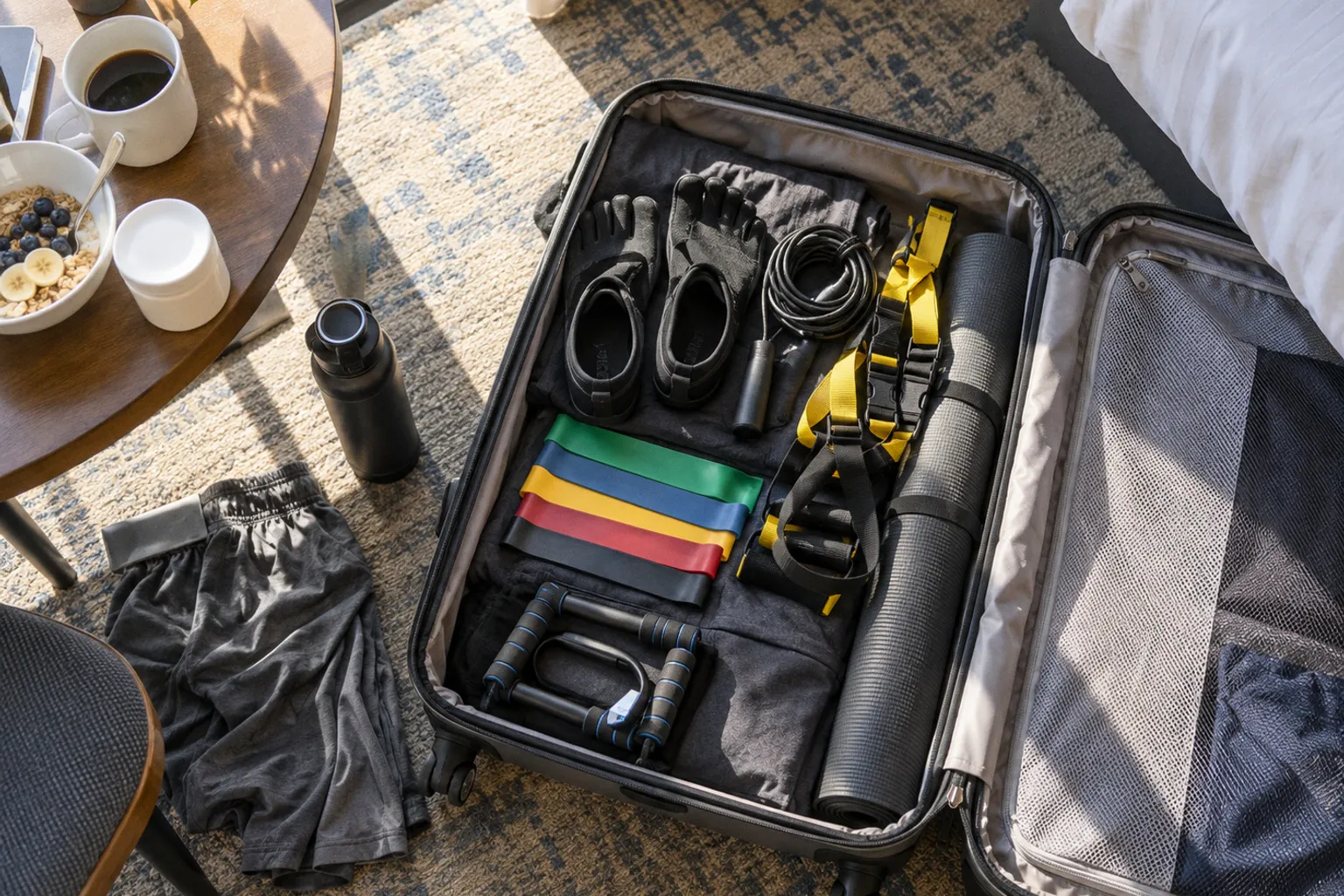
Most travel workout kits fail before the flight takes off. Not because the equipment is useless, but because people pack too much of it, choose single-purpose gadgets, and then discover that their hotel room has the floor space of a postage stamp and a door frame that looks one hard pull away from retirement.
The smarter approach is to pack travel fitness gear for small luggage around movement patterns rather than product categories. You need a way to create resistance, raise your heart rate, train the lower body, and recover without carrying a miniature commercial gym through airport security. That usually means a few compact tools with several jobs each—not a suitcase full of shiny fitness props.
I have made most of the predictable mistakes: bulky shoes, optimistic assumptions about hotel gyms, and equipment that looked clever online but became dead weight the moment it entered a carry-on. The useful kit is not the one with the most parts. It is the one that still gives you a workable session when the room is cramped, the schedule is wrecked, and the nearest dumbbell weighs approximately as much as a decorative candle.
The physics of portable resistance: bands versus suspension trainers
Resistance training is the hardest part of packing light because strength work usually depends on load. A barbell gives you load. Dumbbells give you load. A hotel towel gives you a surprising amount of lint and not much else.
For travel, the compromise is portable resistance. Resistance bands and suspension trainers earn their place because they are light, flexible, and capable of covering several major movement patterns without taking over your luggage.
Simple resistance bands are made from materials including latex, silicone, synthetic rubber, TPE, and fabric. That matters less than the marketing department would like you to believe, but it does affect how the band feels, stretches, and handles compression in a packed bag. Latex bands typically offer a familiar elastic feel and a wide range of resistance options. Fabric bands can feel more stable around the legs, particularly for glute work, while TPE and synthetic rubber options may suit people who want a different texture or latex-free construction.
The main benefit is versatility. A compact set can support:
- Squat and split-squat variations
- Romanian deadlift patterns
- Rows and rear-delt pulls
- Chest presses and fly variations
- Overhead presses
- Pallof presses and anti-rotation work
- Curls, triceps extensions, and lateral raises
- Warm-up and activation drills
That is a respectable menu from equipment that can lie flat between a laptop and a pair of socks.
The limitation is equally clear: bands do not behave like barbells. Resistance changes through the range of motion, and the hardest point may arrive near the end of the movement rather than where you expect it. They are excellent for maintaining training volume, adding challenge to bodyweight exercises, and creating meaningful resistance when you are away from a gym. They are not a magic replacement for heavy barbell strength work, especially if your goal depends on moving maximal loads.
Where suspension trainers fit
A suspension trainer gives you another kind of resistance: your bodyweight, adjusted through leverage and body position. The TRX suspension trainer system weighs about 2 pounds and uses 53-inch by 2-inch straps. It can anchor behind a door or around a suitable outdoor structure, assuming that structure is genuinely suitable and not merely convenient.
That last part is where the fantasy tends to meet the door hinge.
Suspension trainers are particularly useful for rows, assisted single-leg work, push-ups, hamstring curls, fallouts, and core exercises. You can make many movements easier or harder by changing your angle. The result is more adjustable than a fixed resistance band and often more engaging for the trunk and stabilizers.
But they demand an anchor. A band can travel with you and work around your body. A suspension trainer must connect to something that will not shift, tear, or send you into a bedside table. If the hotel room only offers a flimsy interior door with an uncertain latch, the trainer may be better used for exercises that do not require aggressive loading—or left in the bag.
The best portable resistance tool is not the one with the highest resistance rating. It is the one you can anchor, control, and use without negotiating with hotel maintenance.
Here is how I would think about the two options:
| Parameter | Resistance bands | Suspension trainer |
|---|---|---|
| Packing efficiency | Extremely compact and flat | Compact, but bulkier than a band set |
| Setup | Usually immediate; may need a door anchor | Requires a secure door or structural anchor |
| Best use | Full-body accessory work, activation, moderate resistance | Rows, assisted strength work, core, leverage-based training |
| Resistance style | Elastic resistance that changes through the movement | Bodyweight adjusted by angle and leverage |
| Main limitation | Harder to create heavy, stable loading | Dependent on safe anchor points |
| Best traveler | Anyone needing the smallest possible kit | Travelers willing to inspect their surroundings before training |
For most people, bands are the better first purchase. A suspension trainer becomes worthwhile when you already understand how to use it and regularly train in places with reliable anchor points. Buying both can make sense for longer trips, but only if you have a program that gives each tool a distinct job. Otherwise, you are packing duplicate solutions and calling it preparedness.
Cardio without the treadmill: jump ropes and travel shoes
Cardio equipment has a simple problem: machines are large, and your suitcase is not. The answer is usually a jump rope, walking, short interval circuits, or some combination of the three.
A jump rope at a moderate pace can burn roughly 10 to 16 calories per minute. That makes it efficient, but efficiency is not the same as universal suitability. Jumping rope is high-impact compared with walking, and your hotel floor may not appreciate repeated contact any more than your calves do.
A rope is a strong choice when:
- You have a suitable surface and enough overhead clearance.
- Your ankles, knees, and Achilles tendons tolerate repeated jumping.
- You want a short conditioning session with very little equipment.
- You can control your pace instead of turning every interval into a frantic audition for a boxing montage.
The rope itself should be simple. Handles that are comfortable and easy to grip matter more than app connectivity, Bluetooth counters, or a motivational phrase printed on the cable. If you need data, a watch can track time and heart rate without adding another electronic object to the bag.
The hotel-room reality
A standard hotel room may not give you enough safe clearance for a full jump-rope session. Low ceilings, light fixtures, beds, desks, and neighbors below all have opinions. If the surface is hard and unforgiving, use shorter intervals, reduce jump height, or switch to low-impact conditioning:
1. March quickly in place while driving the arms.
2. Use step-ups only if the surface is stable and intended for that purpose.
3. Perform alternating reverse lunges with controlled tempo.
4. Add fast bodyweight squats or squat-to-reach movements.
5. Use mountain climbers, bear crawls, or plank variations if the floor allows it.
6. Walk stairs or take a purposeful outdoor route when the setting is safe.
The point of portable cardio is to create a repeatable training option, not to force one tool into every room. A jump rope is excellent when the environment cooperates. It is not a moral obligation.
Do minimalist shoes actually save space?
Traditional training shoes can be one of the bulkiest items in a carry-on. Minimalist workout shoes, including models such as Vibram FiveFingers, weigh approximately 4 ounces, or 113 grams, and take up far less space than many conventional athletic shoes.
That is attractive for travel. It is also where people start making confident decisions about feet they have not prepared.
Minimalist shoes provide less structure and cushioning than standard training shoes. If you already use them comfortably, they can be a useful space-saving option for hotel-room strength work, mobility, and selected conditioning sessions. If you normally train in supportive shoes, switching abruptly because the minimalist pair fits beside your toiletry bag is not a clever progression. It is an invitation to make your calves and feet file a formal complaint.
Consider the surface and the session:
- Bodyweight strength: often manageable in minimalist footwear if you are accustomed to it.
- Jump rope: depends on your tolerance, surface, and technique.
- Long walks: individual preference and foot history matter more than packing theory.
- Heavy or high-volume lower-body work: do not change footwear and loading strategy at the same time.
- Wet or uneven outdoor terrain: minimalist shoes may not offer the protection or traction you need.
Footwear should support the training you can safely perform, not merely satisfy a luggage spreadsheet. If space is extremely limited, a pair that works for walking and light training may be more useful than a specialized gym shoe. But “minimalist” does not mean “universally appropriate,” despite what the product photography suggests.
Advanced strength training: door-mounted pull-up grips
Compact pull-up handles are appealing because they promise something bands cannot quite replicate: a more familiar vertical pulling pattern. The Jayflex CrossGrips, for example, weigh 4.3 pounds and measure 7 by 10 by 3 inches. They attach to door frames between 4.5 and 7.5 inches wide and 2 to 4 inches tall.
Those dimensions are not decorative trivia. They are the entire decision.
Door-mounted equipment is only useful when the door frame matches the equipment requirements and can tolerate the forces involved. A product page cannot inspect the construction of your hotel room. You have to do that part, preferably before hanging your body from it.
Check:
- The width and height of the door frame against the equipment specifications.
- Whether the frame is structurally integrated or merely decorative trim.
- Whether the door closes and latches securely.
- Whether the handles sit evenly and do not rock under light pressure.
- Whether the equipment contacts the frame in a way that could damage paint or trim.
- Whether you have enough clearance to move without hitting the wall, ceiling, or furniture.
- Whether the hotel permits this type of equipment.
Do not assume that every hotel door frame supports doorway pull-up attachments. It does not. Even when the dimensions appear correct, the frame may be weak, damaged, unusually shallow, or unsuitable for dynamic movement.
The weight-versus-use calculation
At 4.3 pounds, compact pull-up grips are not outrageously heavy. They are also not weightless. A band set, jump rope, and minimalist shoes can cover a large amount of training for less luggage punishment. The grips make sense when vertical pulling is a priority and you will use them often enough to justify their space.
They make less sense when you are packing them as a theoretical solution to a problem you rarely train. A four-pound piece of equipment that stays in the suitcase is still four pounds of equipment. The fact that it folds or looks compact does not make it useful by default.
If you bring door-mounted grips, build your program around them rather than treating them as a novelty:
- Use controlled pull-ups or chin-ups if you can perform them safely.
- Add slow eccentrics if full repetitions are limited.
- Pair pulling work with push-ups, split squats, and band exercises.
- Include isometric holds only when the setup remains stable.
- Avoid kipping, swinging, or explosive repetitions on an unfamiliar door frame.
- Stop immediately if the frame shifts, creaks, slips, or shows damage.
The goal is to train while traveling, not to test the load-bearing philosophy of a budget hotel.
Building a minimalist workout kit for hotel rooms
A useful kit should cover the major movement categories with as few objects as possible. I generally start by asking what cannot be replaced by bodyweight, walking, or a short circuit. That question removes a surprising amount of equipment.
For most trips, a compact kit can be built around:
- One set of long resistance bands with suitable resistance levels.
- One small loop band for warm-ups, lateral work, and lower-body accessories.
- A basic jump rope, if the surface and joints allow it.
- Minimalist shoes only if you already tolerate them.
- A lightweight door anchor, provided you understand the door limitations.
- A small towel for comfort, sweat, and improvised support.
- A watch or phone timer rather than a dedicated interval gadget.
A suspension trainer can replace several band exercises but takes more setup. Door-mounted pull-up grips can add meaningful vertical pulling but weigh more and depend heavily on the room. You are not choosing the best equipment in isolation. You are choosing the best combination under a weight, space, and infrastructure limit.
A practical packing hierarchy
When I am narrowing down a travel kit, I rank equipment in this order:
1. Versatility: Can it train several movement patterns?
2. Reliability: Will it work in an ordinary room, not an imaginary one?
3. Packability: Does it lie flat or fit into unused spaces?
4. Skill requirement: Can I use it effectively when tired or short on time?
5. Environmental dependence: Does it need a special anchor, surface, or ceiling height?
6. Durability: Can it survive being compressed, unpacked, and thrown into a bag repeatedly?
7. Replacement cost: If it disappears or breaks during travel, is the loss tolerable?
This hierarchy is less exciting than buying a “travel gym” bundle with fourteen attachments. It is also more likely to produce actual workouts.
The best compact fitness gear for travel usually has at least two jobs. A band can provide resistance, assist mobility, and serve as an activation tool. A jump rope can deliver conditioning and coordination work. A towel can support mobility and make a hard floor less unpleasant. A suspension trainer can provide rows, presses, core drills, and assisted leg exercises—but only if the anchor is sound.
The suitcase test
Before committing to a kit, lay everything out and ask four unfriendly questions:
- Can I train my whole body with this equipment and bodyweight?
- Can I use it in a room no larger than a typical hotel room?
- Can I complete a useful session in 20 to 30 minutes?
- Would I still pack it if the hotel gym were closed and the weather were terrible?
If the answer is no, the item may be a hobby rather than travel fitness gear.
Weight limits, storage, and the false economy of overpacking
Carry-on space is not just a volume problem. It is a friction problem. The more equipment you bring, the more often you have to unpack, reorganize, and carry it. At some point, your portable workout kit begins to compete with clothing, work equipment, and the basic requirements of being a person away from home.
Flat items are easier to place around the edges of a bag. Bands can fit beside a laptop compartment or inside a shoe. A jump rope can coil into a small gap. Shoes are awkward because they occupy fixed volume, even when they are lightweight. Pull-up grips are compact by gym-equipment standards but still behave like rigid objects that refuse to cooperate with soft luggage.
I would pack based on trip length and access rather than optimism:
For a short business trip
Choose bands, a small loop band, and a timer. Add a jump rope only if you know you will have a suitable place to use it. This is enough for full-body circuits, strength maintenance, and short conditioning sessions.
For a longer trip with uncertain gym access
Add a suspension trainer if you expect reliable doors, railings, or outdoor anchors. It gives you more options for rows, assisted work, and core training without taking up the space of free weights.
For a trip centered on training
Consider door-mounted pull-up grips if vertical pulling is a priority and your accommodations are predictable. They are not a casual add-on. Check the dimensions before packing and inspect every door frame before use.
For active sightseeing or walking-heavy travel
Prioritize footwear that can handle your daily movement. A tiny training tool is not a bargain if your shoes are miserable for the rest of the day. The best travel workout is the one that does not wreck your feet before the afternoon starts.
Pack for the workout you can repeat in a bad room, on a bad schedule, with limited patience. That is the workout your trip will actually get.
Safety and compatibility: the unglamorous part that saves your shoulders
Portable equipment creates a false sense of control. You bring the tool, so you assume the environment will cooperate. It will not. Hotel rooms are inconsistent, doors vary, floors can be slippery, and outdoor structures are not automatically exercise equipment just because a strap fits around them.
Bands also deserve inspection. Look for cuts, cracks, thinning, unusual discoloration, or areas that feel damaged. Do not position a band where it can snap toward your face or another person. Keep tension controlled, especially when using door anchors. A band under load stores energy; it does not care about your confidence.
With suspension trainers, test the anchor progressively. Apply light pressure before committing bodyweight. Check whether the door opens toward you or away from you, whether the anchor is positioned correctly, and whether the frame moves. Never rely on a vague assumption that the setup is probably fine.
With jump rope, look at the surface first. Concrete, rough asphalt, and hard tile may increase impact and accelerate wear on the rope. Low ceilings are a problem. Nearby lamps are another. If the room does not suit the rope, change the exercise rather than changing the ceiling.
For footwear, the main risk is sudden escalation. A lightweight shoe can feel liberating for ten minutes and punishing after several days of unaccustomed loading. Keep training volume familiar, especially with minimalist shoes and repeated jumping.
A short pre-session inspection takes less time than dealing with a strained calf, damaged door, or broken piece of equipment:
- Test the floor for slipping.
- Clear furniture and sharp edges.
- Inspect bands and straps.
- Confirm door and frame dimensions.
- Apply light load before full bodyweight.
- Keep repetitions controlled.
- Stop when equipment shifts or shows damage.
That is not excessive caution. It is basic wear-and-tear management for your body and your temporary surroundings.
My verdict: what is actually worth packing?
For most travelers, the strongest minimalist setup is a resistance-band kit, a small loop band, and a jump rope used selectively. It covers resistance, conditioning, mobility, and activation while taking very little space. Add minimalist shoes only if you already use them comfortably. They can save weight, but they are not a shortcut to suddenly having resilient feet.
A suspension trainer is the next logical upgrade for people who like bodyweight training and can reliably find secure anchors. It offers more exercise variety and better leverage control than bands alone, but its usefulness depends on the room. Bring it because you have a plan for using it, not because the straps look serious.
Door-mounted pull-up grips are a specialist choice. At 4.3 pounds and with strict frame requirements, they are harder to justify in a general travel kit. If pull-ups are central to your training and your accommodation is compatible, they can be worth the space. If not, bands and rows will handle the job with fewer structural negotiations.
The winning travel kit is not the most advanced, the most expensive, or the one with the largest number of attachments. It is the kit that survives limited luggage, awkward rooms, inconsistent schedules, and your own tendency to overestimate how motivated you will feel after a delayed flight.
Pack less. Choose tools with overlapping uses. Inspect the infrastructure. Train hard enough to maintain momentum, not so recklessly that the rest of the trip becomes a recovery project. That is how portable workout equipment earns its place in a carry-on.