Clean eating cookbooks: hidden time and budget traps
The hidden costs of clean eating cookbooks are rarely listed beside the recipes. The cover shows lean proteins, colorful produce, and controlled portions.
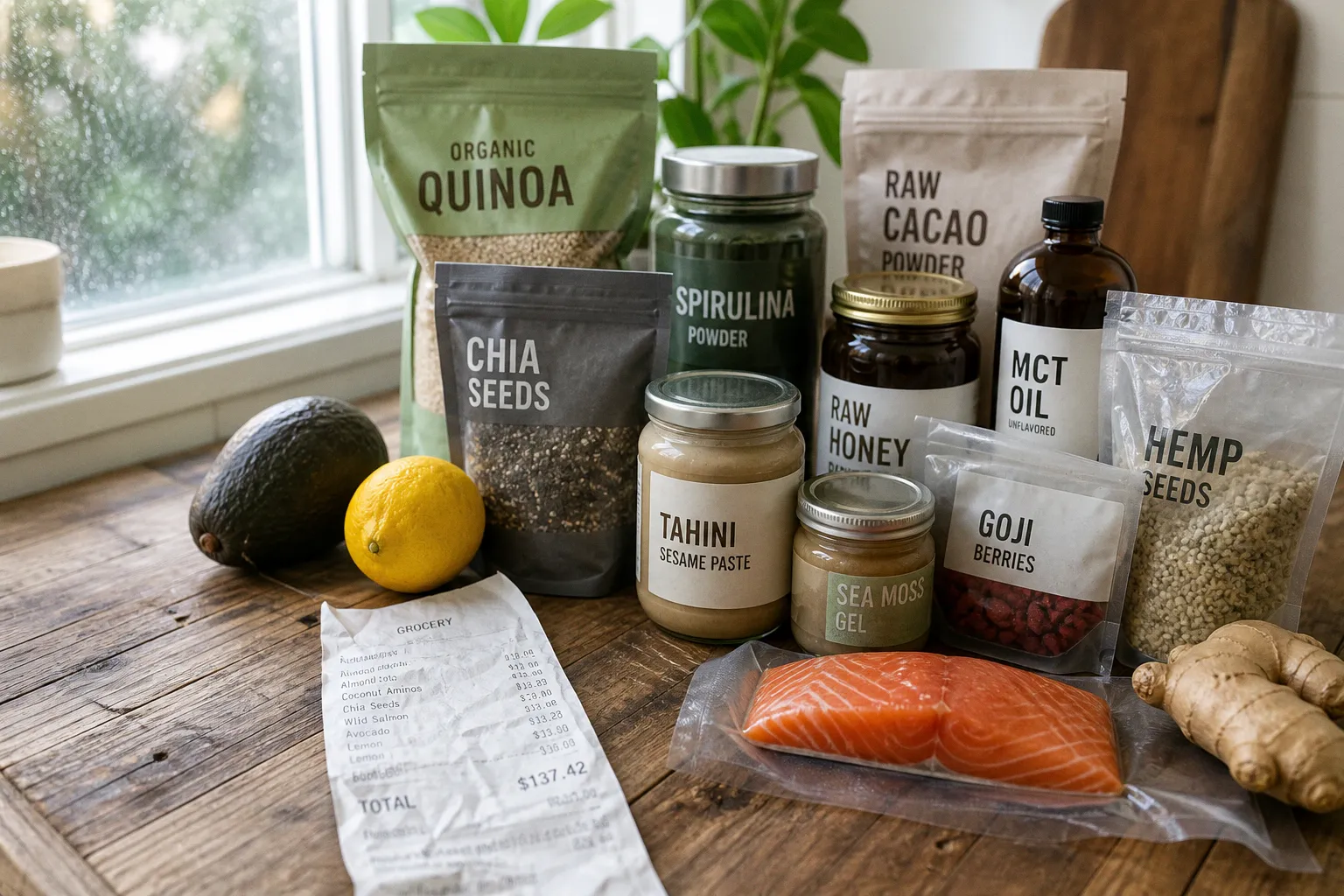
The shopping process reveals something else: specialty ingredients, equipment, preparation time, storage limits, and unused food.
A recipe can be nutritionally sound and still be operationally defective. If it requires three fresh herbs for one meal, a blender for a sauce, a separate container for every portion, and a second grocery trip for ingredients used once, the problem is not discipline. The system has poor resource control.
This matters for fitness nutrition. A meal plan must support training without creating excessive friction. Protein intake, carbohydrate availability, total energy intake, and recovery are biological variables. The cookbook is only a delivery mechanism. If that mechanism produces cost escalation and food waste, adherence declines before the nutrition plan has a chance to work.
The first trap: “clean” is not a budget category
Clean eating is not a standardized nutritional system. It usually implies minimally processed foods, a high intake of produce, identifiable protein sources, and reduced reliance on packaged meals. Those principles can support a strong diet. They do not automatically reduce grocery expenditure.
Many clean eating recipes replace ordinary pantry products with premium versions:
- organic produce instead of conventional produce;
- wild-caught seafood instead of standard frozen fish;
- seed-oil-free dressings and sauces;
- specialty spice blends;
- alternative flours;
- fermented products;
- nut-based spreads;
- unsweetened products with limited availability.
The substitution may be nutritionally neutral in the context of the whole diet. The price is not neutral. A cookbook can create the impression that every ingredient is mandatory because the recipe is presented as a finished composition rather than as a flexible template.
That is the first of the healthy recipe book pitfalls. The reader confuses the author’s preferred ingredient with a physiological requirement.
A chicken bowl does not become unsuitable because the recipe uses conventional rice. A yogurt sauce does not stop supporting protein intake because the herbs are not imported. The body responds to energy, amino acids, carbohydrate, fat, fiber, micronutrients, and total dietary pattern. It does not reward an expensive label.
A premium ingredient is not a nutritional mechanism. It is a purchasing choice unless the recipe identifies a specific functional reason for using it.
Where the grocery bill expands
The cost problem usually comes from accumulation, not one dramatic item. A single recipe may be affordable. A weekly structure built from recipes with low ingredient overlap is not.
Consider the difference between these two systems:
| Planning feature | Low-friction system | High-friction system |
|---|---|---|
| Protein sources | Repeated use of chicken, eggs, yogurt, beans, or frozen fish | Different protein for nearly every recipe |
| Produce | Seasonal and interchangeable vegetables | Exact fresh produce required for individual dishes |
| Sauces | One batch used across several meals | Separate specialty sauce for each recipe |
| Carbohydrates | Rice, potatoes, oats, pasta, or bread used repeatedly | Multiple grains and alternative flours |
| Shopping structure | One consolidated list with quantities | Individual recipe shopping with duplicate purchases |
| Storage | Meals designed for refrigeration or freezing | Delicate dishes with short usable windows |
| Equipment | Pan, pot, knife, sheet tray, scale | Blender, vacuum sealer, processor, specialty containers |
A clean eating cookbook becomes expensive when it optimizes recipe novelty instead of ingredient utilization. Novelty is useful for appetite management. It is not a substitute for logistics.
The same issue appears in high-protein meals. A book may show twelve different dinners, each with a distinct protein source and sauce. That looks varied. It also creates fragmented purchasing, more open packages, and more perishable leftovers. For a single person, this can produce a refrigerator full of partial ingredients rather than a controlled meal-prep cycle.
Equipment is part of the recipe, even when the cookbook hides it
Recipes often list food ingredients but omit the capital equipment required to produce them efficiently. That omission changes the real cost.
A standard kitchen can handle most useful fitness meals with a pan, pot, knife, cutting board, oven tray, food scale, and basic storage containers. The hidden expense begins when the cookbook treats specialized preparation as normal.
Common examples include:
- vacuum sealers for portion storage;
- high-end meal-prep containers;
- specialized blenders;
- food processors;
- spiralizers;
- air fryers;
- immersion blenders;
- multiple baking trays;
- silicone molds;
- digital scales with advanced tracking functions.
None of these tools is automatically wasteful. A blender can reduce sauce preparation time. A food scale can improve portion consistency. A freezer-safe container can prevent food loss. The error is assuming that equipment purchases improve the diet by themselves.
A budget hand blender may cost around $30. That can be a rational purchase if it replaces repeated manual preparation and is used several times per week. It becomes a trap when it is acquired for one sauce that appears once in a cookbook.
The same applies to vacuum sealing. It can extend storage flexibility and protect food quality, but it adds purchase cost, bags, cleaning, and another preparation step. If the meal plan already fits inside a normal three- or four-day refrigeration cycle, the device may solve a problem that does not exist.
Evaluate equipment by workload, not by aspiration
Use a simple calculation:
1. Identify the preparation step the tool changes.
2. Count how often that step occurs in the actual weekly plan.
3. Estimate the active minutes removed per use.
4. Compare those minutes with the purchase and maintenance burden.
5. Reject the tool if the cookbook is the only reason it appears necessary.
This is not anti-equipment. It is a workload analysis.
A kitchen tool earns its place when it reduces repeated friction across meals. It does not earn its place because a recipe photograph includes it.
Time is an ingredient
The most expensive component of many meal-prep cookbooks is active preparation time. It is often treated as free.
A recipe with twenty minutes of cooking may require:
- washing and cutting produce;
- opening multiple packages;
- preparing a marinade;
- making a sauce;
- cooking separate components;
- cooling food before storage;
- labeling portions;
- washing equipment;
- cleaning the work surface.
The published preparation time may refer only to the central cooking action. That is not the same as total kitchen time.
The distinction matters for training. A person who lifts after work may have adequate energy to cook one pan meal. The same person may not have the time or recovery capacity for a plan that requires several separate preparations each evening. The program then fails through scheduling, not motivation.
Global nutritional research has examined the hidden costs of preparing basic healthy meals across 168 countries. The relevant point is not a universal price label. Costs vary by location, income, food access, and household structure. The relevant point is that home preparation consumes labor and energy in addition to food expenditure. Any meal plan that ignores those inputs is incomplete.
Meal prep is not only a nutrition problem. It is a time-allocation problem with a refrigerator attached.
The batch-cooking error
Batch cooking reduces active work only when recipes share components. It does not reduce work when every dish is prepared as an isolated project.
A functional batch system might use:
- one protein batch;
- one carbohydrate batch;
- two vegetables with different textures;
- one sauce or seasoning profile;
- a small number of interchangeable meal combinations.
This creates variation through assembly. The cooking process remains stable.
A poorly designed meal-prep cookbook may instead prescribe five complete recipes. Each recipe has a separate sauce, separate garnish, separate cooking temperature, and separate storage requirement. The reader calls this meal prep because the food is prepared in advance. Mechanically, it is a restaurant production line operated by one person without restaurant labor.
The result is predictable:
1. More active minutes.
2. More utensils.
3. More cleaning.
4. More opportunities for overproduction.
5. More ingredients that expire before use.
6. Lower probability of repeating the process next week.
The book has not created a sustainable system. It has compressed several cooking sessions into one high-load session.
Food waste comes from poor ingredient overlap
Perishable ingredients create a timing constraint. Fresh produce, herbs, leafy greens, berries, opened dairy products, and prepared sauces do not all remain usable for the same period. A recipe collection that treats each dish independently can produce waste even when every recipe is reasonable.
The classic failure pattern looks like this:
- Recipe one uses a small amount of cilantro.
- Recipe two requires a different herb.
- Recipe three uses half an avocado.
- Recipe four requires a specialty vegetable.
- The remaining portions are not integrated into later meals.
- The reader buys replacement ingredients the following week.
This is not a failure of food quality. It is a failure of inventory design.
Cookbooks structured purely as individual recipes are especially vulnerable. Without integrated weekly shopping lists, batch frameworks, and storage instructions, the reader must perform the planning work manually. Most people do not calculate ingredient overlap, usable yield, or expiry timing while trying to follow a recipe after a workday.
A useful cookbook should tell you more than what to combine. It should show how the ingredients move through the week.
What ingredient overlap should look like
A practical meal plan does not require every meal to taste identical. It requires the raw materials to have multiple destinations.
Use the following structure:
- A large vegetable purchase appears in at least two cooked meals and one quick meal.
- A protein batch serves different formats rather than a single repeated plate.
- A sauce is used with bowls, wraps, vegetables, or grains.
- Delicate produce is scheduled early in the week.
- Frozen ingredients are used for later meals and reduce expiry pressure.
- Herbs and condiments are selected for cross-recipe use.
- Leftovers are assigned before the shopping trip.
The goal is not minimal variety. The goal is controlled variety.
A low-carb recipe collection can create the same problem through a different route. It may replace grains with several specialty vegetables, seed products, nut flours, and packaged substitutes. The carbohydrate reduction may be intentional, but the shopping system can still be inefficient. Low carbohydrate does not mean low cost, and “clean” does not mean low waste.
Nutrition quality must survive real scheduling
A recipe can contain high-quality ingredients and still be poorly matched to training. The main variable is not whether the food appears clean. It is whether the meal provides the required substrate at the required time.
For an active person, meal planning usually needs to account for:
- total daily protein;
- protein distribution across meals;
- carbohydrate availability around training;
- total energy intake;
- fiber and produce intake;
- hydration and sodium exposure;
- digestion speed before exercise;
- storage and reheating tolerance.
A post-workout meal does not need ceremonial ingredients. It needs a practical combination of protein and energy that the athlete can consume consistently. If the recipe requires an hour of preparation, it may be less useful than a simpler meal assembled in minutes.
This is where fitness recipe book traps become obvious. The visual identity of the food replaces the performance function of the food. A dish may photograph well, contain six colors, and still fail as a post-workout option because it is too low in energy, too slow to prepare, or difficult to digest before the next session.
Build substitutions around function
Substitutions should preserve the role of the ingredient.
| Recipe function | Original type | Practical substitutions |
|---|---|---|
| Main protein | Fresh chicken or fish | Eggs, Greek yogurt, tofu, beans, frozen fish, or another available protein |
| Main carbohydrate | Specialty grain | Rice, potatoes, oats, pasta, bread, or another tolerated staple |
| Sauce base | Premium seed-oil-free sauce | Yogurt, tomato, tahini, blended beans, or a simple oil-and-acid dressing |
| Vegetable volume | Exact named vegetable | Seasonal, frozen, or interchangeable vegetables |
| Texture | Nuts or seeds | Toasted oats, beans, seeds already in the pantry, or omitted garnish |
| Flavor | Specialty spice blend | Salt, acid, garlic, herbs, and standard spices |
The substitution is valid when it preserves the meal’s intended role. If the goal is protein, replace with a protein source. If the goal is carbohydrate availability, replace with a carbohydrate source. If the goal is texture, do not spend a disproportionate amount on a garnish that has no meaningful effect on the meal’s nutritional structure.
This is a mechanics-first approach to food. Preserve function. Remove unnecessary complexity.
How to audit a clean eating cookbook before buying it
The cover and recipe photographs provide little useful information. Audit the system.
1. Inspect the weekly architecture
Look for integrated shopping lists, quantities, batch instructions, storage guidance, and a method for using leftovers. If the book provides only individual recipes, expect to perform the logistics yourself.
A recipe collection is not a meal plan. The distinction is operational.
2. Count unique ingredients
Do not count only the number of recipes. Count the number of ingredients that appear once. A long list of single-use products predicts cost and waste more accurately than the number of pages.
Single-use ingredients are not always a problem. A specialty item becomes a problem when the book gives no second use for it.
3. Separate active time from passive time
Active time includes cutting, mixing, cooking, portioning, washing, and cleaning. Passive time includes oven or refrigeration time during which you can perform another task.
A plan with low listed preparation time can still have high active labor. This is one of the main causes of meal prep cookbook time waste.
4. Identify equipment assumptions
Mark every recipe that requires a blender, processor, air fryer, vacuum sealer, or other specialized device. Then determine whether the same device serves multiple meals.
One isolated equipment requirement should not control the design of an entire diet.
5. Check the storage model
The book should indicate whether meals can be refrigerated, frozen, reheated, or assembled later. A delicate meal that must be eaten immediately is not automatically bad. It is simply incompatible with a schedule that requires portability and advance preparation.
6. Test the substitution logic
A useful cookbook explains what can replace an ingredient and why. If the instructions treat every brand, produce type, and spice as fixed, the system is fragile.
Flexible recipes are not less precise. They are more robust under real food availability.
7. Calculate the cost of failure
The cost is not limited to food purchased. Include:
- equipment;
- storage containers;
- extra grocery trips;
- discarded produce;
- unused sauces and condiments;
- energy for cooking;
- active preparation time;
- meals purchased when the plan collapses.
The exact monthly increase cannot be determined from a cookbook alone. Household size, local prices, training schedule, storage capacity, and ingredient substitutions change the result. The correct approach is to model the plan before committing to it.
A more efficient protocol for using recipe books
Use the cookbook as a component library, not as a command structure.
Phase one: define the biological target
Set the daily structure before selecting recipes. Establish the number of meals, approximate protein distribution, carbohydrate placement around training, and the total preparation time available on training and non-training days.
Do not begin with photographs. Begin with constraints.
Phase two: select repeatable components
Choose a small number of proteins, carbohydrates, vegetables, and sauces that can cross multiple meals. Use fresh foods early in the cycle. Use frozen foods and shelf-stable items to absorb later demand.
The objective is not to eliminate variety. It is to make variety cheap to produce.
Phase three: run a single shopping audit
Create one list. Remove ingredients that appear once unless they are central to several meals. Replace premium products when the replacement preserves nutritional function. Check package sizes against actual weekly use.
Buying a large package of a perishable ingredient is not economical if half of it becomes waste.
Phase four: batch by movement pattern
In strength training, exercise selection is organized by joint action and movement pattern. Meal prep benefits from the same logic. Group tasks that use the same equipment and sequence:
- roast several portions together;
- cook one carbohydrate base while the oven is occupied;
- prepare one sauce while food cools;
- portion only after the full batch is complete.
This reduces transitions. Transitions consume time and create errors.
Phase five: reassess after one cycle
Track four variables:
- actual grocery spend;
- active preparation minutes;
- discarded food;
- meals that were not consumed as planned.
Do not judge the system by intention. Judge it by output.
If the meals meet nutritional requirements but preparation time is excessive, simplify the cooking process. If the meals are efficient but protein is inconsistent, adjust the component quantities. If waste is high, reduce recipe variety and improve ingredient overlap.
The protocol is strict because the constraints are real. A meal plan that fails under ordinary work and training conditions is not a sustainable nutrition strategy.
The practical bottom line
Clean eating cookbooks are not inherently expensive, and they are not inherently efficient. Their cost depends on architecture.
A book built around ordinary ingredients, repeatable components, substitution rules, integrated shopping lists, and realistic storage can reduce decision fatigue and support training. A book built around premium products, single-use ingredients, specialized equipment, and isolated recipes can increase grocery spending and active kitchen time without improving the nutritional result.
The hidden costs of clean eating cookbooks are therefore measurable. Count the ingredients. Count the transitions. Count the equipment. Count the food that reaches the bin. Then compare the nutritional output with a simpler system.
Use this implementation protocol:
1. Define the protein, energy, and training-time requirements.
2. Select recipes with high ingredient overlap.
3. Replace premium ingredients when they do not change physiological function.
4. Reject single-use equipment unless it removes repeated workload.
5. Batch components rather than complete dishes.
6. Schedule perishable foods by storage life.
7. Audit spend, time, and waste after one week.
8. Keep the recipes that produce consistent meals with minimal operational cost.
The best fitness recipe book is not the one with the most elaborate food. It is the one that delivers the required nutrients repeatedly, under the time and budget constraints of the person using it.
FAQ
Why does clean eating often lead to higher grocery bills?
How can I tell if a kitchen tool is a necessary investment?
What is the best way to reduce food waste when following a meal plan?
Is it okay to substitute ingredients in clean eating recipes?
How should I audit a cookbook before buying it?
More products
 Trimoryn
 Lulutox Detox Tea HCTCUSD34.95