Fitness meal delivery: hidden traps that waste your money
Fitness meal delivery services solve a real mechanical problem: food preparation creates friction between training and adherence. The service removes shopping, portioning, and cooking from the process. It does not remove cost.
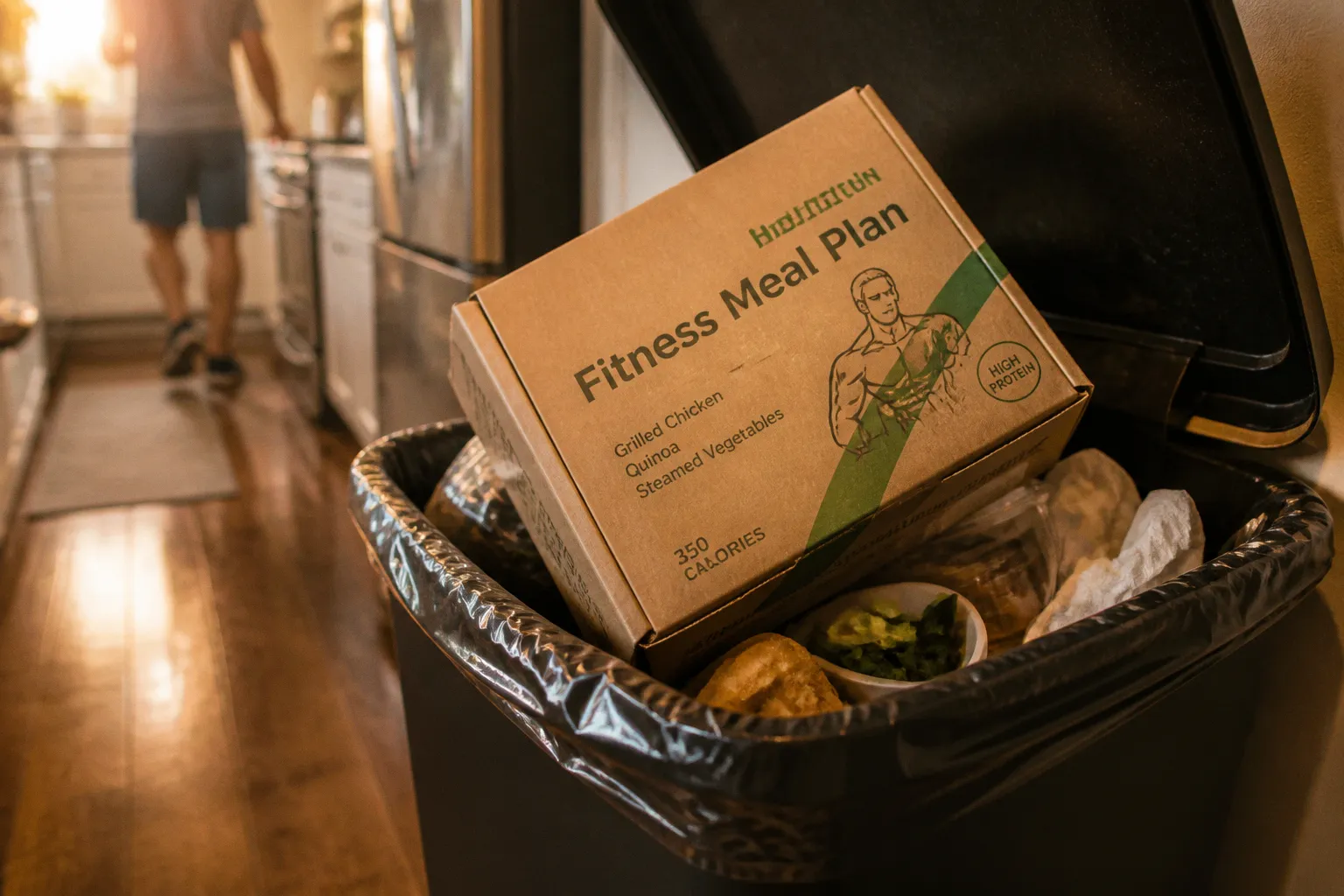
In many cases, it only relocates the cost into shipping, recurring billing, protein add-ons, and nutritionally dense sauces.
The relevant comparison is not the advertised box price. It is the delivered cost per meal that supplies the protein, calories, and carbohydrate distribution required by your plan. Average meal delivery pricing commonly falls between $6 and $12 per serving. Grocery shopping averages approximately $3 to $5 per serving. That gap can be justified by time savings. It cannot be justified by assuming every meal is automatically macro-complete.
Fitness meal delivery services have hidden costs because the visible price is often only one variable in the system. The final output depends on serving size, shipping, renewal terms, protein quantity, and the difference between the introductory offer and the regular subscription rate.
The useful unit is not the meal. It is the meal that reaches your macro target at its final delivered price.
The math behind the convenience: grocery versus delivery costs
A meal delivery subscription is usually presented as a price per serving. That number is incomplete until the box has been converted into a weekly and monthly expense.
A simple grocery meal may cost less because the raw ingredients can be purchased in larger quantities. Rice, oats, potatoes, beans, eggs, poultry, canned fish, and frozen vegetables have a lower unit cost when the buyer controls the package size and uses the remainder across multiple meals. A delivery service packages those same inputs into controlled portions, adds preparation, packaging, logistics, labor, and shipping, then distributes the cost across the serving price.
That convenience has a measurable premium.
| Cost variable | Grocery-based meal prep | Fitness meal delivery |
|---|---|---|
| Typical serving cost | About $3–$5 | About $6–$12 |
| Portion control | Determined by the buyer | Determined by the provider |
| Ingredient flexibility | High | Limited to the menu |
| Labor requirement | Shopping, weighing, cooking, storage | Lower preparation demand |
| Shipping cost | Usually absent | May apply per delivery |
| Protein adjustment | Easy to scale from bulk ingredients | May require add-ons or extra meals |
| Billing risk | No automatic renewal | Subscription may renew automatically |
| Waste exposure | Depends on planning and storage | Depends on minimum order and delivery schedule |
The comparison becomes more complex when food waste is included. Household food waste has been cited at roughly 30% on average, although the actual rate varies by household, shopping behavior, storage, and cooking frequency. A grocery plan that appears cheaper on paper may lose part of that advantage if ingredients expire before use. Conversely, a delivery subscription can create waste through minimum order requirements, unwanted meals, or portions that do not match the user’s intake.
This is why the question “Are healthy meal delivery kits worth it?” has no universal answer. The service is purchasing time and reducing decision load. The relevant question is whether the reduction in friction produces enough adherence to offset the price premium.
Calculate the delivered cost, not the promotional cost
Use the following calculation:
Total box cost + shipping + mandatory fees ÷ number of usable servings
The term usable serving matters. If a meal contains 18 grams of protein but your plan requires 30–40 grams at that sitting, the serving is not equivalent to a complete high-protein meal. It is a partial protein serving that may require an additional food purchase.
The advertised introductory price should also be excluded from long-term planning. Welcome discounts routinely reduce the first box while regular pricing begins afterward. Shipping charges may remain constant even when the number of meals increases. A larger order can therefore reduce the per-serving food price while leaving the delivery charge unchanged.
For a weekly plan, record four numbers:
- The regular food price after the introductory offer ends.
- The shipping charge applied to each delivery.
- The number of meals that will actually be eaten.
- The additional cost required to correct protein or calorie deficits.
Do not compare a discounted first box with ordinary grocery spending. Compare the renewal price with the recurring grocery budget.
Drip pricing and the true cost of subscription models
Drip pricing separates the purchase decision from the final price. The consumer sees the base box, selects meals, enters payment information, and encounters shipping or service charges later in the checkout path. The problem is not that every fee is illegitimate. The problem is that the cost architecture makes the initial number less useful.
Across food delivery platforms, unexpected charges have been reported at an average of $12.80 per order, with total spending approximately 21% higher than the initial displayed price under non-upfront fee structures. Those figures describe delivery platforms broadly, not every fitness meal subscription. They demonstrate the mechanism: a low headline price can have a poor relationship to the amount charged.
The same issue appears in meal prep service hidden fees. A subscription may contain:
- Per-delivery shipping.
- Service or handling charges.
- A minimum weekly order.
- A premium charge for selected meals.
- Additional cost for larger portions.
- Charges associated with skipping after a deadline.
- Automatic renewal at the standard rate.
- Add-on protein items that are not included in the base plan.
The final price should be visible before payment. If the service requires several screens of navigation to reveal it, the purchasing system is optimized for conversion rather than comparison.
Shipping changes the unit economics
Assume a delivery charge is applied once per box. That charge has a different effect on a four-meal order than on a twelve-meal order. The food itself may be priced on a per-serving basis, but shipping is a fixed cost attached to the delivery event. Ordering fewer meals increases the shipping burden per serving. Ordering more meals reduces that burden but creates storage and waste constraints.
This produces a trade-off:
- Small order: lower commitment, higher shipping cost per meal.
- Large order: lower shipping cost per meal, higher risk of unused portions and storage pressure.
- More frequent delivery: potentially fresher inventory, more recurring shipping events.
- Less frequent delivery: fewer shipping charges, greater demand on refrigeration and planning.
The correct choice depends on consumption rate. A theoretical per-serving saving is not a saving if the final meals remain uneaten.
Introductory offers distort the first decision
A welcome discount has one valid function: reducing the cost of a trial. It has no predictive value unless the regular rate is visible and acceptable.
Calculate the subscription under three conditions:
1. The introductory box.
2. The first standard-price renewal.
3. The normal monthly pattern, including shipping and protein corrections.
If the service is affordable only during the promotional period, it is not an affordable meal system. It is a temporary discount.
A subscription should be judged at renewal price, because that is where the habit becomes expensive.
Automatic renewal is another source of cost leakage. The risk is not limited to forgetting a cancellation date. Meal services often operate on a delivery schedule, so a skipped week may require action before a cutoff. Missing that window can create a box charge even when the user did not intend to receive food.
The practical response is procedural rather than emotional. Set a calendar reminder before the renewal deadline. Review the account after every plan change. Save the cancellation confirmation. Do not treat an email receipt as proof that the subscription has ended unless it explicitly confirms cancellation.
The protein gap: why budget meals require costly add-ons
Fitness meal delivery services are often purchased for macro control. Protein is the variable that exposes weak formulations quickly.
A meal can be low in calories and still be poor for a high-protein plan. It can contain vegetables, grains, and a sauce while supplying insufficient protein for the intended meal slot. Budget-focused services may reduce the amount of expensive protein in the portion to maintain a lower initial price. The result is a meal that appears complete but requires an additional protein source.
For fitness-focused customers, a practical standard is 30–40 grams of protein per meal. This is not a universal physiological requirement. It is a useful planning threshold for many high-protein meal structures. The exact target depends on total daily intake, body mass, training volume, meal frequency, and the distribution of protein across the day.
The cost problem appears when the menu is evaluated only by calories.
A 500-calorie meal with insufficient protein may require:
- Greek yogurt or cottage cheese.
- Eggs or egg whites.
- Canned tuna or another ready protein.
- A protein shake.
- Extra poultry, lean meat, tofu, or legumes.
- A second prepared meal.
Each correction changes the delivered cost. The box is no longer a $X meal in functional terms. It is a base meal plus the protein required to make it compatible with the plan.
Audit the label in this order
Do not begin with marketing labels such as clean, lean, balanced, or performance-focused. These terms do not define the macronutrient output.
Read the nutrition panel using this sequence:
1. Protein grams per serving. Confirm that the listed amount applies to the actual portion you will eat.
2. Serving size. Check whether the package contains one serving or more than one.
3. Calories from sauces and fats. A small protein portion can be obscured by calorie-dense dressings, oils, and creamy sauces.
4. Carbohydrate source. Identify whether the meal uses intact grains, potatoes, legumes, or refined carbohydrate products.
5. Sodium. High sodium does not automatically make a meal unusable, but it affects the suitability of repeated intake and should not be hidden by vague health claims.
6. Fiber. Low-fiber meals can create poor satiety despite adequate calories.
7. Actual portion mass. A large tray is not evidence of a large protein serving.
For a premade fitness meals comparison, protein density is more useful than the total calorie number. Calculate:
Protein grams ÷ calories × 100
This gives protein grams per 100 calories. It is not a complete measure of meal quality, but it reveals whether the meal is structurally protein-forward or primarily carbohydrate and fat with a small protein component.
Protein quantity must match meal function
A post-workout meal is not defined by a label on the package. It is defined by its position in the daily intake pattern and by what it contributes to recovery. If the meal is being used as the primary protein event after training, a low-protein portion may be inadequate. If it is being used alongside a separate shake or high-protein breakfast, the same meal may fit.
The error is not using a lower-protein meal. The error is paying for macro control while still having to perform the macro control manually.
A service that offers adjustable portions may justify a higher price if the adjustment reduces separate purchases. A service that sells low-protein meals and then monetizes protein add-ons may have a lower entry price but a higher functional cost.
Hidden nutritional trade-offs in pre-made fitness kits
Meal delivery removes cooking decisions. It does not guarantee nutritional quality. Prepared meal kits can contain high sodium, refined carbohydrates, or calorie-dense sauces used to improve flavor and stability. None of these components is automatically incompatible with body composition goals. The issue is repeated intake without verification.
A sauce can alter the energy balance of a meal without changing the visible volume. Oil, cream, sugar, and thickened dressings are compact sources of calories. A meal described as light can become materially different when the sauce is included in the listed portion. If the nutrition panel separates the sauce, the calculation must include both components.
High sodium also requires context. Sodium supports fluid balance and is not a defect by itself. However, a diet built around repeated prepared meals can produce a higher sodium load than expected, especially when meals include processed proteins, seasoning blends, and sauces. The label is the control point.
Refined carbohydrate is similarly context-dependent. A portion of white rice or pasta can fit a training diet. It becomes a problem when the meal displaces fiber-rich carbohydrate sources, produces poor satiety, or is combined with a sauce that adds calories without improving protein or micronutrient density.
The menu can be convenient and still be poorly matched
A service may offer a broad menu while providing limited control over the variables that determine whether the food supports the training plan.
Review the menu for:
- Repeated use of the same protein source.
- Low vegetable volume relative to total calories.
- Sauces that are included but difficult to measure.
- Meals with similar macro profiles despite different names.
- High reliance on refined starches.
- Large variation in protein grams between meals.
- Labels that use weekly averages instead of meal-specific information.
- Portion sizes that do not match the consumer’s training schedule.
The goal is not dietary purity. The goal is predictable input. A biological system responds to total energy, protein, carbohydrate, fat, fiber, sodium, and adherence. A meal service is useful when those inputs are sufficiently transparent to manage.
Meal kits versus prepared meals
Meal kits and prepared meals create different forms of friction.
Meal kits provide ingredients and instructions. They retain cooking time, but usually allow more control over oil, salt, portion size, and protein quantity. Prepared meals reduce labor further. They also place more of the formulation in the provider’s hands.
| Variable | Meal kits | Prepared fitness meals |
|---|---|---|
| Cooking labor | Present | Minimal or absent |
| Control over oil and salt | Higher | Lower |
| Portion adjustment | Easier during cooking | Limited after packaging |
| Storage demand | Raw ingredients | Refrigerated or frozen meals |
| Macro consistency | Depends on preparation | Depends on label accuracy and serving size |
| Protein correction | Easy to add during cooking | Usually requires a separate add-on |
| Waste pattern | Unused ingredients or leftovers | Uneaten packaged meals |
| Best use case | User can cook but needs planning support | User needs maximum reduction in preparation time |
Neither model is automatically superior. The correct model is the one that preserves adherence without creating a cost or nutrition problem larger than the original cooking burden.
Audit the subscription before it audits your budget
The subscription should be treated as a recurring system with defined inputs and failure points. Do not evaluate it as a single purchase.
Before starting, document:
- Standard price after the introductory offer.
- Shipping per delivery.
- Minimum number of meals.
- Delivery frequency.
- Deadline for skipping or changing a box.
- Cancellation method.
- Whether selected meals carry a premium.
- Cost of larger portions.
- Cost of protein add-ons.
- Storage requirements.
- Refund or replacement rules for delivery issues.
This is not administrative excess. It is the minimum information required to calculate the service’s actual cost.
Use a one-month audit protocol
For the first month, record each meal in a basic food log. Include the listed price, protein grams, calories, and any additional food required to complete the meal. At the end of the month, calculate:
Total subscription spending + correction foods ÷ meals actually eaten
Then compare that number with a grocery-based alternative that uses the same protein target and approximate calorie distribution.
The audit should answer five questions:
1. Did the service reduce preparation time enough to improve consistency?
2. Did the meals supply the intended protein without frequent add-ons?
3. Did shipping and fees alter the expected cost?
4. Did the menu create excessive sodium, refined carbohydrate, or sauce exposure?
5. Did the delivery schedule match actual consumption?
If the answer to the first question is no, the subscription has no operational advantage. If the answer to the second is no, it does not provide reliable macro control. If the answer to the third is yes, the pricing model needs to be recalculated. If the answer to the fourth is yes, the menu needs tighter selection. If the answer to the fifth is no, the plan is generating waste or forcing consumption.
Cancellation is part of the selection process
A service with a clear cancellation process is easier to manage than one that relies on hidden account navigation or narrow cutoff windows. Do not infer cancellation from pausing. Do not infer cancellation from removing meals from the next box. Confirm the account status.
The minimum protocol is:
1. Identify the renewal and delivery cutoff dates.
2. Set reminders before those dates.
3. Skip or cancel through the account interface.
4. Save the confirmation.
5. Check the next billing cycle.
6. Remove payment details only if the service permits it and cancellation has already been confirmed.
Do not claim that every meal delivery company uses deceptive billing. The terms differ. Read the specific subscription agreement. The risk exists whenever the displayed price, renewal price, shipping, and cancellation deadline are separated from one another.
A strict protocol for choosing fitness meal delivery
Use this sequence before committing to a recurring plan.
Step 1: Define the meal’s physiological job
Decide whether the meal is intended to be:
- A full high-protein meal.
- A post-workout meal.
- A lower-calorie meal paired with another protein source.
- A convenience meal for a high-friction day.
- A replacement for grocery shopping.
- A temporary bridge during a schedule disruption.
Without a defined function, every menu label becomes noise.
Step 2: Set the protein threshold
For a high-protein plan, screen meals against the intended 30–40 gram protein range. Meals below the threshold are not necessarily unusable. Price them with the required correction food included.
Step 3: Calculate the regular delivered price
Ignore the first-box discount. Add shipping and mandatory fees. Divide by meals that will actually be consumed, not meals that arrive.
Step 4: Inspect the nutritional structure
Review protein, serving size, calorie density, carbohydrates, fiber, sodium, and sauces. Select meals based on their label, not their name.
Step 5: Test the schedule
Start with a quantity that matches demonstrated consumption. Do not maximize the box to reduce shipping until storage, appetite, and waste are known.
Step 6: Install renewal controls
Record the renewal date and cancellation cutoff before placing the order. The subscription should never be allowed to run on autopilot.
Step 7: Recalculate after the first standard-price box
The first discounted shipment measures trial cost. The first regular shipment measures viability. Make the decision from the second number.
Fitness meal delivery services can be worth the premium when they remove a consistent barrier to eating enough protein and managing total intake. They are poor value when the service sells convenience but leaves the customer to solve portion size, protein gaps, shipping charges, and renewal terms independently.
The correct standard is simple: transparent final pricing, verified macro content, a meal schedule that matches consumption, and enough control to prevent add-ons from becoming routine. If those conditions are absent, grocery-based meal prep remains the lower-cost control system. If they are present, delivery can function as a useful adherence tool rather than an expensive collection of branded trays.
FAQ
How do I calculate the real cost of a meal delivery subscription?
Why do fitness meal services often require extra protein purchases?
Are fitness meal delivery services cheaper than grocery shopping?
How can I avoid hidden costs in meal delivery subscriptions?
What should I look for on a nutrition label when choosing fitness meals?
More products
 FitSpressoUSD59
 SodaSlimUSD79