Healthy meal delivery services: hidden budget and nutrition traps
A fitness meal delivery service can reduce cooking time while increasing the cost of every completed meal. The advertised price is rarely the relevant number. Introductory discounts expire. Shipping appears separately. Portions may be smaller than expected.
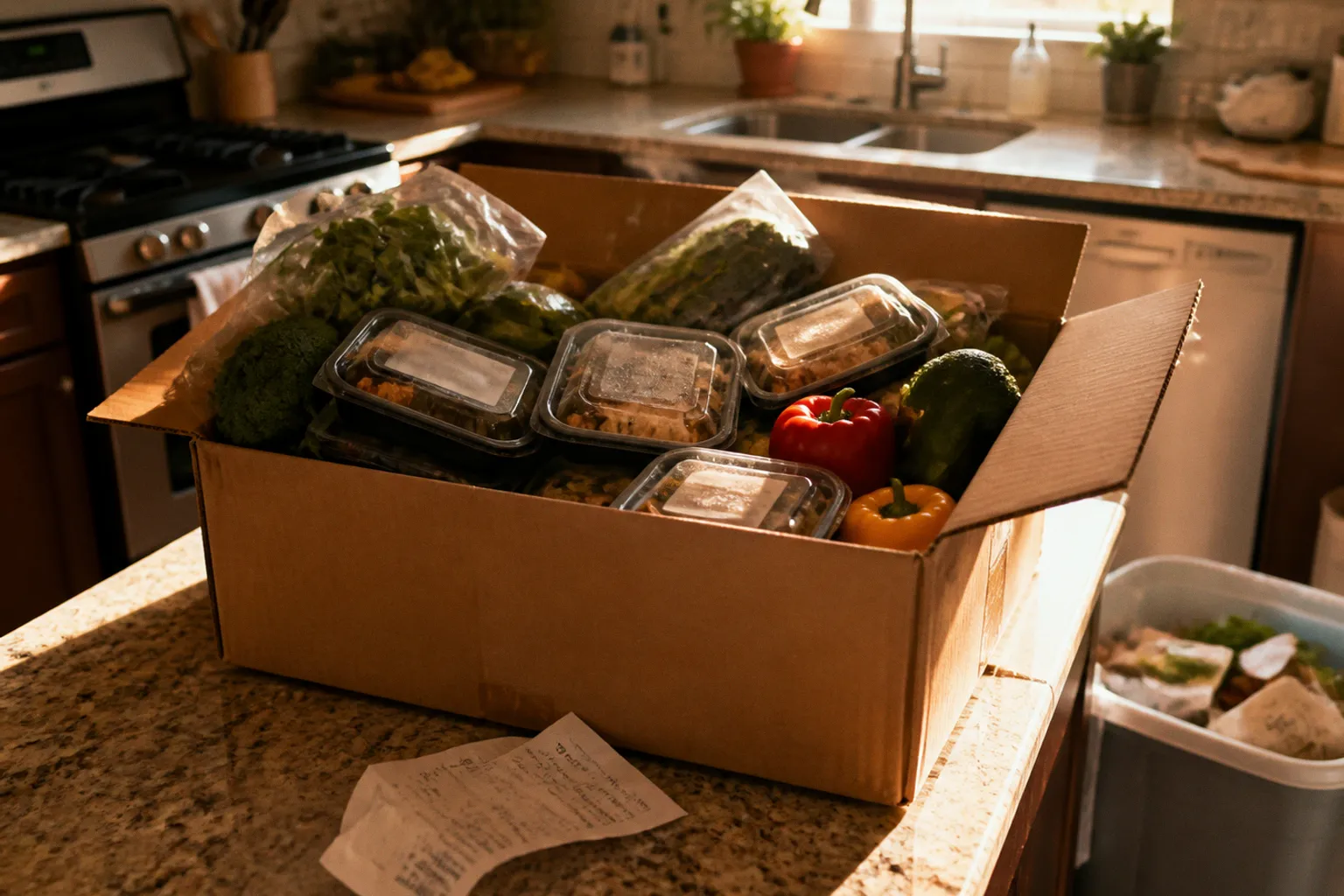
Sodium can exceed the level implied by the product’s branding.
The correct analysis is mechanical: calculate the cost of the meal you actually receive, then compare its protein, energy, sodium, and portion size with a grocery-based alternative. A delivery service is not automatically expensive, and a home-cooked meal is not automatically efficient. Food waste and labor time alter the result.
The listed meal price is an input. The delivered, nutritionally usable portion is the output.
The true cost of convenience: beyond the introductory offer
Fitness meal delivery pricing is designed around the first transaction. The initial box may carry a discount of up to 50%. That price establishes the buying decision, but it does not establish the cost of the subscription.
The recurring charge normally returns to the standard rate. Shipping may be added to each order. Some services also reduce the per-meal price only when the order reaches a specific volume. A smaller order can carry a higher effective unit cost even when the menu price appears unchanged.
Prepared meal delivery services commonly fall in the range of $6 to $12 per serving. Traditional grocery shopping can produce a meal for roughly $3 to $5 per serving, before accounting for labor and waste. In the UK, mainstream fitness meal preparation services generally charge about £6.95 to £8.00 per meal, while highly customized daily plans can reach £11 to £20 or more per day.
These ranges do not describe equivalent products. A grocery-based meal may require purchasing raw ingredients, cooking, portioning, storing, and cleaning equipment. A delivered meal may include preparation labor, packaging, menu rotation, and logistics. The comparison must therefore use a complete meal rather than a raw ingredient price.
Calculate the recurring unit price
Use the recurring invoice, not the welcome offer.
A practical calculation is:
Total recurring charge ÷ number of complete meals delivered = real price per meal
Include:
- The full subscription charge after the introductory period.
- Shipping and delivery fees.
- Required minimum order quantities.
- Add-ons needed to make the meal complete.
- Any meals that cannot be eaten because of schedule, storage, or dietary restrictions.
- The usable protein portion, not only the package count.
A box marketed as ten meals may not function as ten meals for your training schedule. If two meals contain too little protein to serve as a main meal, the effective cost of the meals that meet your requirements rises.
This is where many fitness meal delivery reviews become unhelpful. They compare menu price, package appearance, and flavor. Those variables do not determine economic value. The relevant variables are recurring price, edible portion, nutritional density, and utilization rate.
Meal kits and prepared meals have different cost structures
A prepared meal arrives cooked or nearly ready to eat. A meal kit arrives with ingredients and instructions. The kit may have a lower listed price, but it preserves the labor component: preparation, cooking, and cleanup.
The distinction matters when comparing options.
| Parameter | Prepared fitness meal | Meal kit | Grocery-based meal |
|---|---|---|---|
| Cooking time | Low | Moderate | Moderate to high |
| Portion control | Usually fixed | Ingredient-dependent | Controlled by the buyer |
| Macro precision | Depends on label accuracy and serving size | Requires weighing or recipe calculation | Requires weighing or calculation |
| Food waste | Lower when portions match intake | Moderate | Variable |
| Shipping exposure | Direct | Direct | Usually none |
| Menu flexibility | Limited by the menu | Moderate | High |
| Primary cost risk | Recurring fees and small portions | Labor plus shipping | Waste and unused ingredients |
A prepared service solves a time problem. It does not solve every nutrition problem. A meal can be convenient and still have a poor protein-to-calorie ratio. It can also fit a calorie target while creating excessive sodium intake across the day.
Quantifying the grocery gap: waste and time as hidden expenses
The lower sticker price of groceries is not the same as the lower completed-meal cost. Raw food becomes a financial loss when it remains unused, spoils, or requires purchases that exceed the recipe’s actual needs.
USDA data cited by Daily Harvest estimates that American households waste roughly 30% of purchased food. The Natural Resources Defense Council has reported that food waste costs the average American family approximately $1,500 per year.
Those figures do not mean every household wastes the same amount. They establish the direction of the calculation: grocery price alone can overstate the efficiency of home cooking.
A grocery-based fitness meal usually contains more than the measured amount consumed. You may buy a full package of meat, a larger bag of vegetables, or a container of a sauce used once. If the remaining food is not incorporated into the next meal, its cost belongs in the first meal’s accounting.
Time is a cost, but not a fixed one
The labor cost of cooking depends on the individual’s schedule and behavior. A person who batch-cooks twice per week has a different cost structure from a person who prepares one meal at a time. The second person spends more time on repeated setup and cleanup.
Meal delivery creates a different workload:
- Selecting meals and modifying the subscription.
- Receiving and storing the package.
- Checking use-by dates.
- Recycling or disposing of packaging.
- Reheating and managing portions.
- Canceling or pausing before the next billing cycle.
Do not describe delivery as labor-free. It shifts labor from cooking to administration and logistics. The shift can still be favorable if the service prevents missed meals, unplanned restaurant purchases, or repeated grocery waste.
The correct question is not simply whether healthy meal deliveries are worth the price. The question is whether the service produces more usable meals per unit of money and time than the alternative available in your week.
Portion size changes the comparison
A delivered meal listed at $8 may look efficient until the actual portion is compared with your intake requirement. If the meal contains a modest amount of protein and does not satisfy the energy demand of a main meal, you may add yogurt, fruit, a shake, bread, or another side. The added food belongs in the total cost.
Use a complete-meal calculation:
1. Record the delivery price after the introductory period.
2. Add shipping and mandatory fees.
3. Divide by the number of meals that match your schedule.
4. Add the cost of supplementary foods needed to reach the target portion.
5. Remove meals that expire unused.
6. Compare the result with the cost of a grocery meal containing the same protein and energy range.
This approach eliminates the most common meal delivery service budget traps. It also prevents the opposite error: assuming that every grocery meal costs only the value of the raw ingredients listed in a recipe.
Nutritional red flags: why healthy labels require scrutiny
The word healthy is not a macro target. It does not specify protein quantity, energy density, fiber, or sodium. A meal can use lean meat and vegetables while still failing to support a specific training objective.
The label must carry the analysis.
For a high-protein meal delivery comparison, evaluate at least these variables:
- Total protein per complete meal.
- Total energy per serving.
- Carbohydrate quantity relative to the training session.
- Fat quantity and the main fat sources.
- Fiber content.
- Sodium per serving.
- Serving weight.
- Whether the listed values describe the entire meal or only one component.
Protein quantity is not enough. A meal containing substantial protein can still be poorly matched to a post-workout requirement if its total energy is too low. The opposite also occurs: a meal can provide adequate calories while contributing little protein relative to the total energy.
Sodium is the common hidden variable
Dietitians recommend selecting meal kit options with 500 mg or less of sodium per serving to reduce hidden sodium consumption. That threshold is useful because sodium accumulates across the day. A single packaged meal may not appear excessive in isolation, but the total rises when combined with sauces, snacks, restaurant food, and processed protein products.
The main sodium sources are often not the meat or vegetables. They are:
- Prepared sauces.
- Seasoning blends.
- Broths and stocks.
- Cured or smoked proteins.
- Cheese.
- Packaged grains or side dishes.
- Preservation systems used for refrigerated meals.
A meal marketed for fitness can therefore be high in sodium without being high in calories. The label requires direct inspection. Do not infer nutritional quality from terms such as clean, balanced, fresh, or chef-prepared.
Serving size can distort the label
A label is only useful when the serving corresponds to the package you consume. Some products define one tray as one serving. Others separate the meal into components or use serving weights that do not reflect the full container.
Check the relationship between:
- Net package weight.
- Declared serving size.
- Number of servings per container.
- Protein per serving.
- Protein per dollar.
- Protein per 100 calories, when comparing different meal formats.
The last measure is not a universal ranking system. It is a diagnostic. A very low protein-per-calorie ratio may be incompatible with a high-protein plan. A very high ratio may indicate that the meal is too small to function as a complete post-workout meal.
A label can be accurate and still be unsuitable. Accuracy describes the package. Suitability describes the biological task.
Post-workout nutrition is a timing and composition problem
A post-workout meal needs to fit the next training demand, not merely follow a marketing category. The relevant variables are available protein, total energy, carbohydrate intake, and the time until the next substantial meal.
A small prepared meal may work as an interim meal. It may not work as the only recovery meal after a high-volume session. This is a portion problem, not a brand problem.
Build the meal around the required output:
- Use the delivered protein as the anchor.
- Add carbohydrate when the next training session or total daily intake requires it.
- Add produce or a fiber source if the meal is deficient.
- Avoid adding high-sodium sauces automatically.
- Recalculate the full meal rather than treating additions as nutritionally invisible.
This preserves the convenience of delivery while correcting its fixed-portion limitations.
Strategic subscription management: preventing recurring overruns
Subscription billing creates a behavioral error: the user evaluates the first box and forgets the renewal mechanism. The service continues charging even when the schedule changes, travel interrupts consumption, or the menu becomes repetitive.
A subscription is a recurring system. Manage it as one.
Before placing an order, document:
- The standard recurring price.
- The promotional price and its expiration.
- Shipping and delivery fees.
- The billing date.
- The number of meals in each shipment.
- The cancellation deadline.
- The pause function and its limits.
- The storage life of the meals.
- Whether skipped weeks alter the price per meal.
Do not rely on memory. A discount that ends after the first box is not part of the long-term cost. It is an acquisition incentive.
Match order volume to biological and logistical demand
Ordering more meals usually improves the listed unit price. It also increases the risk of unused food. A lower price per meal is not a saving if the meal expires before consumption.
Match volume to:
- Training frequency.
- Days spent away from home.
- Available refrigerator and freezer space.
- Number of meals already supplied by work, family, or restaurants.
- Your tolerance for repeated menus.
- The number of meals that can be consumed before the use-by date.
A service becomes inefficient when it supplies more meals than your schedule can absorb. This is especially common when the subscription is sized for a theoretical training week rather than the actual week.
Use a pause protocol
The safest subscription pattern is active management before each billing cycle.
1. Review the upcoming shipment several days before the billing date.
2. Count meals remaining from the previous delivery.
3. Check travel, work, and training changes.
4. Compare the remaining meals with the next shipment.
5. Pause or reduce the order when inventory exceeds realistic use.
6. Confirm the change in the account rather than assuming it was saved.
7. Recalculate the next shipment’s unit price after any volume change.
This is not administrative detail. It is cost control. Promotional pricing and automatic renewal are the two mechanisms most likely to distort the apparent value of the service.
Calculating the real return on investment
A fitness meal delivery service has value when it improves adherence to a nutrition plan at a lower total cost than the alternatives you actually use. The comparison is not between a delivered tray and an idealized home-cooked meal. It is between a delivered tray and your real behavior under time pressure.
Use three outputs:
1. Financial output
Calculate the full cost of each meal after shipping and recurring pricing. Then account for waste and additions.
A delivery service may be financially rational when it replaces:
- Unused grocery purchases.
- Repeated restaurant meals.
- Emergency convenience food.
- Extra shopping trips.
- Large ingredient packages that do not fit your intake.
It may be financially weak when you already batch-cook efficiently, use nearly all groceries, and do not require portion control.
2. Nutritional output
Evaluate whether the meal provides the required protein, energy, and sodium profile. A low-priced meal that requires multiple additions may be less efficient than a more expensive meal with a complete composition.
For a high-protein plan, compare protein per complete meal and protein per dollar. For a lower-carbohydrate plan, inspect sauces, grains, and side portions rather than relying on the menu title. For weight loss, assess satiety-related volume, fiber, and total energy rather than selecting the lowest calorie tray by default.
3. Adherence output
The service must reduce friction without creating new errors. It should make the planned meal easier to execute than the unplanned alternative.
Adherence improves when:
- The meal is available at the correct time.
- The portion matches the intended intake.
- The label is detailed enough to support tracking.
- The storage process is practical.
- The menu contains foods you will consume consistently.
- The subscription can be adjusted before surplus accumulates.
Adherence worsens when the meals are too small, too repetitive, too salty, difficult to store, or expensive after the discount ends.
The service is a tool, not a nutritional identity
Meal delivery should not replace basic food management. It can supply a controlled component of the diet. It cannot decide whether your total daily protein is adequate, whether energy intake matches training demand, or whether sodium has accumulated across the rest of the day.
Use it selectively:
- Prepared meals for high-friction weekdays.
- Grocery-based meals when time and storage allow batch cooking.
- Simple protein and produce combinations for low-complexity meals.
- Delivery only on days where its labor substitution has measurable value.
This hybrid structure often produces a better result than a full subscription. The service handles the meals most likely to fail. The kitchen handles the meals that remain inexpensive and simple to prepare.
The implementation protocol
Apply this sequence before committing to a fitness meal delivery service:
1. Record the recurring price. Ignore the introductory discount during the long-term calculation.
2. Add every mandatory fee. Shipping belongs in the meal cost.
3. Inspect the complete nutrition label. Record protein, calories, serving weight, fiber, and sodium.
4. Set a sodium screen. Use 500 mg per serving as a practical selection threshold when comparing options.
5. Measure portion adequacy. Identify any extra foods required to make the meal function as planned.
6. Calculate usable meals. Remove meals that will expire, be skipped, or remain uneaten.
7. Compare against actual groceries. Include waste, supplementary ingredients, and the labor pattern you will realistically use.
8. Test one normal billing cycle. Judge recurring economics, not the first-box promotion.
9. Review the subscription before renewal. Pause or reduce volume when inventory exceeds demand.
10. Retain only the meals that solve a defined problem. Time, portion control, tracking, or adherence must improve.
The most reliable meal delivery service is not the one with the largest discount or the most aggressive fitness branding. It is the one that produces a complete meal at a predictable recurring cost, with a label that supports the required intake and a portion that matches the biological task.
Calculate the output. Then decide whether convenience has earned its price.
FAQ
How do I calculate the actual cost per meal for a delivery service?
Why is the introductory discount misleading?
What is a safe sodium limit for fitness meal delivery services?
How does food waste affect the cost of grocery-based meals?
Is a meal kit cheaper than a prepared meal service?
More products
 SodaSlimUSD79
 Matcha SuriUSD49