Macro tracking mistakes: essential checks before you start
You can scan every barcode in the kitchen, log your chicken and rice, and still end up with a week of numbers that do not explain what is happening to your body. The problem is usually not that your metabolism has suddenly stopped responding.
More often, the log is built on inconsistent measurements, incomplete entries, or targets that were never as precise as they looked.
Macro tracking for beginners is less like solving a perfect math problem and more like setting up a reliable measuring system. The app can add the numbers you give it, but it cannot tell whether the rice was weighed dry or cooked, whether the oil made it into the pan, or whether your “tablespoon” of peanut butter was actually closer to two.
This is not an argument for obsessive perfection. It is a way to identify the mistakes that create the biggest gaps between the food you think you logged and the food you actually ate. Fix those inputs, and your data becomes much more useful.
The Hidden Cost of Eyeballing Portions
When beginners describe how they measure food, the answer is often some version of “by eye.” A handful of almonds. A chicken breast roughly the size of a deck of cards. A scoop of peanut butter that looks like a tablespoon. A serving of cereal poured directly into the bowl.
None of these choices feels reckless in the moment. That is why they are so easy to repeat. The issue is that visual estimates are poor at distinguishing between portions that look similar but contain meaningfully different amounts of food. The difference between a small handful of nuts and a generous handful may be difficult to see, but the difference in fat and calories can be substantial. The same applies to cooking fats, cheese, pasta, rice, granola, and spreads.
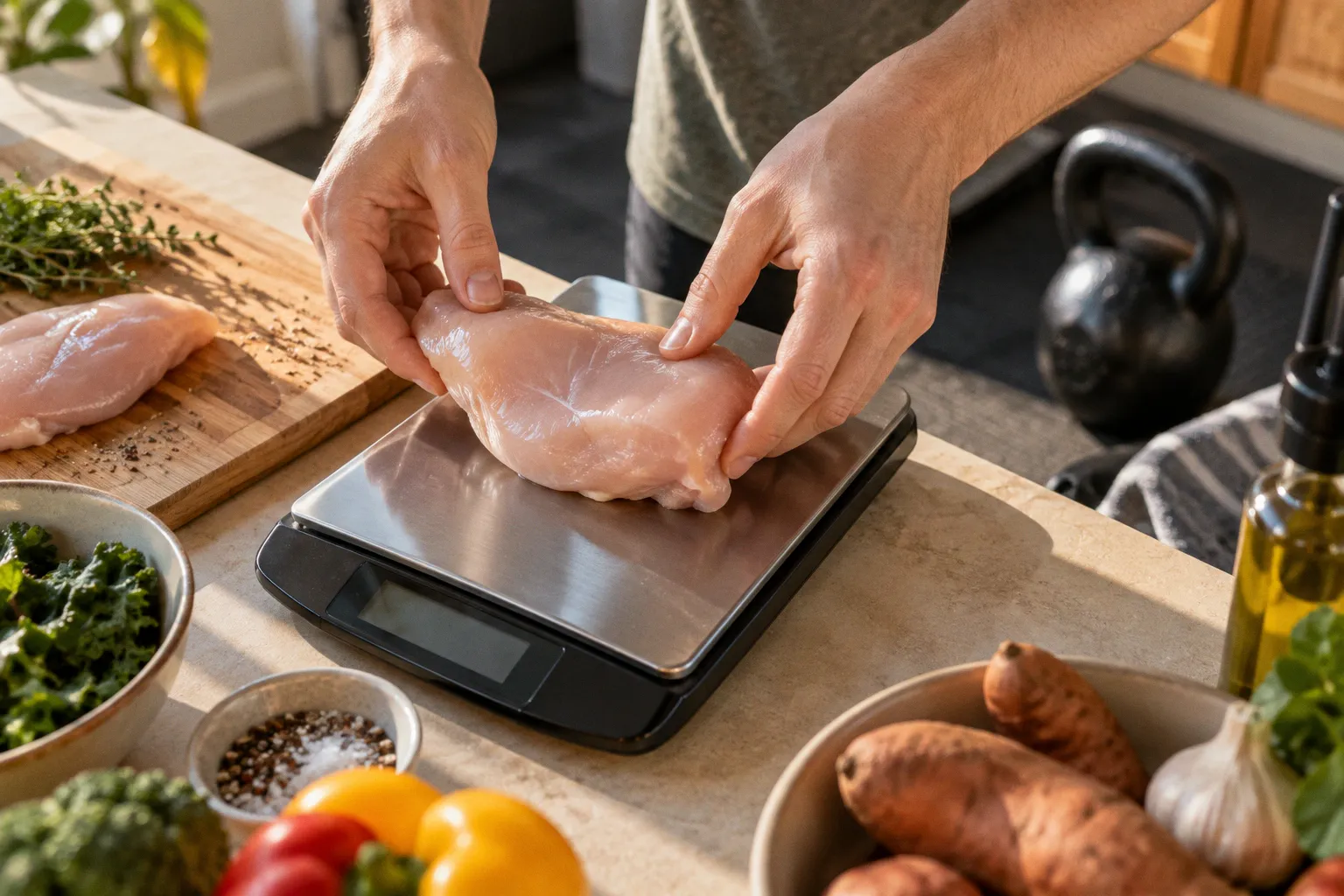
A digital kitchen scale is not a punishment for being bad at dieting. It is simply the right instrument for the job. If the goal is to track grams, a scale is more dependable than a measuring cup, a spoon, or your memory of what a portion looked like yesterday.
Start with foods that are easy to underestimate:
- oils, butter, dressings, and sauces;
- nuts, seeds, nut butters, and granola;
- dry pasta, rice, oats, and cereal;
- cheese and other calorie-dense toppings;
- large pieces of fruit or vegetables when the database entry is based on weight.
The point is not to weigh every lettuce leaf forever. The point is to learn where your visual estimates are most likely to drift. Many people become extremely careful with lean protein while treating oil as a detail, even though the oil can change the total energy of the meal more than the seasoning or vegetables ever will.
If your numbers are not moving and your logs look perfect, the log itself is still one of the first variables to examine.
Use the scale for a few weeks and pay attention to the foods that surprise you. The useful information is not just the weight of one portion. It is the pattern: the foods you consistently underestimate, the foods you routinely over-serve, and the ingredients you forget to log altogether.
A tare function makes the process less awkward. Put the bowl on the scale, reset it to zero, add the first ingredient, record it, reset again, and continue. For a recipe, you can weigh each ingredient as it goes into the pot and divide the finished dish into portions afterward. That creates a much cleaner record than trying to reconstruct the meal once the pan is empty.
Raw vs. Cooked: Why Weight Consistency Matters
One of the most common nutrition tracking errors is not choosing the “wrong” method. It is mixing two methods without realizing it.
Chicken weighs less after cooking because it loses water. Rice and pasta weigh more after cooking because they absorb water. The food has changed in weight, but the energy contained in the original ingredient has not changed in the same way. If you weigh cooked rice and choose a database entry for dry rice, the resulting number may look precise while describing an entirely different quantity.
You can track food raw or cooked. The important part is to match the weight with the correct database entry and use the same approach consistently.
| Food or meal component | If weighed raw | If weighed cooked |
|---|---|---|
| Chicken, meat, or fish | Choose an entry that describes the raw ingredient | Choose an entry that describes the cooked ingredient and cooking method when available |
| Rice, pasta, or grains | Use the dry-weight entry | Use a cooked entry that reflects the prepared food |
| Frozen vegetables | Use the frozen entry if weighing them before cooking | Use a cooked entry if the final portion is weighed after preparation |
| Mixed recipes | Log the ingredients individually before cooking | Weigh the finished recipe and calculate portions from the total cooked weight |
For home cooking, weighing raw ingredients is often easier because the package and recipe are usually organized that way. You know how much dry rice went into the pot, how much oil went into the pan, and how much raw meat was purchased. For leftovers, cooked weights can work well if you calculate the full recipe first and then divide it by the final weight or number of servings.
The key is to avoid switching back and forth casually. Weighing raw chicken on Monday, cooked chicken on Tuesday, and selecting whichever app entry looks closest is not a reliable system. It creates noise that can be mistaken for a change in appetite, metabolism, or progress.
Cooking oil deserves its own line in the log. A quick pour around the pan is still an ingredient, even when some of it remains behind. If the quantity is difficult to estimate, measure the oil before it goes into the pan. With a recipe, you can log the full amount used and then decide whether the dish is divided evenly or whether some of the oil remains in the cookware. You do not need laboratory-level precision. You do need a repeatable assumption.
The same principle applies to sauces. A meal may be built from lean protein and vegetables, but a generous coating of dressing, mayonnaise, coconut milk, or restaurant sauce can change the total considerably. If you cannot measure it exactly, log a reasonable estimate rather than leaving it invisible.
Navigating the 25% Variance in Nutrition Labels
Food labels look definitive because they are printed on packaging and presented in neat columns. They are useful, but they are not a promise that every individual portion contains exactly the listed amount of protein, carbohydrate, fat, or energy.
Agricultural products naturally vary. The size and ripeness of a piece of fruit can change its composition. Meat can differ in fat content. Grain products may absorb different amounts of water during cooking. Manufactured foods also depend on recipes, batches, and serving-size assumptions. The label gives you a workable reference point, not a personal laboratory analysis of the exact bite on your plate.
That does not make labels worthless. It means you should avoid treating small differences as meaningful. If two similar products have slightly different numbers, choose the one you actually buy and log it consistently. If the product is central to your diet, use the package label instead of automatically accepting the first database result.
This is especially important with branded foods. Apps often contain several entries for the same product, including user-created versions with incorrect serving sizes or outdated information. Check whether the entry matches:
- the serving size on the package;
- the weight in grams;
- the country or market where the product was sold;
- the listed protein, carbohydrate, and fat values;
- the preparation state, such as dry, cooked, drained, or ready to eat.
A barcode scan is convenient, but it is not a guarantee that the entry is correct. Read the label once before relying on the scanned result.
Whole foods can be easier to track because they have fewer ingredients and fewer layers of preparation. That does not mean they are nutritionally identical every time, but it does make the source of variation easier to understand. A potato is still a potato even when its size changes. A packaged snack may differ in serving size, recipe, and database entry while appearing to be the same item in the app.
Tracking is not about creating imaginary precision. It is about making the important inputs visible and consistent.
Restaurant meals are a separate category. You may not know the exact amount of oil, sugar, flour, or sauce used, and the listed portion may not resemble the portion served. Log the meal as honestly as possible, using a comparable entry, then return to your normal routine at the next meal. One estimated meal does not ruin a week. Pretending it did not happen makes the data less useful.
For the same reason, do not overreact to a single day that lands slightly above or below your target. Nutrition labels, portion sizes, cooking methods, and water content all introduce variation. Look for patterns across repeated meals and across the week. Consistency gives you a clearer signal than chasing microscopic differences between individual entries.
The Trap of Automated App Targets and Exercise Calories
A tracking app can produce a calorie target and a macro split almost instantly after you enter your height, weight, age, activity level, and goal. That speed is useful, but it can create false confidence. The number is an estimate based on general inputs. It is not a direct measurement of your daily energy needs.
Generic algorithms do not know exactly how much you move outside your workouts. They cannot see whether your job involves standing, walking, or sitting most of the day. They do not know how hard your training sessions actually are, how consistently you sleep, or how your appetite changes under stress. They also cannot reliably separate a planned workout from the activity already included in the selected activity level.
Exercise calories create another problem. If your app has already assumed that you train regularly and you then add back every calorie reported by a watch, machine, or workout tracker, you may count the same movement twice. Fitness devices are useful for observing trends, but calorie-burn estimates are not precise enough to treat as a food allowance.
A more stable approach is to choose a realistic baseline, keep it steady, and assess what happens over time. Give the target enough time to show a pattern rather than changing it after every hard session or high weigh-in. The scale can fluctuate because of sodium, hydration, digestion, menstrual-cycle changes, stress, and the amount of carbohydrate stored with water. One measurement cannot distinguish those factors from a genuine change in body fat.
Use several signals together:
- your average body weight across repeated weigh-ins;
- waist or clothing changes when fat loss is the goal;
- training performance and recovery;
- hunger, energy, and adherence;
- how consistently the planned intake was actually logged.
If progress is not moving in the direction you want, first check whether the log is complete. Review oils, drinks, bites while cooking, weekend portions, restaurant meals, and exercise calories. Then consider whether the target needs adjustment. Changing the target before checking the inputs often leads to a cycle of increasingly aggressive numbers and increasingly unreliable tracking.
The same caution applies to protein and carbohydrate targets. A macro split generated by an app is a starting structure, not a law. Protein should be distributed across the day in a way that supports your training and meals. Carbohydrates can be placed around workouts if that helps performance and appetite. Fat should not disappear simply because the app has presented a neat percentage. The target has to fit your food preferences and your actual routine well enough to be followed.
Precision Logging: Essential Habits for Reliable Data
Once the main sources of error are visible, reliable tracking becomes less dramatic. You are not trying to create a perfect record. You are trying to make the most important parts of the record repeatable.
1. Weigh the ingredients that matter most
Start with calorie-dense foods and the ingredients most likely to be misjudged. Weigh the oil, rice, pasta, oats, nuts, cheese, spreads, and sauces before they disappear into the meal. If you want to weigh everything at first, that can help you learn portions, but you do not need the same level of attention forever.
The goal is to know which foods deserve precision and which foods have a smaller impact on the total.
2. Log while you cook
Logging at the end of the day turns nutrition tracking into a memory test. By then, you may remember the main meals but forget the oil in the pan, the taste of the sauce, the few bites taken while preparing dinner, or the milk added to coffee.
Logging ingredients as you cook takes less mental effort than rebuilding the entire day later. For a repeat recipe, save the meal in the app once you have checked the ingredients and serving size. Reusing a reliable recipe is not boring; it is one of the easiest ways to reduce daily friction.
3. Decide how you will handle shared recipes
A large pot of chili or a tray of roasted chicken can be logged in several ways, but the method should be clear. Add all ingredients to one recipe, record the total cooked weight if the portions will vary, and weigh the amount you serve. Alternatively, divide the recipe into equal portions if the servings are genuinely similar.
Do not assume that four containers contain the same amount because they look similar. Dense ingredients settle, liquid may distribute unevenly, and one portion may receive more of the meat while another receives more of the sauce. Weighing the finished portions is useful when accuracy matters.
4. Keep raw and cooked entries separate
Create a simple personal rule. For example: dry grains are logged dry, raw meat is logged raw, and leftovers are logged from a recipe calculated in advance. Write the rule down if necessary. The best system is not the one that sounds most sophisticated; it is the one you can apply without hesitation.
5. Review the app entry before saving it
Do not accept every search result automatically. Check the serving unit, gram weight, and macro breakdown. “One cup” can mean different things depending on whether the food is packed, drained, cooked, or raw. A database entry with a familiar food name may still describe a different product.
This is one of the most important steps for how to track macros accurately. The number of entries in your log matters less than whether the entries match the food in front of you.
6. Build repeatable meals into your week
A few familiar breakfasts and lunches can make tracking much easier. Overnight oats, eggs with toast, a rice bowl, Greek yogurt with fruit, or a prepared protein-and-vegetable meal can become dependable reference points. You can still eat a varied diet; the repeatable meals simply reduce the number of decisions you have to make.
When a meal is already saved and its ingredients are known, you spend less time searching and less time guessing. That leaves more attention for the parts of nutrition that actually require judgment, such as hunger, training demands, and whether the plan fits your life.
7. Record uncertainty instead of hiding it
Some meals will be estimates. That is normal. If a restaurant dish contains an unknown amount of oil, choose a comparable entry and make a note if useful. If a family meal cannot be divided precisely, estimate the portion and move on.
An honest estimate is more valuable than an apparently perfect entry built from assumptions you do not believe. The purpose of tracking is to improve decisions, not to create a record that looks clean while leaving major ingredients out.
8. Use your weekly pattern to make adjustments
Daily numbers can be noisy. A single high-calorie meal, salty dinner, hard workout, or late bedtime can affect the next morning’s scale reading without telling you much about long-term progress. Compare similar stretches of time and look at adherence before deciding that the plan has failed.
If your intake appears consistent but the outcome does not match the goal, change one factor at a time. You may need to revisit portions, exercise-calorie adjustments, meal frequency, or the target itself. Changing everything at once makes it difficult to learn what actually worked.
Start With the Next Meal
You do not need to rebuild your entire kitchen before tracking becomes more useful. Before your next meal, choose one ingredient that is easy to underestimate and weigh it before cooking. Rice, oats, pasta, oil, chicken, cheese, or peanut butter are all good places to start.
Then check that the app entry matches the ingredient’s state: raw, cooked, dry, drained, or prepared. That small sequence solves two of the most common macro-counting pitfalls for athletes and beginners alike: an unreliable portion and a mismatched database entry.
From there, add one habit at a time. Log the oil. Save the recipe. Stop adding back every exercise calorie automatically. Check the serving size on the package. Use your weekly pattern rather than one isolated weigh-in to judge whether the plan is working.
Macro tracking is most useful when it gives you a clearer view of your routine without taking over your life. A kitchen scale, a consistent raw-or-cooked rule, and a little skepticism about automated targets will take you much further than a beautifully formatted app full of guesses. The objective is not perfect data. It is dependable enough data to make a better decision at the next meal.