Running shoes for weightlifting: are they safe to wear?
You walked into the gym in the same pair you wore for yesterday’s 5K. Cushioned, comfortable, broken in just right.
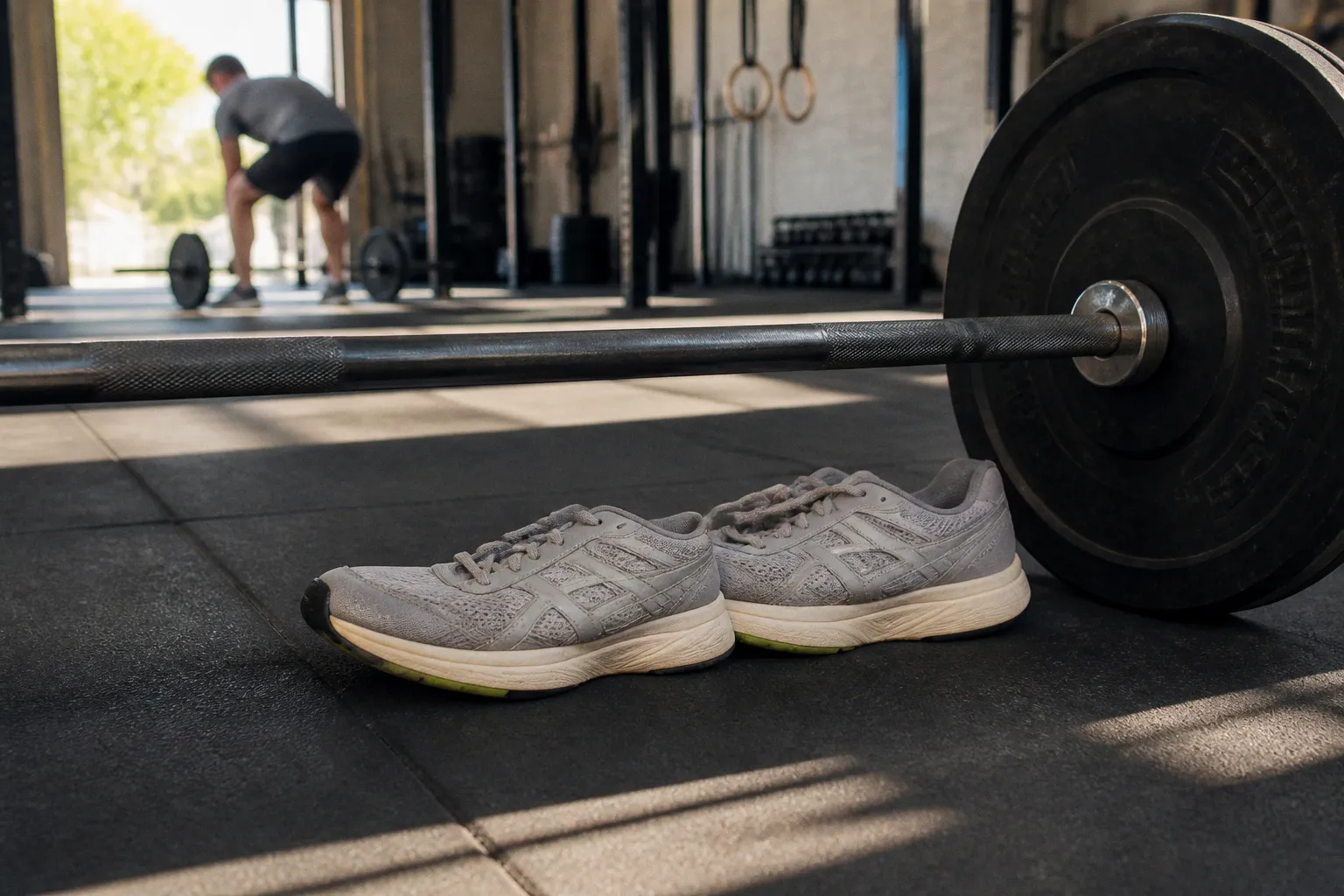
Now you are about to load up the squat bar, and the only thing between your feet and the floor is a slab of EVA foam designed to absorb heel strikes on pavement.
Is that automatically unsafe? No. Is it the best setup for serious strength work? Also no.
The answer depends on the lift, the load, your balance, your footwear, and how well you can control the movement. Running shoes for weightlifting safety is not an all-or-nothing question. A soft trainer may be perfectly workable for a light machine circuit and a poor choice for a heavy deadlift. Treating those situations as identical is where the advice usually goes wrong.
The squishy-floor problem: why cushioning can work against you under load
A running shoe is built for forward movement. Its midsole is designed to soften impact, its upper is usually flexible enough to move with the foot, and its sole may curve upward to help the runner transition from heel to toe. Those features can make a long run more comfortable. They do not automatically make the shoe a stable platform for a barbell.
Strength training starts with the floor. Before your hips, knees, back, shoulders, or arms can produce force, your feet have to transmit that force into a surface. When the sole compresses under load, part of that force is absorbed by the foam and part of your balance work becomes more complicated. The platform beneath you is not necessarily moving dramatically, but it is changing shape as you brace, shift pressure, and push.
That matters most when the exercise demands precision. In a heavy squat, you need to keep pressure distributed through the foot while the bar travels over a controlled path. In a deadlift, you want to push against the floor without rocking toward the toes or losing contact through the heels. In a clean or snatch, the foot has to remain stable while the body moves quickly around the bar.
A soft sole does not guarantee that any of these things will go wrong. It can, however, make them harder to repeat consistently.
A running shoe is a cushion. A squat is a launchpad. Asking one to do the job of the other is a compromise, not a catastrophe.
The practical issue is not that foam is inherently dangerous. It is that cushioning can reduce the information you get from the floor. A rigid sole gives you a clearer sense of where your weight is moving. A soft, highly cushioned sole can make small shifts feel less predictable, especially when the shoe has a tall stack height or a pronounced rocker.
This is one reason a lift can feel stronger and cleaner as soon as someone changes shoes. The new footwear has not magically added muscle. It has simply reduced movement between the foot and the floor, allowing the lifter to organize the rest of the body around a more stable base.
What running shoes can change in your mechanics
Heel-to-toe drop and pressure distribution
The heel-to-toe drop is the difference in height between the heel and the forefoot. Many running shoes use a noticeable drop to support the mechanics of a running stride. That raised heel can change where your body places pressure when you stand under a bar.
For squats, the effect is not automatically negative. A modest heel elevation can make it easier for some lifters to reach depth while keeping the torso more upright. That is part of the reason dedicated weightlifting shoes use a raised, rigid heel. The difference is that a lifting shoe does not combine the heel with a soft, compressible midsole. The heel acts as a stable wedge rather than a springy cushion.
Running shoes are less predictable because their heel elevation is often paired with foam, a curved outsole, and a flexible upper. The result may feel comfortable but less planted. If your knees drift forward, your heels lift, or your feet roll inward as you descend, the shoe may be contributing to the problem—or simply making an existing mobility or control issue easier to notice.
The deadlift is a different problem
Deadlifts usually benefit from a sole that is flat, firm, and as close to the floor as practical. A thick running-shoe midsole puts extra material between your feet and the platform. A raised heel can also shift your pressure toward the front of the foot, which is rarely what you want when setting up to pull.
There is one important technical correction here: heel elevation does not shorten the deadlift’s range of motion. If the foot is held higher above the floor, the bar starts farther below the feet relative to the lifter. All else being equal, that increases the bar-to-floor distance and can make the pull longer. The elevated position may also alter the starting angles at the ankles, knees, and hips.
A raised heel can therefore create two separate issues during a deadlift:
- It may move your balance forward, making it harder to keep pressure through the whole foot and heels.
- It may increase the distance the bar has to travel from the floor, adding work to an already demanding movement.
Some lifters can deadlift in running shoes without any obvious problem, especially with moderate weights. That does not make the setup ideal for everyone. If you feel unstable at the start, notice your heels shifting, or struggle to keep the bar close to your legs, a flatter shoe is a straightforward variable to change.
Lateral stability and dynamic lifts
Running shoes are generally optimized for forward travel. Their uppers may not hold the foot firmly when force comes from the side, and their cushioning can allow the foot to move inside the shoe during lateral or explosive movements.
That distinction matters for more than obvious side-to-side exercises. A push press, walking lunge, step-up, hang clean, or kettlebell movement can all challenge your ability to keep the foot connected to the floor. The more dynamic the exercise, the less appealing a soft, unstable platform becomes.
Again, this is a risk factor, not a prediction. Wearing running shoes does not mean you will roll an ankle during a lunge. It means the shoe may provide less support and less precise contact than footwear designed for training. If the shoe feels unstable, the exercise becomes less controlled, or the sole folds under pressure, take those signals seriously.
When lifting weights in running shoes is usually reasonable
The phrase “lifting weights in running shoes” covers too many different activities to support one universal rule. A light dumbbell workout, a machine circuit, and a heavy barbell session place very different demands on your feet.
For exercises performed with manageable loads, slow tempo, and a stable stance, running shoes may be acceptable if they feel secure and do not interfere with your technique. That can include:
- Light dumbbell presses and rows
- Cable exercises
- Machine-based strength work
- Controlled biceps, triceps, and shoulder exercises
- Warm-up sets
- Light goblet squats
- Easy walking lunges, provided the shoe does not slide or roll
- General conditioning sessions where running is part of the workout
“Acceptable” does not mean optimal, and it does not mean risk-free. Any exercise can be poorly loaded, poorly controlled, or inappropriate for an individual’s mobility and injury history. The point is narrower: the disadvantages of a running shoe are less important when the load is light, the movement is controlled, and the foot is not being asked to resist large or rapid forces.
Your own feedback is more useful than a slogan. Notice whether:
- The sole compresses so much that you lose balance.
- Your heel lifts or your foot rolls during a squat or lunge.
- Your toes grip the floor to compensate for an unstable base.
- The shoe slides inside the heel or feels loose around the midfoot.
- Your knees or ankles feel different from one shoe to another.
- You cannot repeat the same foot position from one set to the next.
If the shoe passes these basic checks during light training, it may be serviceable for that particular session. You still may want a better option as the weight, speed, or technical complexity increases.
Where running shoes become a poor choice
The case against running shoes gets stronger when the exercise depends on a rigid platform and precise force transfer. That usually means heavy compound lifts, explosive lifts, or movements where a small balance error can affect the entire body position.
Heavy squats
A heavy back squat or front squat asks the foot to stay stable while the knees, hips, and torso coordinate under load. A soft shoe can make the bottom position feel less secure, particularly if the outsole is curved or the heel compresses unevenly.
Some lifters prefer a raised heel for squats because it helps them reach depth with a more upright torso. That does not mean any running shoe with a high heel is a substitute for a weightlifting shoe. A running shoe’s heel is usually softer and less stable. Under pressure, it may flatten, shift, or encourage the foot to roll.
For squats, compare how the same movement feels in three positions: your running shoes, a firm flat shoe, and a proper lifting shoe if you have access to one. Look at whether your whole foot stays planted, whether your knees track consistently, and whether you can control the descent without chasing balance. The most comfortable option is not always the most stable one, but the most stable option should still allow you to move well.
Deadlifts
For conventional deadlifts, a flat, firm shoe is usually the cleaner choice. Canvas trainers, minimalist shoes, and other flat-soled options reduce the distance between your foot and the floor and avoid the compression of a thick foam midsole.
Some lifters pull barefoot or in socks where the gym’s rules and hygiene standards allow it. That can improve floor contact, but it does not solve every problem. It may not be appropriate if the floor is slippery, if dropping equipment is a possibility, or if you need more protection for your feet. A thin, secure shoe often gives you the practical benefits of a low profile without leaving the foot exposed.
Running shoes are especially unhelpful when their outsole is tall, soft, or heavily rockered. They can make the setup feel like you are starting from a slight slope rather than a stable platform. If you are working near your limits, that is an unnecessary variable.
Olympic lifts
Cleans, snatches, and related movements require speed, balance, and a firm connection with the floor. Running shoes are rarely the best option because the lifter has to move rapidly from one position to another while controlling a load that can pull the body out of alignment.
A weightlifting shoe’s rigid base and secure upper are designed for this environment. The raised heel can help with the receiving position and ankle demands of the lift, while the solid platform keeps the foot from sinking into foam. A running shoe may be usable for drills or very light technique work, but the more load and speed you add, the less attractive the compromise becomes.
Heavy overhead work
Overhead presses and jerks can also expose weaknesses in footwear. When the weight moves above your head, you need to create force from the floor and keep the body organized as the load travels. A soft, unstable shoe does not necessarily cause a problem, but it can make bracing and balance less consistent.
For a seated machine press, the shoe matters less. For a standing barbell press, push press, or jerk, the base matters more. The exercise itself should guide the footwear choice.
Flat shoes vs running shoes for squats
The flat shoes vs running shoes for squats debate is often framed too simply. Flat shoes are not automatically better for every lifter, and running shoes are not automatically unsafe. The real question is whether the shoe supports the squat pattern you can control.
A flat shoe keeps the heel closer to the floor and can provide a stable base for lifters with adequate ankle mobility. It is particularly useful for deadlifts and for athletes who prefer to squat with a more hip-dominant posture. But if your ankle mobility is limited, a completely flat shoe may make it harder to reach depth without your heels lifting or your torso folding forward.
A weightlifting shoe with a solid raised heel can help by allowing more forward movement at the knees while keeping the heel planted. That can make a deeper, more upright squat easier for some people. It is a mechanical aid, not a correction for every squat issue. If your knees cave, your feet collapse, or your brace fails, changing shoes will not replace technique work.
Running shoes sit awkwardly between these options. They may provide enough heel elevation to change your squat mechanics without providing the rigid base of a lifting shoe. They can also feel fine during warm-ups and become noticeably less stable as the load climbs.
| Feature | Running shoes | Flat-soled shoes | Dedicated weightlifting shoes |
|---|---|---|---|
| Sole | Cushioned and often compressible | Firm, low-profile, and stable | Rigid platform with a solid heel |
| Heel position | Usually elevated relative to the forefoot | Flat or close to flat | Deliberately raised |
| Best match | Running, conditioning, light general training | Deadlifts and many strength movements | Squats, Olympic lifts, and technical barbell work |
| Force transfer | Can be reduced by foam compression | Direct and predictable | Direct and predictable |
| Lateral control | Depends on the model; often limited | Varies, but usually stable at the base | Secure upper and strong midfoot support |
| Main drawback | Soft, tall, or curved platform | May expose limited ankle mobility | Less versatile and less comfortable for running |
The best shoe is the one that gives you a stable base for the actual movement. A flat shoe may be better for your deadlift and worse for your squat. A lifting shoe may be excellent for squats and awkward for a circuit that includes running. There is no prize for forcing one pair to do every job.
The hybrid trap: when one shoe tries to do everything
Cross-training shoes are often a sensible middle ground, but they are still a compromise. A good cross-trainer may have a firmer heel and more lateral support than a running shoe while remaining flexible enough for conditioning. That can make it useful for general gym sessions, especially when your workout mixes machines, dumbbells, short intervals, and moderate barbell work.
The problem is assuming that every shoe marketed for “lift and run” performs equally well in both roles. Marketing language does not tell you how much the sole compresses, how securely the heel is held, or whether the outsole stays stable under load.
When assessing a hybrid shoe, pay attention to the actual construction:
- A firm heel should resist compression when you press into it.
- The sole should not fold sharply through the middle when you brace.
- The upper should hold the midfoot without cutting off circulation.
- The outsole should provide reliable traction without feeling sticky or unstable.
- The heel should not slide when you step, squat, or change direction.
- The shoe should feel predictable on both feet, not merely comfortable while standing.
If your week genuinely includes both running and strength training, two specialized pairs may be more practical than one expensive all-rounder. A flat shoe can stay in your gym bag for deadlifts and barbell work, while your running shoes remain available for the activity they were designed to support. You do not need the most expensive equipment in either category. You need footwear that does not undermine the movement in front of you.
How to decide before you load the bar
You do not need a laboratory to identify a poor footwear match. A few simple checks can tell you whether your running shoes are making the exercise harder to control.
1. Start with an unloaded movement
Perform several bodyweight squats, hinges, lunges, or overhead reaches. Notice whether the shoe rolls, slides, or compresses unevenly. If the base feels unstable before you add weight, loading the movement will not make the issue disappear.
2. Check the whole-foot connection
In a squat, try to keep the heel, base of the big toe, and base of the little toe connected to the floor. In a deadlift, maintain pressure through the whole foot without rocking forward. If you have to claw the floor with your toes to stay balanced, the shoe may be part of the problem.
3. Compare the same set-up in a firmer shoe
The comparison does not need to be dramatic. If a flat or rigid shoe gives you a clearer foot position, more consistent balance, and better control, that is useful information. It does not prove that the running shoe is dangerous. It shows that the alternative may be better suited to the task.
4. Separate discomfort from instability
A new shoe can feel unfamiliar without being wrong. On the other hand, a shoe can feel soft and comfortable while allowing too much movement. Pay attention to instability, slipping, heel lift, and loss of control rather than judging only by comfort.
5. Reduce the load when the footwear is not ideal
If running shoes are the only option, use them for a session that matches their limitations. Keep the load manageable, avoid testing a one-repetition maximum, and choose controlled exercises over highly technical or explosive lifts. That is not a substitute for appropriate equipment, but it is a more sensible response than pretending the footwear does not matter.
The wrong shoe will not always hurt you. It may simply make balance, force transfer, and repeatable technique harder than they need to be.
So, is lifting in running shoes bad?
Lifting in running shoes is not automatically bad. It is context-dependent.
For light dumbbells, machines, warm-ups, and controlled accessory work, a running shoe may be a reasonable option if it fits securely and does not interfere with your balance. That does not remove the possibility of discomfort or injury, and it is not a guarantee that the shoe will protect your joints. It simply means the drawbacks may be modest at that level of training.
For heavy squats, deadlifts, Olympic lifts, and demanding standing presses, the disadvantages are more significant. A soft midsole can compress under load, a rocker can make foot pressure less predictable, and a raised heel can change your position without offering the rigid support of a lifting shoe. In a deadlift, heel elevation can increase the bar-to-floor distance rather than shorten it, while also encouraging pressure toward the toes.
The practical choice is simple: use a flat, firm shoe for most deadlifts; consider a dedicated weightlifting shoe for squats and Olympic lifts; and reserve running shoes for running and lighter gym work unless they genuinely feel stable for the session.
You do not need to panic if you arrived at the gym in your trainers. Just do not mistake “I can perform this lift in them” for “these are the best shoes for the job.” Fitness equipment does not have to be complicated. Sometimes the most useful upgrade is simply replacing a soft running sole with a firm connection to the floor.