Suspension straps vs resistance bands: travel workout paths
Packing for a trip often exposes a simple fitness problem: the equipment that looks most complete is not always the equipment you will actually use. A suspension trainer may offer a remarkably broad exercise library, but it needs a reliable anchor.
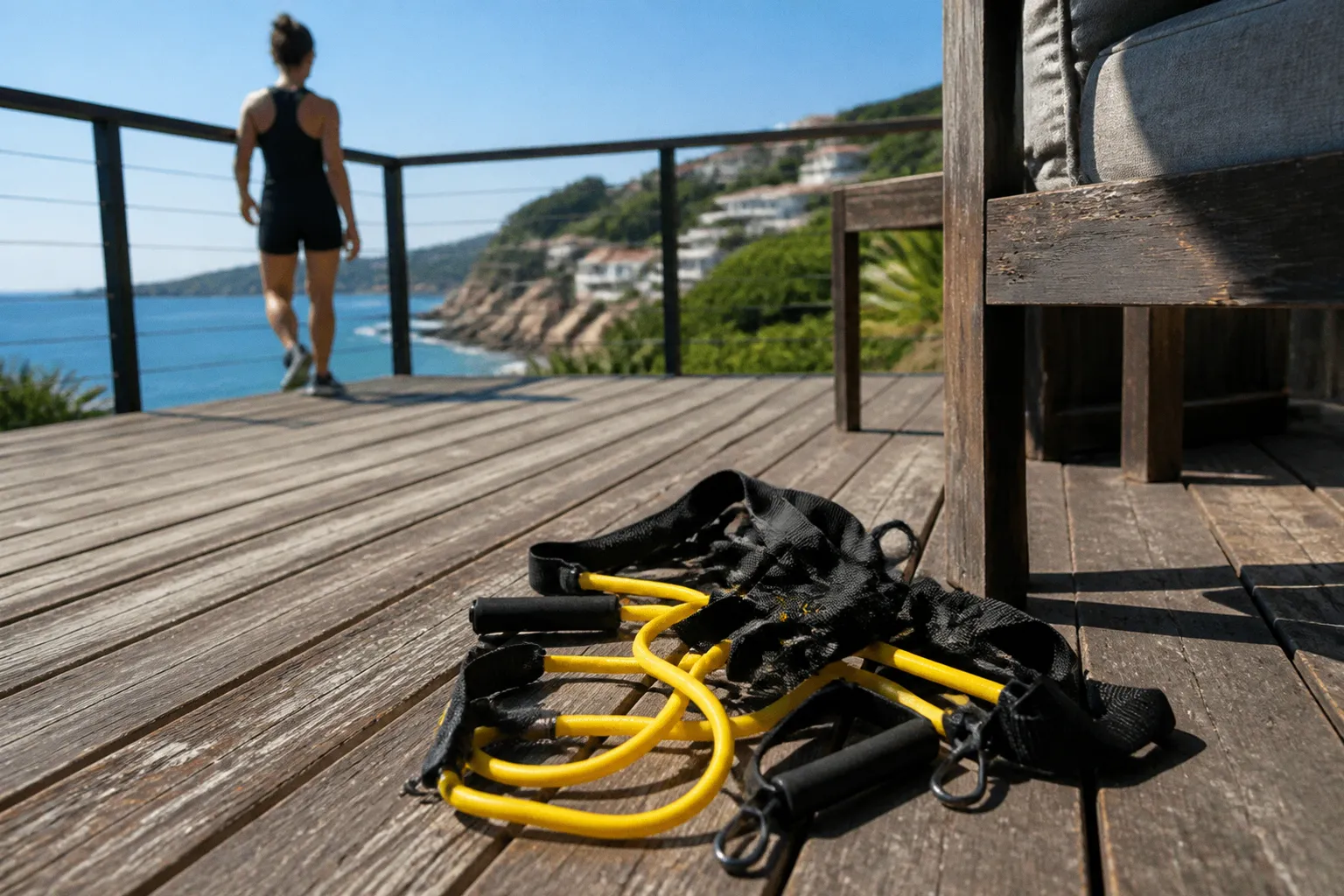
Resistance bands can slip into a small side pocket and work almost anywhere, yet they do not recreate every movement pattern or loading experience.
That is the real question behind suspension straps vs resistance bands for travel. We are not choosing the tool with the most impressive marketing. We are choosing the one that fits your destination, your training style, your tolerance for setup, and the amount of friction you are willing to manage after a long day of travel.
Both options can support effective strength workouts. Neither automatically builds more muscle simply because it is a suspension system or an elastic system. Progress still depends on creating enough challenge, repeating the work consistently, and gradually increasing difficulty.
Two different ways to create resistance
Suspension trainers and resistance bands may live in the same category of portable travel workout gear, but they make your body work in different ways.
A suspension trainer uses your body weight, gravity, and leverage. You hold or place your feet in the straps, then change the angle of your body to make an exercise easier or harder. A more horizontal body position usually creates a greater challenge during rows or presses. A more upright position reduces the load.
Resistance bands rely on elastic tension. As the band stretches, the force increases. That means the resistance is accommodating rather than perfectly uniform: the beginning of a movement may feel relatively easy, while the end range becomes more demanding as the band lengthens.
This difference shapes the entire workout.
With suspension straps, instability is part of the package. Your trunk and smaller stabilizing muscles stay active across nearly every exercise because the handles or foot cradles can move. With bands, the challenge is often easier to control and more predictable, particularly when the band is attached to a fixed point or used around the legs.
Neither method is universally superior. They simply make different trade-offs.
| Training factor | Suspension trainer | Resistance bands |
|---|---|---|
| Main resistance source | Body weight, gravity, and body angle | Elastic tension that rises as the band stretches |
| Anchor requirement | Usually requires a verified door anchor, beam, or sturdy outdoor support | Can be used independently; anchors add more exercise options |
| Core demand | High stabilizer involvement because the straps move | Varies by exercise and setup |
| Best travel advantage | Broad bodyweight exercise selection in one compact kit | Low weight, low cost, and minimal setup |
| Progression method | Change body angle, range of motion, tempo, or unilateral loading | Use a thicker band, combine bands, increase stretch, or change leverage |
| Main inconvenience | Finding a safe anchor and setting the correct height | Matching band tension to the exercise and avoiding snap-back |
| Typical cost | Many established suspension systems fall around $100–$200 | Basic loop or band sets may cost under $20; multi-tube kits cost more |
| Packing example | TRX Go kit: 1.5 pounds | A fully loaded five-tube Bodylastics set: 3.25 pounds |
The weight difference is not as dramatic as some travelers expect. A TRX Go Suspension Trainer kit is listed at 1.5 pounds, while a fully loaded five-tube interchangeable Bodylastics set with handles, door anchor, ankle strap, and carrying bag weighs 3.25 pounds. The lighter choice, however, is not automatically the better choice. A band set with several tubes may replace more individual loading options, while a suspension kit may provide more exercise variety without carrying multiple weights.
The best travel equipment is not the smallest item in your bag. It is the tool you can set up safely and use without negotiating with yourself.
Where suspension straps make more sense
Suspension straps are a strong option when you want your travel workouts to feel like a real training session rather than a collection of emergency exercises.
The leverage system gives us a simple way to scale difficulty. For a row, we can stand more upright for an easier version or lean farther back for a harder one. For a suspended push-up, moving the feet closer to the anchor line or placing the body at a steeper angle can increase the demand. We can also progress with slower lowering phases, pauses, longer ranges of motion, or single-limb variations.
That flexibility is useful when a traveler does not want to carry a full home fitness kit. One suspension trainer can support:
- Rows and pulling variations for the upper back and arms.
- Push-ups and chest presses with adjustable difficulty.
- Split squats, assisted single-leg work, and hamstring curls.
- Pike variations and other shoulder-demanding movements.
- Planks and body-saw patterns that challenge the trunk.
- Mobility-friendly assisted movements when balance or range of motion is limited.
The core requirement is an anchor that deserves your trust. A suspension system does not become safe merely because a product includes a door attachment. The door, frame, direction of force, and way the anchor is installed all matter. A solid-looking door may open toward you, away from you, or sit inside a frame that cannot tolerate repeated pulling. We should follow the equipment instructions and verify the structure rather than assume that every hotel door is suitable.
Outdoor anchors create another layer of judgment. A tree limb may look sturdy but contain rot, cracks, or an awkward angle that causes the straps to rub. A public park may have a suitable bar, but the surface can be wet, unstable, or crowded. Suspension straps are portable, not magical. They still need a stable point that can handle the direction and repeated nature of the load.
The payoff is a workout that often feels coordinated and athletic. Because the straps can move, we must control the position of the hands or feet while keeping the ribs, pelvis, and shoulders organized. That makes suspension training particularly appealing for people who enjoy full-body movements and want more than isolated band exercises.
There is one important boundary: instability should not be confused with superior strength stimulus. A shakier exercise is not automatically a better exercise. If the instability forces you to shorten the range of motion, lose control, or avoid meaningful loading, it may be the wrong progression for that day.
Where resistance bands win the travel decision
Resistance bands are usually the easier recommendation when the priority is convenience.
A basic loop or tube set can fit into a carry-on, personal item, or gym pouch without demanding much space. Entry-level sets are often available for under $20, which lowers the cost of trying the system. If a band gets lost or damaged during a trip, replacing a single piece is generally less complicated than replacing a complete suspension setup.
Bands also work when the environment is unpredictable. You can perform many exercises without an anchor:
- Squats and split squats with the band under the feet.
- Rows with the band wrapped around the feet.
- Presses, curls, and triceps extensions held in the hands.
- Glute bridges, lateral steps, and standing abduction with loop bands.
- Deadlift patterns with the band under the feet.
- Pallof-style anti-rotation work when you have a safe attachment point.
This independence matters in hotel rooms. We may not have a suitable door, a sturdy railing, or enough outdoor space. A band-based workout can begin on the floor or beside the bed without turning the room into an equipment inspection site.
Bands are also forgiving when our energy is inconsistent. After a flight, a moderate band circuit can provide movement without demanding the same level of setup and coordination as a full suspension workout. That can be a practical way to preserve the habit while respecting sleep disruption, stiffness, or a busy schedule.
The trade-off appears when we need a precise loading progression. A color-coded band set may suggest a clear system, but the actual challenge changes with the band’s length, the starting position, the angle of pull, and the distance from the anchor. The same band can feel very different in a short-range shoulder exercise than in a long-range lower-body movement.
Elastic tension also rises as the band stretches, and it does not increase in a perfectly linear way throughout the movement. A band may feel light at the start and unexpectedly difficult near lockout. That can be useful, but it can also change the point at which you lose technique. We should choose a resistance that lets us control the complete range rather than forcing the final few inches.
A tube set with handles, ankle straps, a door anchor, and a carrying bag can expand the exercise menu. It also adds weight. The five-tube Bodylastics example at 3.25 pounds is still travel-friendly, but it is no longer the same minimalist proposition as a couple of loop bands. For some travelers, that extra weight buys enough versatility to be worthwhile. For others, it is equipment that remains in the suitcase.
The travel setting should decide the winner
The phrase “best portable exercise equipment” only makes sense after we define where the equipment will be used.
A suspension trainer is more attractive for a trip that includes:
- A private room with a verified, structurally appropriate door setup.
- Access to sturdy outdoor bars or reliable anchor points.
- Longer stays where a more varied strength routine will pay off.
- A preference for bodyweight training and compound movements.
- Enough time to inspect the anchor and set up before each session.
Resistance bands are usually the more dependable choice for:
- Hotel rooms with uncertain doors or limited floor space.
- Work trips where the workout needs to begin and end quickly.
- Carry-on-only travel.
- Training plans built around activation, mobility, and moderate strength work.
- Travelers who want equipment that functions without any attachment point.
- People sharing accommodation and trying to keep the setup quiet and unobtrusive.
We should also account for the surface beneath us. A slippery hotel floor can make some standing band movements awkward, while a suspension trainer may require enough clearance to move safely. A low ceiling, narrow room, or furniture placed close to the wall can limit both tools. The equipment list cannot be separated from the room layout.
A simple destination-based decision
1. If you cannot identify a safe anchor, choose bands.
This is the cleanest decision. Do not turn an uncertain door or questionable tree into the foundation of a pulling workout.
2. If you want the broadest bodyweight progression, choose suspension straps.
Angle changes, unilateral variations, tempo, and range of motion can create a long progression path without adding plates.
3. If you need the lowest setup friction, choose a small band kit.
When the workout must fit between meetings, the tool you can use immediately has a major advantage.
4. If you are training legs seriously, bring enough band tension.
A very light loop may be excellent for glute activation but insufficient for a challenging squat or hinge. A tube system or several bands may be more useful.
5. If you are traveling for several weeks, consider a combination.
A compact loop band plus suspension straps can cover more situations, but only if the additional weight and cost will not discourage you from packing them.
That last point is where many equipment comparisons become unrealistic. More tools create more options, but they also create more decisions. We want a system that supports consistency, not a miniature fitness store in the bottom of the suitcase.
How progression works without heavy weights
The main concern with travel workouts is often the same: can a portable tool create enough challenge?
Yes, but progression must be intentional.
With suspension straps, we can increase difficulty by adjusting the body angle, extending the lever, increasing the range of motion, slowing the eccentric phase, adding a pause, or moving from two limbs to one. A split squat with the rear foot supported in a strap can become substantially more demanding than a standard bodyweight squat, but it also requires more balance and control. We should earn the harder variation rather than use instability to compensate for a lack of loading.
With bands, progression can come from selecting a stronger band, combining two bands, increasing the stretch distance, reducing rest, using a slower tempo, or choosing a unilateral variation. We can also make the same band more challenging by changing the anchor position or starting with greater pre-tension.
The goal is not to make every set feel dramatic. The goal is to create enough mechanical demand that the target muscles have a reason to adapt while technique remains repeatable.
A useful travel session can follow a simple framework:
Start with one lower-body movement
Choose a squat, split squat, hinge, or bridge pattern. If the band is light, use a unilateral variation or a slower lowering phase. If you are using suspension straps, adjust your body angle before immediately searching for a more complicated exercise.
Add one push and one pull
A band press and a band row can work well without an anchor if you adjust the setup around your feet. A suspension trainer gives more obvious options for rows and presses, but both should be performed through a controlled range. The question is not whether the movement looks advanced. It is whether we can keep the shoulder position and trunk stable.
Include a trunk-focused pattern
Suspension straps naturally challenge the core because the contact points are unstable. With bands, we can use anti-rotation presses, loaded carries when space permits, or controlled dead-bug and plank variations. We do not need to make every core exercise a test of exhaustion.
Finish with a small amount of mobility
Travel often makes the body feel compressed: hips stay flexed, the upper back stays rounded, and the ankles do less work than usual. A few deliberate mobility movements can help us transition out of the session and return to the day with better energy. This is not a substitute for strength training, but it can make the routine more sustainable.
A portable workout succeeds when it preserves the training signal without creating a second travel problem.
Safety is part of the equipment choice
Portable equipment reduces logistical barriers, but it does not remove mechanical risk.
With suspension straps, inspect the stitching, buckles, handles, and anchor before loading the system. Check that the strap is not twisted in a way that changes the force path. Avoid anchoring to a door unless the door and the specific door attachment are set up according to the manufacturer’s instructions. The direction in which the door opens matters, as does whether the frame and hardware can tolerate the load.
Do not use a decorative railing, lightweight furniture, or an unidentified branch as an anchor. If the strap rubs against a sharp edge, the concern is not only whether the current set feels stable. Repeated friction can damage the material.
With resistance bands, inspect the latex or rubber for cuts, cracks, thinning, or surface damage. Keep the band away from rough concrete, sharp furniture edges, and hot surfaces. Do not position your face directly in the path of a band under tension. A snapped band can travel quickly, especially when it has been stretched aggressively.
Door anchors deserve care in both systems. The presence of an attachment does not guarantee that the door is appropriate. If the setup shifts, creaks, or pulls the door out of alignment, stop and change the exercise. There is always another movement in the session; there is no benefit in forcing a questionable anchor.
We should also distinguish discomfort from useful effort. A muscle working hard is expected. Sharp pain, joint instability, numbness, or a sudden change in movement quality is a reason to stop and reassess. Travel workouts are there to support your routine, not to prove that you can ignore feedback from your body.
TRX versus resistance bands for hotel workouts
The common search for TRX vs resistance bands for hotel workouts is really a comparison between structured versatility and immediate practicality.
TRX-style suspension systems generally sit in a higher price category, with typical systems often ranging from $100 to $200. They can offer excellent build quality, a polished adjustment system, and a consistent training experience. The TRX Go kit, at 1.5 pounds, is specifically designed for portability.
Resistance bands have a wider price range. A basic loop set may cost under $20, while a multi-tube kit with handles and anchors can cost more. The lower entry point makes bands easier to add to an existing travel routine, particularly if the goal is light strength work, glute training, mobility, or a backup option for days when the hotel gym is crowded.
The more useful question is not which brand appears more premium. Ask which tool matches your most likely hotel scenario:
- No reliable anchor and very little time: bands.
- A verified anchor and a desire for full-body progression: suspension straps.
- A plan built around lower-body accessories and activation: loop bands.
- A plan built around rows, presses, planks, and assisted single-leg work: suspension straps.
- A long trip with varied environments: a carefully selected combination may be justified.
If your normal training already relies heavily on free weights, bands may serve as a complementary travel format rather than a complete replacement. If your home training is mostly bodyweight-based, suspension straps may feel more familiar and offer a smoother transition.
The important thing is to set expectations. A travel tool can maintain strength practice, movement quality, and routine. It may not replicate every heavy lift from your regular gym, and it does not need to. The strongest travel plan is often the one that keeps you engaged until you return to your usual equipment.
The most sustainable choice is the one you will use
We can compare weight, price, anchors, resistance curves, and exercise libraries all day, but adherence still decides the outcome.
Choose suspension straps if you enjoy adjusting leverage, want a broad bodyweight system, and can reliably identify safe anchor points. Choose resistance bands if you value simplicity, need an independent setup, or want a low-cost piece of equipment that can travel almost unnoticed.
For many people, the decision can be made with one sentence: bands are the safer default for uncertain environments; suspension straps are the more expansive option when the environment is prepared for them.
Before your next trip, pack the tool that supports your actual schedule. Then plan the first session before you leave: one lower-body exercise, one push, one pull, one core movement, and a short mobility finish. At your next meal, keep the same practical mindset—include a clear protein source, a fruit or vegetable, and enough carbohydrate to support the day ahead. Small decisions that reduce friction are how we protect energy, training consistency, and progress wherever we happen to be.