Weight loss snacks: your weekly prep roadmap
A weight-loss snack has one job: control energy intake between meals without creating a second meal. The useful range is narrow.
Aim for 10–20 grams of protein, pair it with fiber-rich carbohydrates or healthy fats, and keep the portion under 200 calories.
Most snack failures are not caused by poor food selection. They are caused by poor portion architecture. A large container of trail mix, a full tub of yogurt, or a package eaten directly from the bag removes the only control point: the serving size.
This is why healthy snacks for weight loss meal prep should be assembled as individual units. The food is selected once. The portion is defined once. The decision is removed when hunger is highest.
A snack is not a reward and not a miniature free meal. It is a controlled dose of energy and protein.
The physiological target: reduce hunger without breaking the deficit
Weight loss still requires an overall calorie deficit. Snacking does not create one automatically. A high-protein label does not neutralize excess energy. If the snack adds 300–500 calories to the day, it can erase the deficit regardless of its ingredients.
The practical target is more specific:
- 10–20 grams of protein per serving to improve satiety between meals.
- Less than 200 calories per serving to preserve the daily energy budget.
- Fiber-rich carbohydrates or healthy fats alongside protein to slow the rate of digestion and extend fullness.
- A defined portion that can be consumed without additional measurement.
- A preparation format that survives the point of use: work, travel, training, or the gap between dinner and sleep.
Protein also has a higher thermic effect of food than carbohydrates and fats. The body uses more energy to digest and metabolize it. That does not make protein a fat-burning substance. It makes protein a useful component of an energy-controlled diet.
For active individuals, the general daily protein target in the available guidance is 0.7–1.0 grams per pound of body weight. Snacks can help distribute that intake across the day, but they should not be used to compensate for an inadequate main-meal structure.
A snack is usually justified when one of three conditions exists:
1. The interval between meals is long enough that hunger is likely to impair food choice.
2. Training occurs away from a planned meal.
3. The daily protein target is difficult to reach through main meals alone.
If none of these conditions applies, adding a snack may be unnecessary. Frequent eating is not a metabolic requirement.
Build the snack from three components
The most reliable structure is simple:
protein + volume or fiber + controlled energy density
Protein supplies the primary satiety signal. Fiber-rich foods add volume and slow digestion. Healthy fats can improve palatability and fullness, but they have a high energy density. A small portion can fit. An unmeasured portion can dominate the calorie budget.
Use the following assembly logic.
1. Select the protein anchor
The protein anchor determines whether the snack reaches the 10–20 gram target. Common options include:
- Low-fat Greek yogurt.
- Low-fat cottage cheese.
- Eggs.
- Lean poultry portions.
- Tuna or other ready-to-eat fish, where practical.
- Edamame or other protein-containing plant foods.
- A measured protein serving added to a yogurt or smoothie format.
The anchor should be portioned first. Do not start with crackers, fruit, granola, or nuts and then attempt to add protein afterward. That sequence usually produces a carbohydrate- or fat-dominant snack with a protein garnish.
2. Add fiber-rich carbohydrate or produce
This component increases volume and makes the snack more resistant to rapid consumption. Examples include:
- Berries.
- Pineapple.
- Apples or pears.
- Carrot and cucumber portions.
- Oats in a measured amount.
- Whole-grain crispbread.
- Beans or edamame in a prepared savory snack.
The objective is not to remove all carbohydrate. That is another industry myth. Carbohydrates can be useful before training and can improve the structure of a snack. The variable that determines weight change is total energy intake over time, not whether a single piece of fruit appears in the container.
3. Add fat only when it has a defined role
Nuts, seeds, nut butter, avocado, and olive-based dips can improve texture and satisfaction. They also compress a large amount of energy into a small physical volume.
Use a measured amount. Never treat a jar or large bag as a serving system.
A snack containing yogurt, berries, and a small amount of seeds may be appropriate. A snack containing yogurt, granola, nut butter, nuts, and dried fruit can exceed the intended calorie range without appearing large. The problem is not the ingredient list. The problem is cumulative energy density.
A weekly prep system that controls the variables
Weekly preparation should not mean cooking seven identical meals. It means creating a small set of repeatable portions that remove friction.
Use two or three snack formats for the week. More variety increases preparation time and decision load. Less variety can reduce adherence if the foods become unacceptable by day four. A controlled rotation is adequate.
Step 1: Define the daily allocation
Before purchasing ingredients, decide how many snacks the plan permits. For many people, one planned snack is sufficient. Others may need two because of training timing or a long workday.
Assign the snack a calorie range rather than an unlimited category. The available guidance supports keeping each weight-loss snack under 200 calories. That ceiling is not a universal prescription. It is a practical control point that must fit the total daily deficit.
Then define the protein requirement. A snack with 10 grams of protein may be adequate in one diet. A snack closer to 20 grams may be more useful when the main meals are lower in protein.
Step 2: Choose formats based on your environment
A snack can be nutritionally correct and operationally useless. Yogurt does not belong in a work bag without temperature control. A soft-boiled egg is a poor solution if the container will be shaken through a backpack. A crumbly bar is not a good pre-training option if it causes gastrointestinal discomfort.
Classify the snack by use:
- Refrigerated: yogurt, cottage cheese, eggs, cut produce, prepared poultry.
- Portable: measured shelf-stable items, whole fruit, sealed protein portions.
- Pre-training: lower-fat and easier to digest if consumed close to exercise.
- Post-training: protein-centered, with carbohydrate added when it supports the next meal or training session.
- Evening: high-volume and portion-controlled, with no need for rapid preparation.
This is basic logistics. Ignore it and the plan will fail at the point of use.
Step 3: Portion before storage
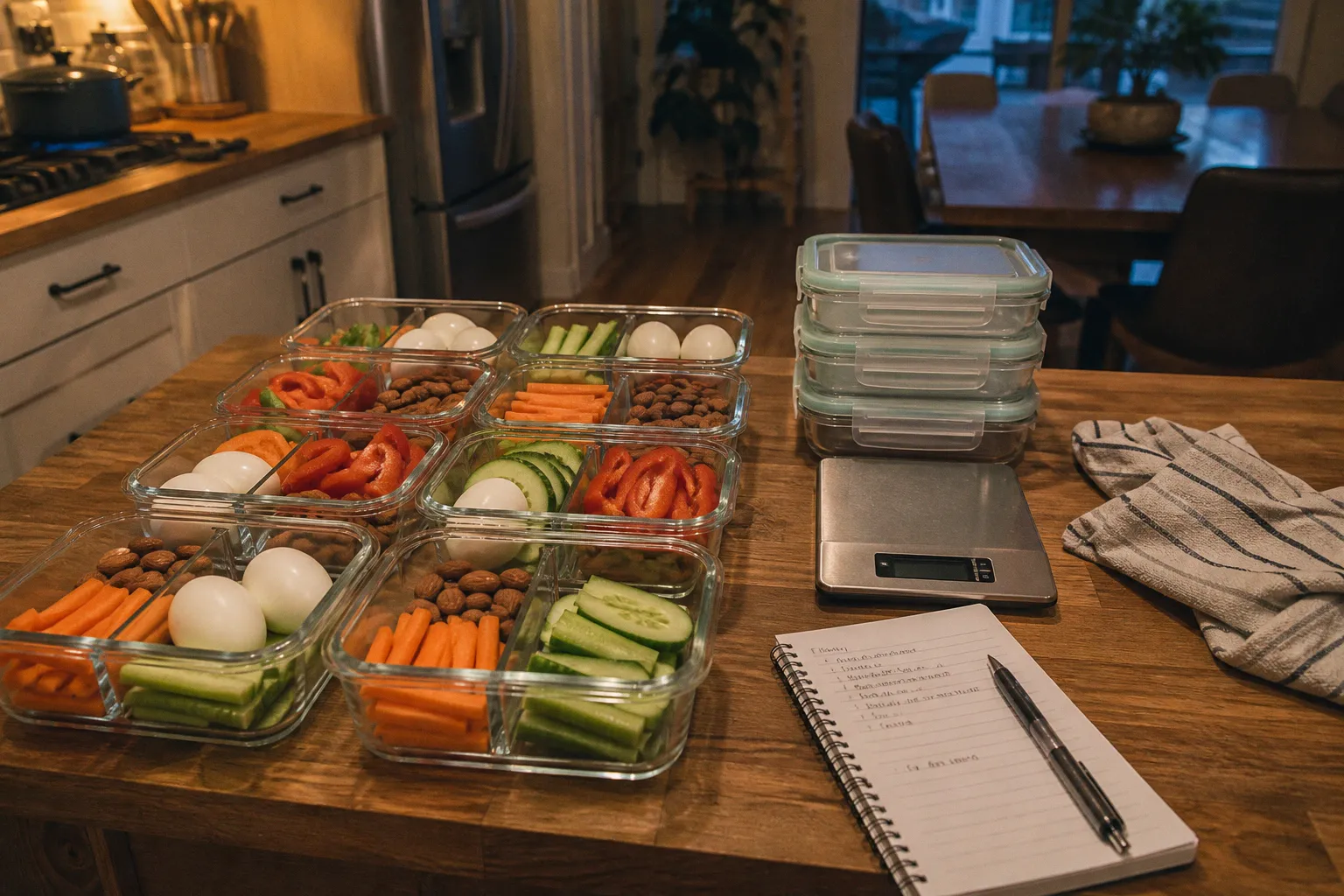
Use divided bento-style containers, small jars, or sealed individual bags. The container should represent one serving.
Do not prepare a large bowl and promise to divide it later. Later is when hunger, time pressure, and visual estimation distort the portion. Pre-portioning reduces decision fatigue and limits impulsive overeating.
Label each portion with the food and preparation date. Do not assign a universal shelf-life claim to every homemade combination. Yogurt, cut fruit, cooked eggs, poultry, and mixed snacks do not behave identically. Storage duration depends on the food, handling, and temperature. Use a format you can store safely and consume within the applicable guidance for that food.
Step 4: Put the portions where the decision occurs
A snack stored behind the ingredients for dinner is not prepared for use. Put it in the section of the refrigerator used during the workday. Pack the portable portion with the items that leave the house. Place the post-training option where the training equipment is stored.
The goal is not convenience for its own sake. The goal is to reduce the number of uncontrolled decisions between hunger and eating.
A practical comparison of prep formats
| Snack format | Approximate protein and energy from the provided examples | Best use | Primary control point |
|---|---|---|---|
| 150 g low-fat Greek yogurt with berries | About 10 g protein and 120 kcal | Refrigerated workday snack | Keep the yogurt and berries in one measured serving |
| 150 g low-fat cottage cheese with 50 g pineapple | About 14 g protein and 130 kcal | Midday or evening snack | Portion the cottage cheese before adding fruit |
| One hard-boiled egg | About 6 g protein and 80 kcal | Compact snack or part of a larger combination | One egg is below the 10–20 g protein target by itself |
| Yogurt with measured fruit and seeds | Depends on seed quantity | Higher-satiety refrigerated option | Measure the seeds; do not pour freely |
| Cottage cheese with fruit and crispbread | Depends on crispbread quantity | Savory-sweet meal gap | Keep the carbohydrate portion defined |
The egg example illustrates a common error. One egg provides approximately 6 grams of protein and 80 calories. It can fit a weight-loss plan, but it does not meet the stated protein range as a standalone snack. Pairing it with another protein source or using two eggs changes the calculation. The snack should be evaluated as a complete unit, not by the presence of a protein-containing ingredient.
Five snack formats that survive weekly preparation
The most useful weight loss snack ideas are not the most elaborate. They are the ones that maintain their portion, texture, and protein content after preparation.
1. Greek yogurt and berries
A 150-gram portion of low-fat Greek yogurt with berries supplies approximately 10 grams of protein and 120 calories according to the provided nutrition reference.
This is the baseline format. It requires minimal assembly and provides protein with a fruit component. Use a measured quantity of berries rather than filling the container until it looks full. Visual volume is not a reliable measurement.
The format is suitable for:
- A mid-morning gap between meals.
- A workday snack stored under refrigeration.
- A light post-training option when the next meal is close.
If additional granola, honey, nuts, or nut butter is added, the energy profile changes. Those ingredients are not automatically problematic. They are simply no longer part of the original 120-calorie example and must be measured.
2. Cottage cheese and pineapple
A 150-gram serving of low-fat cottage cheese with 50 grams of pineapple supplies approximately 14 grams of protein and 130 calories.
This combination sits inside the useful protein range and remains below the 200-calorie ceiling. The cottage cheese is the anchor. The pineapple supplies carbohydrate and volume. The fruit amount is defined. That is the entire point.
Prepare the cottage cheese in a sealed container and add the pineapple as a separate compartment if texture matters. A divided container prevents the fruit from changing the consistency of the dairy product before consumption.
3. Egg-based pairings
One hard-boiled egg supplies approximately 6 grams of protein and 80 calories. It is compact and easy to portion. It is not sufficient as a 10–20 gram protein snack unless paired with another protein source.
A functional pairing could include an egg with a measured dairy portion or a small serving of another protein-containing food. Do not convert the format into an unstructured grazing box with cheese, nuts, crackers, and dips. That removes the energy limit.
Eggs work best when the complete serving is decided before storage. The number of eggs is not a detail to determine at the moment of hunger.
4. Protein and produce containers
Use a measured protein anchor with raw vegetables or fruit. This format is useful when the main problem is low food volume rather than low protein.
The vegetables can include carrots, cucumbers, peppers, or similar produce. The snack remains effective only if the dip, oil, nuts, or cheese added to it is measured. Produce is low in energy density. The accompaniments may not be.
5. A controlled portable unit
Portable snacks should contain no hidden second serving. Use a single sealed portion of a protein-containing food with whole fruit or another fiber-containing component.
Avoid carrying a full family-size package and relying on restraint. That is not a preparation system. It is a test of inhibition conducted under hunger. The container should provide a physical stop.
The strongest snack plan is not the one with the cleanest ingredient list. It is the one that preserves the intended portion when you are tired, rushed, and hungry.
Timing around training: use mechanics, not folklore
The phrase “post-workout nutrition” is often used to justify unnecessary eating. Training does not create an obligation to consume a snack immediately afterward. The requirement depends on the next planned meal, total daily protein, training schedule, and appetite.
A snack before training can be useful when the previous meal was several hours earlier. Select a format that does not create excessive gastrointestinal load. Large fat portions and large total food volume are often poor choices close to exercise, particularly when the activity includes repeated flexion, impact, or high ventilation.
After training, a protein-containing snack may be useful if the next meal is delayed. The purpose is to provide a controlled bridge, not to trigger unrestricted eating. If dinner is ready and already contains sufficient protein, adding a separate recovery snack may be redundant.
The relevant decision points are:
- Time since the last meal.
- Time until the next meal.
- Protein consumed across the day.
- Training duration and intensity.
- Individual gastrointestinal tolerance.
- Whether the snack remains within the planned energy budget.
No acute metabolic switch requires a sugary snack at a fixed minute after lifting. The body is not a stopwatch. It responds to total intake, training stress, and recovery over time.
Why common “healthy” snacks still disrupt weight loss
The word healthy describes a food’s nutrient profile. It does not describe the size of the portion or its effect on the daily energy balance.
Nuts and nut butter
These can provide healthy fats and some protein. They are also energy dense. A handful is not a standardized unit. A tablespoon is not always measured accurately. Use a scale or a defined package portion if the snack needs to remain below 200 calories.
Granola and dried fruit
Both can be useful additions. Both can also increase energy density without increasing physical volume enough to improve satiety. A yogurt bowl that begins as a controlled snack can become a dessert-sized serving through repeated additions.
Smoothies
Liquid calories are easy to consume quickly. A smoothie can contain protein, fruit, milk, oats, and nut butter. That combination may be appropriate as a meal replacement in a specific plan. It is not automatically a snack. The label depends on total energy and the role assigned to it.
“Clean” snack bars
Clean is not a physiological measurement. Read the nutrition panel and define the portion. A bar with a health-oriented label can still exceed the intended snack allocation or provide insufficient protein.
Fruit alone
Fruit is not a problem. A piece of fruit may be an appropriate carbohydrate component. It simply does not always provide enough protein to serve as the complete snack target. Pair it with a protein anchor when the objective is sustained fullness and protein distribution.
Grazing plates
A plate containing small amounts of several foods can be difficult to quantify. Cheese, olives, nuts, crackers, hummus, and fruit accumulate energy through repeated sampling. If the plate is used, build it as one measured serving. Do not eat from a replenished surface.
Portion architecture for a seven-day system
The weekly plan should contain enough repetition to reduce preparation demand and enough rotation to prevent rejection. Three formats are sufficient for most basic systems:
- Dairy and fruit: Greek yogurt with berries or cottage cheese with pineapple.
- Egg and protein pairing: one or more eggs combined with a measured protein source.
- Portable protein and produce: a sealed protein portion with fruit or vegetables.
Prepare the components in one session. Store them as individual portions. Assign each portion to a specific day or use case. Do not prepare seven different recipes if the objective is adherence. Complexity has a cost.
A simple allocation may look like this:
| Preparation block | Portion design | Operational purpose |
|---|---|---|
| Refrigerated dairy | 150 g dairy plus measured fruit | Immediate access during the workday |
| Egg portions | One defined egg serving with a protein pairing | Compact snack between appointments |
| Portable containers | Protein anchor plus fruit or vegetables | Prevent unplanned vending or convenience food |
| Optional higher-protein portion | Up to the planned 20 g protein range | Useful on days when main meals are lower in protein |
The table is a planning structure, not a prescription. The correct number of portions depends on your daily calorie target and schedule. A snack should be removed from the plan if it is not needed. More containers do not create better nutrition.
A macro-tracking approach without false precision
Macro tracking is useful when it clarifies intake. It becomes counterproductive when it creates arithmetic for its own sake.
For each prepared snack, record:
- Total calories.
- Protein grams.
- The carbohydrate or fat component used for satiety and volume.
- The number of portions produced.
- The storage format.
- The context in which the snack will be consumed.
Then assess the complete portion. Do not record the yogurt but ignore the granola. Do not count the egg but forget the oil used in preparation. Do not label a large smoothie as a snack because it contains fruit.
The provided examples offer usable anchors:
- Greek yogurt with berries: approximately 10 grams of protein and 120 calories.
- Cottage cheese with pineapple: approximately 14 grams of protein and 130 calories.
- One hard-boiled egg: approximately 6 grams of protein and 80 calories.
These figures support planning. They do not replace the nutrition label for the exact product used. Dairy products differ in protein and energy content. Fruit portions differ. Preparation changes the total.
The goal is sufficient accuracy to preserve the deficit, not numerical theater.
The implementation protocol
Use this protocol for the next weekly preparation cycle.
1. Set the snack ceiling. Keep each planned weight-loss snack under 200 calories unless your overall diet structure requires a different allocation.
2. Assign a protein target. Select a range between 10 and 20 grams per serving.
3. Choose three formats. Use one refrigerated dairy option, one compact protein option, and one portable option.
4. Define every ingredient portion. Measure the calorie-dense components: nuts, seeds, spreads, oils, granola, dried fruit, cheese, and dips.
5. Prepare individual units. Use divided containers or sealed portions. Do not rely on later division.
6. Label and store. Mark preparation dates and use storage practices appropriate to each food. Do not apply one shelf-life rule to every combination.
7. Place snacks at the decision point. Refrigerator front shelf, work bag, training kit, or another location that matches the use case.
8. Consume only when the plan calls for it. A prepared snack is an available option, not a daily obligation.
9. Review the result after one week. If hunger remains high, evaluate total meal protein, fiber, sleep, and the timing of the snack. Do not immediately increase portion size.
10. Remove failed formats. If a snack is difficult to transport, causes gastrointestinal symptoms, or repeatedly leads to additional eating, replace the format rather than defending it.
Healthy snacks for weight loss meal prep are a control system. Protein defines the target. Portion size protects the energy budget. Fiber or healthy fats extend the interval before the next meal. Containers and placement determine whether the system functions under real conditions.
The protocol is not complicated. It is specific. Prepare fewer options, measure the energy-dense ingredients, and keep the snack inside the role assigned to it.
FAQ
How many calories should a weight loss snack contain?
How much protein should I aim for in a snack?
Why is it important to pre-portion snacks?
Do I need to eat a snack after every workout?
Are nuts and nut butters good for weight loss snacks?
More products