Fitness meal delivery services: hidden costs and budget traps
Pre-made fitness meal delivery can solve a real problem: you finish training, open the refrigerator, and discover that your carefully planned dinner is still somewhere between the grocery store and your motivation.
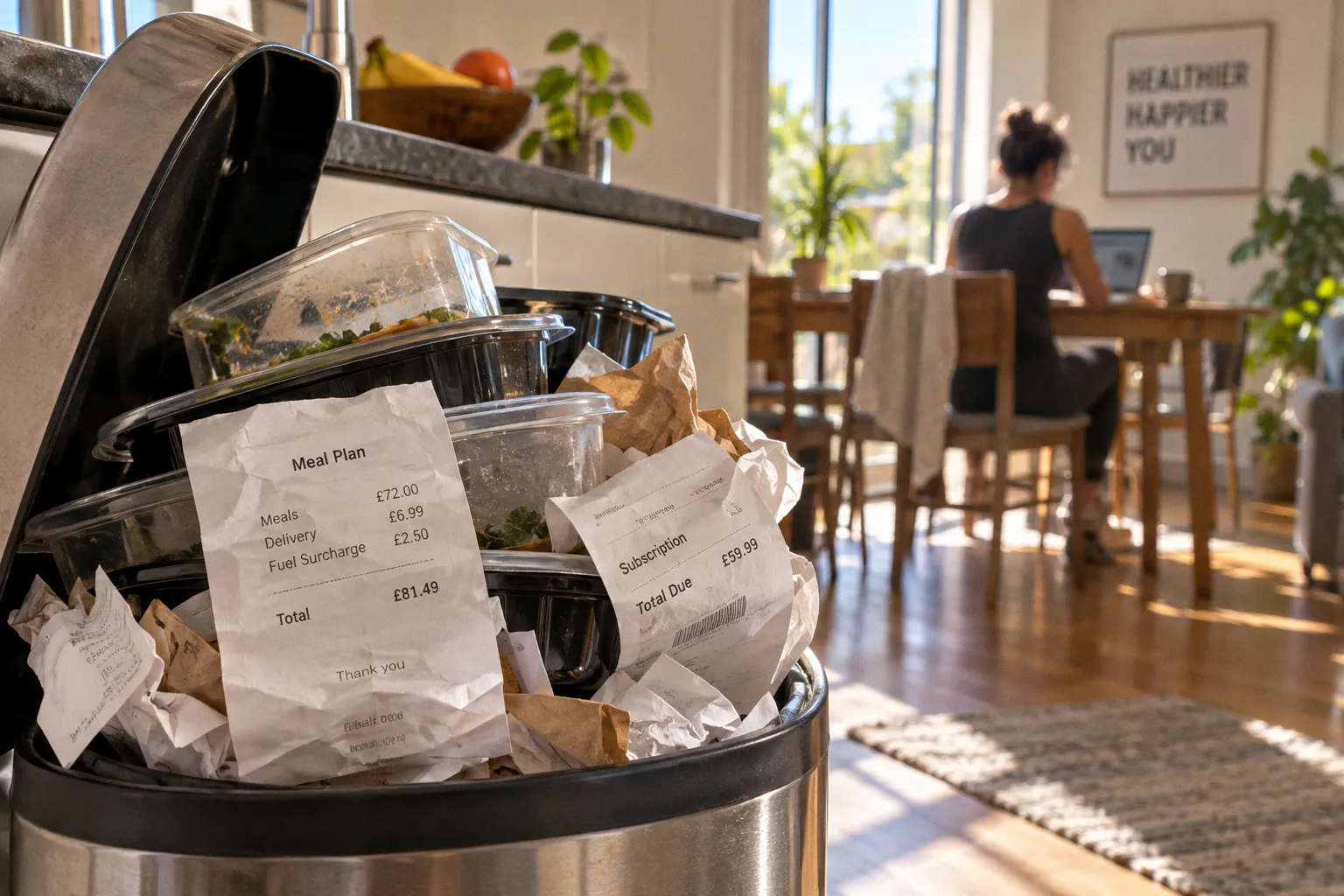
A prepared meal arrives ready to heat, with calories and protein already listed. That convenience has genuine value.
The trouble starts when the advertised price becomes the price you mentally budget around. The first box may be discounted, shipping may appear only at checkout, and a high-protein plan may require more meals than you actually eat. By the time the introductory offer disappears, the cost of fitness meal subscriptions can look very different from the number that brought you in.
We do not need to label meal delivery a bad financial decision. We do need to understand what we are paying for, which charges are predictable, and where a convenient nutrition system quietly becomes an expensive habit.
The true cost gap: grocery shopping versus premium meal services
A home-cooked meal built from ordinary groceries typically costs about $3 to $5 per serving. Standard meal delivery often starts closer to $6 to $12 per serving, while prepared or fitness-focused meals can run higher still. Premium personalized plans, particularly those built around high protein or specific macro targets, may cost more than £11 to £20 per day in the UK market.
That gap is not automatically wasteful. Meal delivery companies are not only selling chicken, rice, and vegetables. They are also covering recipe development, ingredient handling, cooking, packaging, labor, delivery logistics, customer service, and the cost of keeping the subscription system running. The price includes convenience.
But convenience is easiest to evaluate when we separate the cost of food from the cost of removing friction.
A grocery shop gives us lower ingredient costs but asks us to do the planning, shopping, chopping, cooking, portioning, and cleaning. A pre-made meal service takes over most of that chain. For someone with long workdays, irregular training hours, or limited cooking access, that can protect consistency. A meal that arrives ready to eat may be more useful than a theoretically cheaper meal that never gets prepared.
The practical question is not simply, “Is delivery more expensive than groceries?” It usually is on a per-serving basis. The better question is, “Which parts of my week am I paying the service to manage, and am I using all of them?”
A simple comparison
| Cost factor | Home-cooked groceries | Pre-made fitness meal delivery |
|---|---|---|
| Typical food cost per serving | About $3–$5 | About $6–$12 or more |
| Portion control | Decided at home | Usually pre-portioned |
| Macro information | Requires measuring or estimating | Often supplied by the provider |
| Cooking and cleanup | Managed by you | Usually minimal |
| Delivery fees | None | May be added separately |
| Flexibility | High; ingredients can be repurposed | Depends on the menu and plan |
| Risk of waste | Ingredients may spoil | Unused meals may still be charged |
| Promotional pricing | Rarely relevant | Often lowers the first order only |
This is where many meal prep service price traps begin: we compare the discounted first order with our grocery bill rather than comparing the recurring total with the value we actually receive each week.
The delivery fee is rarely the whole problem. The real budget leak is paying for meals, extras, and delivery windows that never fit your actual routine.
Anatomy of a fitness meal delivery bill
The number shown beside a meal is often only the base price. The final charge can include several layers, and each one may be reasonable in isolation. Together, they can change the entire calculation.
Shipping and delivery charges
Some services build delivery into the meal price. Others list it separately. A delivery fee can be flat, location-based, or tied to the size of the order. In some markets, customers may also see fuel surcharges or peak delivery charges when transportation costs rise.
This creates an awkward comparison. A meal may look competitively priced in the menu, but the effective price per serving increases once the order total is divided by the number of meals actually received.
For example, a delivery fee has a very different effect on an order of ten meals than on an order of five. If you reduce your subscription because you are traveling or eating out more often, the fixed charge can become a larger percentage of the food cost.
The useful number is therefore not the listed meal price. It is:
Total recurring charge ÷ meals you will realistically eat
That final phrase matters. If you order twelve meals but eat only nine, your effective cost is based on nine meals. The other three are not a theoretical saving; they are part of the bill.
Minimum order requirements
Many services set a minimum number of meals or a minimum basket value. This can make a plan appear affordable until we try to customize it around real life.
Perhaps we only need four lunches for busy workdays, but the service requires six or eight meals. Perhaps we train heavily on weekdays but prefer to cook on weekends. A minimum order pushes us toward buying more coverage than we need.
That does not make the service inherently poor. It does mean the plan should be judged against our complete food routine. If delivery replaces only a portion of our meals, buying a full plan may create duplication rather than convenience.
Customization and substitutions
Fitness-focused services often promote macro adjustments, meal swaps, larger protein portions, or dietary filters. Those options can be useful, especially when a specific allergy or training target narrows the menu. They may also carry customization or substitution fees.
A plan that looks economical at its basic tier can move into a higher bracket once we select the meals we would actually want to eat. If every acceptable entrée costs extra, the advertised base price is not the price of our real plan.
Before subscribing, we should identify the difference between:
- the lowest listed price;
- the price of the meals that match our dietary needs;
- the price after delivery and selected upgrades;
- the total after the promotion ends.
That sequence gives us a more honest view of hidden fees in healthy meal delivery.
Cancellation and pause policies
Subscription fatigue is not just a feeling. Industry data supplied for this topic indicates that about 90% of new meal kit subscribers cancel within the first year, with price increases after promotions, churn, and the ongoing burden of managing the subscription among the main pressures.
The exact cancellation rules vary by provider and region. Some services require changes before a weekly cutoff. Others renew automatically unless we pause or cancel manually. A missed deadline may trigger another shipment, even when our schedule has changed.
This is why account management is part of the price. A service that requires constant calendar reminders may be inexpensive only when we give it regular attention.
The promotional trap: when month one is not month two
Introductory discounts are designed to reduce the risk of trying something new. Offers such as 50% off the first box or several free meals can be useful if we treat them as a trial. The problem comes when the promotional price becomes our reference point.
Once the offer expires, the regular recurring price resumes automatically unless we pause or cancel according to the service terms. The transition may not feel dramatic if we are still looking at the per-meal figure. It becomes more obvious when we review the full weekly or monthly charge.
A simple habit helps: record three prices before placing the first order.
1. The promotional total, including delivery and any taxes or fees shown at checkout.
2. The first non-promotional total, once the discount disappears.
3. The realistic monthly total, based on the number of weeks we expect to order rather than the number of meals shown in the advertisement.
If the regular price would strain the budget, the promotion has not solved that problem. It has only postponed it.
Why the discount can distort our decision
A discount changes the emotional experience of the purchase. The first box feels like a bargain, so we may evaluate the service based on how much we saved rather than how much we spent. We may also become attached to the routine before seeing the normal price.
This is especially common with fitness meal subscriptions because the service can support several goals at once:
- convenient post-workout nutrition;
- controlled portions;
- a high-protein meal plan;
- fewer decisions during a busy week;
- a visible sense of progress.
Those benefits are real. They can also make us overlook a recurring charge that no longer fits our finances.
We can avoid that trap by setting a stopping point before the first delivery arrives. For example, we might decide to reassess after two regular-price orders, not after the first discounted box. At that point, we can ask whether the meals are improving our eating pattern enough to justify the total cost.
The subscription calendar is part of nutrition planning
A meal plan should support our schedule, not quietly dictate it. Before ordering, we can map the weeks when we will be away, hosting family, eating at work, or cooking from ingredients already in the kitchen.
Then we can check whether the service allows:
- skipping individual weeks;
- changing meal quantities;
- pausing without a fee;
- changing the delivery day;
- editing an order after it has been placed;
- canceling before the next charge.
These details determine whether the service remains flexible when life stops following the menu.
Macro precision versus financial reality
Pre-made fitness meals are often sold on precision: a stated calorie count, a protein target, and a consistent portion. For athletes and people managing a structured nutrition plan, that precision can reduce the friction of tracking.
Yet macro precision does not necessarily mean nutritional perfection, and it does not automatically make the meal financially efficient.
A listed protein number can help us build a day around training. But we still need to examine the whole meal: fiber, vegetables, carbohydrate quality, fat sources, sodium, and how satisfying the portion feels. If the meal is too small, we may add snacks. If it is too repetitive, we may order takeaway later. The original meal then becomes one more cost rather than a complete solution.
The same applies to calories. A meal plan designed for fat loss may look tidy on paper but fail in practice if we are hungry two hours later. A higher-calorie athlete plan may fit training demands but include more meals than we need on rest days.
The right question is not whether a company can calculate macros. It is whether the plan helps us eat consistently without creating additional spending around it.
When the markup can be reasonable
Meal delivery may be worth the money for athletes when it solves a problem we have repeatedly failed to solve with cheaper options. That might include:
- a demanding training schedule with little cooking time;
- frequent late finishes when balanced meals are otherwise replaced by convenience food;
- difficulty managing portions without support;
- a temporary period of travel or relocation;
- a need for reliable meals during a focused training block.
In these situations, the markup can function as a practical service fee. We are paying for reduced planning and preparation, not merely for ingredients.
We should be more cautious when the service duplicates food we already have. If we cook most dinners, enjoy grocery shopping, and need only a few portable lunches, a full subscription may be excessive. A smaller plan, occasional order, or batch-cooking routine may deliver the same nutritional support at a lower cost.
The 25–30% margin question
Meal kit and meal delivery businesses commonly operate with gross margins of roughly 25–30%. That margin is part of the business model and helps explain why the customer price is higher than the raw grocery cost.
It should not be treated as proof that a service is exploiting customers. A gross margin is not the same as pure profit, and it does not tell us whether a particular plan is good value for our household. It simply reminds us that the delivered price includes the company’s operating structure.
The more useful decision is personal: does the service save enough time, decision-making, or unplanned food spending to justify its premium?
We also need to leave room for the value of time. Someone earning a high hourly rate or managing a packed schedule may rationally choose delivery even when groceries are cheaper. The financial comparison is not universal. A lower grocery bill is not the only possible form of value.
A more sustainable way to use meal delivery
The most reliable approach is rarely all-or-nothing. We can use prepared meals as a targeted tool instead of allowing them to become the default for every meal.
Build a hybrid routine
A hybrid system might look like this:
- prepared meals for the two busiest workdays;
- simple grocery-based breakfasts;
- batch-cooked protein or grains for flexible lunches;
- fresh fruit, yogurt, eggs, or other low-preparation foods for snacks;
- one planned meal out or a relaxed cooking night.
This reduces the minimum-order problem and gives us a chance to test whether delivery supports our routine without replacing every part of it.
It also protects flexibility. If we order a full week of meals and then our schedule changes, we are left with unused food and a charge we cannot recover. A smaller role for delivery can make the plan more resilient.
Compare the service with realistic alternatives
The right comparison is not an imaginary week of perfect meal prep. It is the option we would genuinely follow.
For one busy dinner, the alternatives might include:
1. A prepared delivery meal with listed macros and an added delivery fee.
2. A grocery meal built from pre-cooked grains, rotisserie chicken, salad greens, and a simple sauce.
3. A batch recipe prepared once and eaten across several days.
4. A restaurant meal purchased because there was no plan.
5. Skipping a proper meal and compensating with snacks later.
The cheapest option on paper may not be the cheapest option in real life if we never use it. At the same time, the convenience option should not receive an unlimited budget simply because it prevents some friction.
Make a cost-per-use calculation
At the end of each delivery cycle, record:
- total amount charged;
- number of meals ordered;
- number of meals actually eaten;
- delivery and extra fees;
- additional food purchased to complete the meals;
- meals replaced by restaurant food or snacks.
Then divide the total charge by the meals that genuinely served their purpose. This is more revealing than the provider’s advertised per-meal price.
If the plan consistently leaves meals unused, the solution may be a smaller order. If we regularly add extra food, a different calorie or protein tier may fit better. If we order meals but still buy takeaway, the service is not solving the problem we expected it to solve.
Keep a few low-effort meals in reserve
Subscription fatigue often appears when the service is treated as the only nutrition plan. A few dependable grocery meals create breathing room:
- eggs with whole-grain toast and fruit;
- Greek yogurt with oats, berries, and nuts;
- canned tuna or beans with a microwave grain pouch and salad;
- frozen vegetables with pre-cooked chicken or tofu;
- a simple high-protein pasta or chili prepared in batches.
These meals do not need to be elaborate. Their job is to keep one missed delivery or one changed schedule from turning into an expensive emergency.
The most sustainable meal plan is not the one with the most precise packaging. It is the one that still works when your week becomes inconvenient.
How to decide whether the subscription belongs in your budget
A fitness meal delivery service is more likely to earn its place when the regular price is clear, the portions match your needs, and the plan replaces a problem rather than creating another one.
It may be a strong fit if:
- you use most of the meals you order;
- the standard price remains comfortable after promotions end;
- delivery and customization fees are predictable;
- the meals support your protein and energy needs;
- you have a reliable way to pause or adjust the plan;
- the service reduces takeaway spending or skipped meals;
- you value the saved preparation time enough to pay for it.
It deserves a closer look if:
- the first box is heavily discounted but the renewal price is unclear;
- the service requires more meals than your routine needs;
- shipping is added late in the checkout process;
- the meals leave you buying extra protein, snacks, or side dishes;
- customization is necessary for you but carries a meaningful surcharge;
- you frequently travel, change schedules, or forget subscription deadlines;
- you are comparing the promotion with groceries instead of comparing regular totals.
The goal is not to remove convenience from a healthy lifestyle. It is to place convenience where it has the greatest return. A prepared meal can support training, recovery, and daily energy, but only when it fits the way we actually eat.
For the next meal, take one small step: calculate the full cost of that meal, including its share of delivery, and compare it with the grocery alternative you would realistically prepare. That single comparison will tell you more than the headline discount—and it gives your nutrition budget a clearer, more sustainable direction.
FAQ
Why is the price of a meal delivery service higher than buying groceries?
How do I calculate the real cost of a meal delivery subscription?
Are promotional discounts a good way to save money on meal delivery?
What should I consider before signing up for a meal delivery plan?
How can I avoid wasting money on unused meals?
More products
 FitSpressoUSD59
 SodaSlimUSD79