Protein Absorption Limits: How Much Can You Use per Meal?
So you finished a 16-ounce ribeye, chased it with a shake, and now some gym bro is telling you your body "only absorbed 30 grams" while the rest "went to waste." Let me guess — they read it on a…
So you finished a 16-ounce ribeye, chased it with a shake, and now some gym bro is telling you your body "only absorbed 30 grams" while the rest "went to waste." Let me guess — they read it on a fitness infographic in 2014 and have been parroting it ever since, and you'd like a second opinion before you start splitting every meal into six joyless portions.
Here's the thing. That claim has been doing more laps than a treadmill at a budget hotel gym, and it has roughly the same relationship to actual human physiology. Your gut is not a clogged drain. It does not hit some magical 30-gram wall and start dumping protein into the toilet. The real science on protein absorption is more interesting, more useful, and — if you've been religiously chopping your shakes into tiny doses — potentially a lot more freeing.
Let me tear this one apart properly.
The Digestive Reality: Why Your Body Absorbs Almost Everything You Eat
When people talk about a "protein absorption limit," they're usually conflating two very different things: how much protein your digestive tract can physically pull into the bloodstream, and how much of that protein gets turned into muscle. Those are not the same question, and treating them like they are has created two decades of useless advice and a small mountain of shaker bottle sales.
Start with the plumbing. The oro-ileal digestibility of dietary protein — basically the proportion your gut breaks down and absorbs across the entire digestive tract — sits somewhere between 91% and 95%. That's not a marketing figure from your favorite supplement brand. That's the standard scientific range for healthy adults eating normal protein sources. Translation: nearly everything you swallow gets pulled into circulation.
Even fast-digesting sources like whey isolate, the protein equivalent of a quick-burn fuel, clear the digestive tract at roughly 8 to 10 grams per hour. Sounds slow? It is. But it also doesn't stop. Your gut keeps working through that protein for hours, regardless of how big the dose was. A 50-gram shake and a 100-gram shake don't hit some brick wall at the same point — they just take different amounts of time to clear, and your bloodstream keeps getting topped up the whole way through.
So where does the 30-gram "limit" come from? It comes from misreading muscle protein synthesis data and applying it to digestion. The two systems operate on completely different timelines and ceilings, and they share about as much in common as a carburetor and a tire.
> Your gut is a thorough salvage operation. It will not leave protein on the floor just because you gave it a big portion.
Muscle Protein Synthesis: Understanding the 0.4 g/kg Threshold
Now here's where things get interesting, and where the actual nuance lives — the part the infographics never bother to print in the fine print.
The 0.4 g/kg/meal figure isn't an absorption limit. It's a muscle protein synthesis (MPS) stimulus threshold. There's a difference, and it matters enormously. MPS is the signal that tells your muscle fibers to build new protein. Saturate that signal with enough amino acids and you get the maximum anabolic response from that meal. Go past it and the curve flattens for muscle-building purposes — but that doesn't mean the protein vanished into thin air.
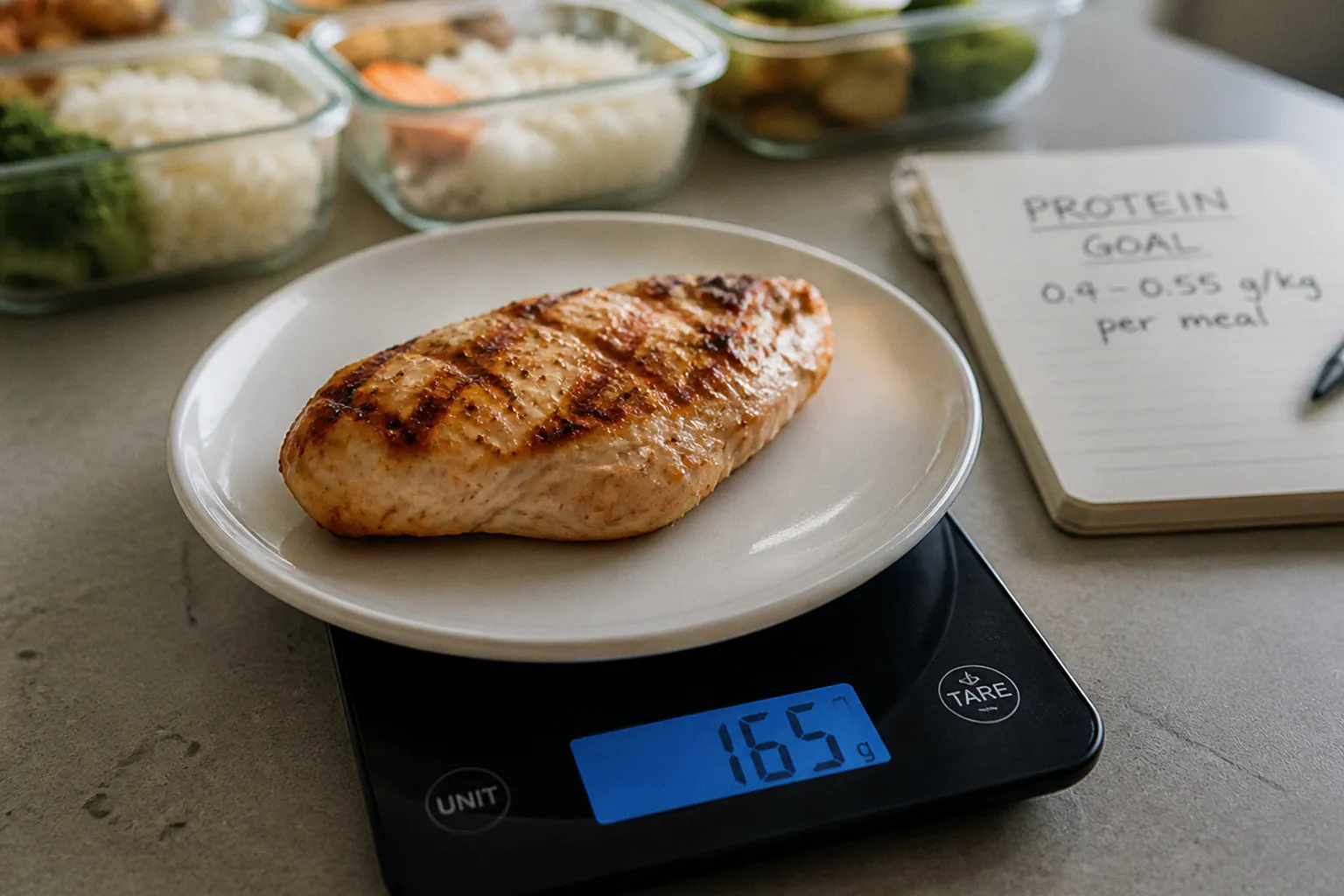
The 2018 Schoenfeld and Aragon review, which still holds up as one of the cleaner breakdowns in this space, recommended targeting 0.4 g/kg per meal across at least four meals to hit a daily minimum of 1.6 g/kg/day. The upper ceiling they outlined was 0.55 g/kg per meal across four meals, putting the daily total somewhere up to 2.2 g/kg/day for active folks trying to maximize lean tissue.
For a 200-pound (~91 kg) lifter, that 0.4 g/kg number works out to roughly 36 grams per meal. For a 180-pound (~82 kg) trainee, it's around 33 grams. Notice how conveniently close that lands to the "30-gram rule" the internet keeps repeating? That's not because 30 is a hard biological ceiling. It's because 30-ish grams happens to be the per-meal MPS stimulus target for a lot of average-sized lifters.
The mistake is treating the MPS saturation point as if it were a digestion cap. Your muscles might stop responding meaningfully to meal number seven's worth of amino acids, but your gut, liver, gut lining, and other tissues are still putting those nutrients to work. The 30-gram ceiling is a story about muscles, not a story about your intestines.
> MPS saturation is not the same as protein absorption. Confusing the two is how broscience built an entire cottage industry.
Beyond the 30g Myth: What Happens to Large Protein Doses?
This is the question that should have killed the 30-gram myth years ago, but it keeps staggering along like a zombie in a straight-to-DVD horror movie — apparently you can't kill it with logic alone.
What actually happens to protein you eat beyond the MPS saturation point? It doesn't pool in your stomach. It doesn't get excreted unused. It doesn't magically convert to fat because your "muscles are full." Every credible piece of research on this points the same direction: the excess amino acids are absorbed more slowly, oxidized for energy, routed toward other tissues, or used for repair work throughout the body.
Your gut lining turns over constantly — it is, in fact, one of the most metabolically active tissues you own. Your immune system runs on protein. Your hair, skin, nails, enzymes, hormones — all of it draws from the same amino acid pool. Even your liver processes a meaningful chunk for gluconeogenesis and other metabolic housekeeping. When you eat a 60-gram protein meal, you're not "wasting" the second 30 grams. You're feeding systems that aren't your biceps, which is fine, because those systems need feeding too.
So why does the 30-gram number persist? Partly because early protein research used small, tightly controlled doses and people extrapolated wildly. Partly because supplement companies love telling you to buy more shakes per day, and "you need six small meals" is fantastic for protein powder sales. And partly because the human brain loves round numbers, and 30 is a much tidier story than "your body processes what it processes over several hours, and the muscle-building ceiling is more like 0.4 grams per kilogram of bodyweight per sitting."
Add in the fact that whey concentrate, casein, eggs, beef, chicken, fish, and plant proteins all behave differently in the gut — and you've got a system far too complicated to be reduced to a single number on a T-shirt.
The 12-Hour Window: What Trommelen's Study Actually Showed
If you want a clean piece of evidence that should have retired the 30-gram myth for good, look at the 2023 Trommelen et al. study. It did something simple but important: it compared a 25-gram protein dose post-workout against a 100-gram dose and tracked the anabolic response over time.
The 25-gram dose kicked off MPS, sure. But the 100-gram dose produced a larger and more prolonged anabolic response that lasted over 12 hours. Let that sink in. A meal containing more than triple the "limit" produced more muscle-building stimulus, not less, and kept that stimulus running for half a day.
How is that possible if there's a hard absorption ceiling? Because there isn't one. The MPS signal just stayed elevated for longer because the bloodstream kept getting fed amino acids as the larger dose slowly cleared the digestive tract. It's the same logic as a slow-drip IV versus a single injection — more total nutrient, more sustained effect. The Trommelen study didn't just debunk the 30-gram ceiling; it pointed in the opposite direction entirely. Larger doses, properly absorbed, kept the muscle-building signal humming along well past the time a smaller dose would have let it taper off.
This doesn't mean you should start slamming 200-gram protein feasts at every sitting. For one, you'd probably stop enjoying food. For another, the Trommelen study is one data point, and the practical upper limit before digestive discomfort kicks in varies wildly based on your gut microbiome, food volume, and what else is on the plate. The unknowns are real — there isn't a clean single number for "the most protein anyone can stomach in one sitting." It depends on the person, the food, and the context. Someone eating a lean chicken breast and white rice is going to have a different experience than someone eating the same protein in a pile of cheesy pasta.
But the implication is unmistakable. If you eat a large protein meal, your body uses it. It doesn't throw it away. And the larger the dose, within reason, the longer your muscles stay in an anabolic state.
Strategic Distribution: How to Actually Eat Protein
So if the 30-gram ceiling is busted, does that mean meal timing and protein distribution don't matter at all? No — and this is where I see people swinging too far in the opposite direction and using "the myth is dead" as an excuse to eat three chicken-and-rice plates a day and call it optimal.
The Schoenfeld and Aragon framework still holds up. Spreading protein across roughly four meals per day, hitting that 0.4 to 0.55 g/kg/meal range, gets you the most reliable anabolic return for your nutritional buck. Your MPS signal doesn't just climb and stay there indefinitely — it rises after a protein-rich meal, peaks, and then drops back down. Spacing your meals out means you re-trigger that signal multiple times per day, which over weeks and months adds up to meaningfully more muscle accretion than the same total protein crammed into one or two sittings.
The practical breakdown:
| Goal | Per-Meal Target | Daily Meals | Daily Total (per kg bodyweight) |
|---|---|---|---|
| Minimum for active lifters | 0.4 g/kg | 4 | 1.6 g/kg |
| Upper anabolic range | 0.55 g/kg | 4 | 2.2 g/kg |
| Flexible / convenience-driven | Whatever fits your schedule | 3–5 | 1.6+ g/kg |
Notice that last row. If hitting four meals with precision isn't realistic for your schedule, the science doesn't punish you for it — it just suggests you're leaving some anabolic potential on the table. The point is to hit the daily total. The distribution is an optimization, not a rule carved into stone by the protein gods.
What about that one massive post-workout meal after a heavy squat session? Go for it. Your body will process it. Trommelen's 100-gram dose showed extended MPS, and there's nothing magical about splitting the same total across five shakes versus eating it as one large meal — though the larger meal will keep you fuller longer and may slow gastric emptying enough to extend the MPS window on its own. If you're an intermittent faster or you just prefer two square meals a day, you can still make progress. The optimal pattern is four meals; the workable pattern is whatever lets you actually hit your numbers consistently.
The real mistake isn't eating too much protein in one sitting. It's undereating protein across the whole day because someone convinced you that anything past 30 grams is wasted. That's the actual crime against your training, and it's happening to thousands of lifters who are scared to eat a real meal.
The Verdict: Stop Obsessing Over the 30-Gram Limit
Let's put a bow on this.
Your digestive tract absorbs between 91% and 95% of the protein you eat. The rate at which fast-digesting sources clear your gut is around 8 to 10 grams per hour, which means a 100-gram meal isn't "too much" — it's just a meal that takes longer to process. The MPS saturation point of 0.4 g/kg per meal is real, but it's a muscle-building threshold, not a digestion ceiling. And large doses — including 100 grams in a single sitting — produce larger and longer-lasting anabolic responses, not smaller ones.
So no, your body doesn't "only absorb 30 grams of protein per meal." That claim has been cooked, served, and reheated so many times it's lost any nutritional value it might once have had. Eat enough protein across the day. Spread it out if you want to maximize the muscle-building signal. Stop splitting your meals into tiny, joyless portions because someone with a shaker bottle and a podcast told you your gut couldn't handle anything bigger.
Train hard. Eat well. Stop listening to infographics.
FAQ
Is there a limit to how much protein my body can absorb in one meal?
Why do people say the body only absorbs 30 grams of protein?
What happens to the protein if I eat more than 30 grams at once?
Does eating a very large protein meal provide any benefit?
How many meals should I eat to maximize muscle growth?
More products
 GumitideUSD79