Vegetarian meal prep: a roadmap to high-protein muscle growth
You've committed to lifting heavy, you're showing up to the gym three or four times a week, and you know — somewhere in the back of your mind — that what you eat is doing at least half the work.
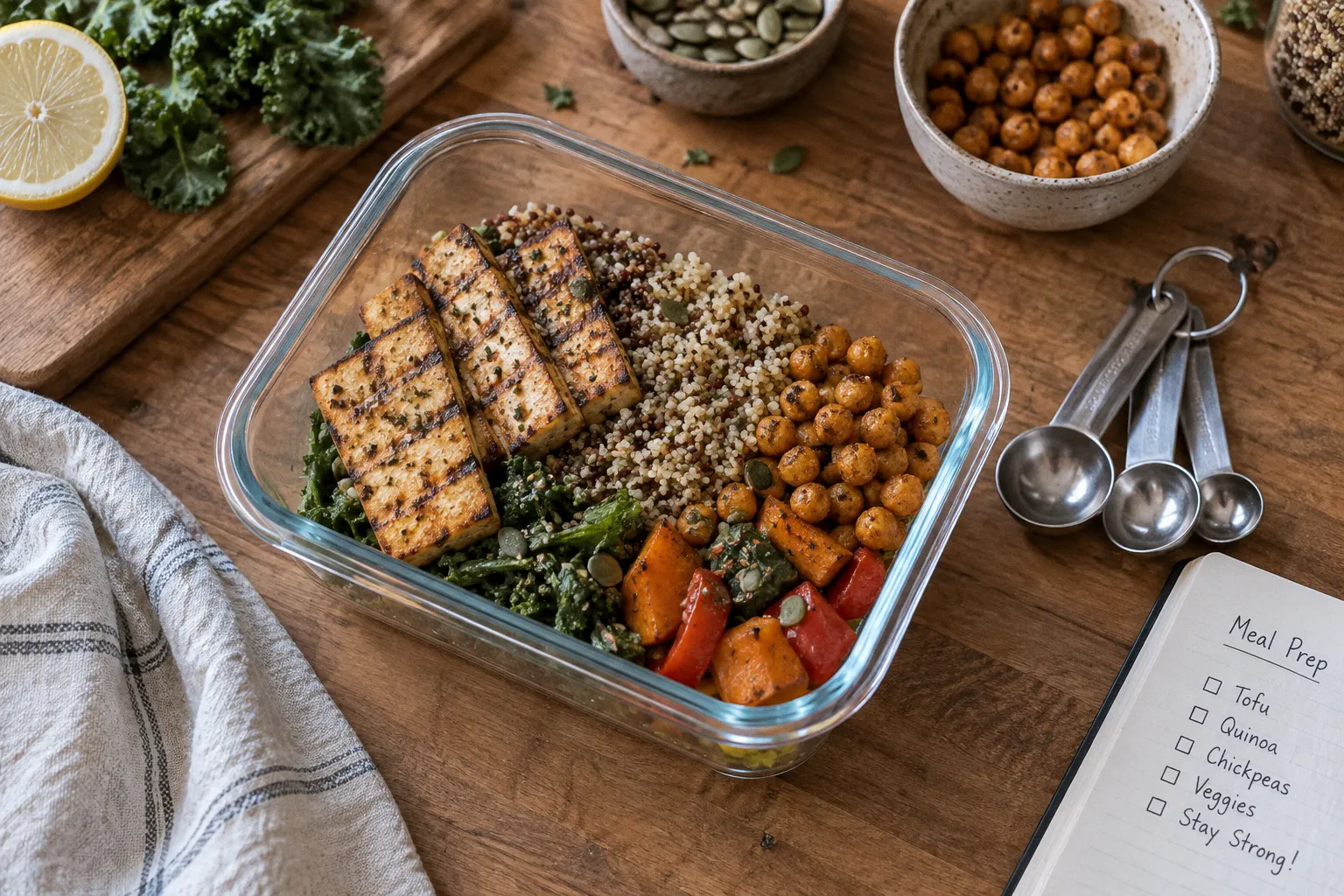
But here's the friction point that trips up so many vegetarian athletes: you sit down on Sunday evening, ready to plan the week, and you realize you have genuinely no idea how to hit 130 or 150 grams of protein a day without chicken, fish, or a single piece of steak. You stare at a block of tofu, a bag of lentils, and a carton of eggs, and you think, this can't possibly be enough.
It can be. It absolutely can — but only if you approach vegetarian meal prep with the same precision you bring to your training program. Guesswork and "I'll just eat more beans" don't build muscle. Strategy does. And that's exactly what we're walking through here: how to calculate what you actually need, which foods carry the most protein-per-bite weight, how to close the gaps intelligently, and how to batch-cook a week's worth of meals that fuel real growth — safely, sustainably, and without spending your entire Sunday in the kitchen.
Calculating Your Protein Requirements for Hypertrophy
Let's start where every serious nutrition plan has to start — with the numbers. Not vague ideas about "eating more protein," but actual grams tied to your actual body.
If you're training with the goal of building muscle, the research is fairly settled on a target range. Active individuals pursuing muscle hypertrophy generally need somewhere between 1.6 and 2.2 grams of protein per kilogram of body weight per day. The International Society of Sports Nutrition (ISSN) echoes a similar range, suggesting 1.4 to 2.0 grams per kilogram daily for both strength and endurance athletes. Compare that to the standard Recommended Dietary Allowance of 0.8 grams per kilogram — that baseline is designed for sedentary adults maintaining basic function, not for anyone trying to grow tissue under progressive overload.
So what does that look like in practice? Say you weigh 75 kilograms. At the hypertrophy target, you're aiming for roughly 120 to 165 grams of protein daily. At 60 kilograms, it's approximately 96 to 132 grams. At 90 kilograms, you're looking at 144 to 198 grams.
Here's why this matters for meal prep specifically: when your daily protein number climbs that high, you can't afford to leave it to chance. You can't hope that a handful of trail mix and a smoothie will get you there by bedtime. You need to distribute protein across every eating occasion — breakfast, lunch, dinner, and at least one or two snacks — and you need to know, before the week begins, where every 20- to 30-gram chunk is coming from.
A useful habit framework: divide your daily target by the number of times you eat. If you eat four times a day and you need 150 grams, each meal or snack should deliver around 35 to 40 grams. That's your planning unit. Every recipe, every container, every snack you prep should be measured against it.
Your protein target isn't a ceiling to barely scrape — it's a daily floor. Build every meal to land on it, not just hope one big dinner carries the whole day.
Strategic Plant-Based Protein Sources for Athletes
Now we get into the actual food. And this is where vegetarian meal prep either comes together beautifully or falls apart — because not all plant proteins are created equal, and understanding that difference is the foundation of every recipe you'll batch-cook.
The Density Problem
Here's the core challenge: most plant protein sources come packaged with more calories per gram of protein than lean meat does. One cup of cooked lentils delivers about 18 grams of protein — respectable — but it also carries around 230 calories. Firm tofu gives you roughly 10 grams of protein per 100 grams, which is workable but modest. Compare that to 100 grams of chicken breast at roughly 31 grams of protein for about 165 calories, and you start to see the gap.
This doesn't mean plant proteins can't build muscle — they absolutely can. But it does mean you have to be more intentional. You have to choose sources that pack the most protein into the fewest calories, and you have to stack them together so their amino acid profiles complement each other.
Your Power Players
Let's rank the most protein-dense vegetarian staples by how hard they work for you in a meal-prep context:
Tier 1 — The Workhorses (highest protein-to-calorie density for vegetarians)
| Food | Protein (approx.) | Calories (approx.) | Best Use in Meal Prep |
|---|---|---|---|
| Tempeh (100g) | 19–20g | 195 | Cubed and roasted for grain bowls |
| Seitan (100g) | 25g | 150 | Sliced for stir-fries and wraps |
| Firm tofu (100g) | 10g | 145 | Marinated and baked in bulk |
| Eggs (2 large) | 12g | 155 | Hard-boiled for grab-and-go snacks |
| Greek yogurt, 2% (170g) | 17g | 130 | Base for parfaits and overnight oats |
| Cottage cheese, 2% (½ cup) | 14g | 92 | Mixed into sauces or eaten solo |
| Lentils, cooked (1 cup) | 18g | 230 | Soups, stews, dal, salad toppers |
| Chickpeas, cooked (1 cup) | 15g | 270 | Roasted for snacking, added to bowls |
Tier 2 — The Supporters (moderate protein, valuable for variety and nutrients)
- Black beans, kidney beans, edamame — all land in the 12 to 17 grams per cooked-cup range, bringing fiber and micronutrients alongside.
- Quinoa and amaranth are higher-protein grains, offering 8 to 9 grams per cooked cup — not enough alone, but meaningful when they replace rice.
- Nut butters and seeds (hemp, pumpkin, chia) add 5 to 10 grams per serving, useful for snacks and smoothie boosts.
Tier 3 — The Amplifiers (small servings, concentrated protein)
- Whey or casein protein powder: a single scoop typically delivers 20 to 25 grams in about 120 calories. For vegetarian athletes, this is often the simplest way to close a 20-gram gap after a meal.
- Soy protein isolate and pea protein blends offer comparable numbers for those avoiding dairy-based powders.
The habit framework here is simple: every meal-prep container should be anchored by a Tier 1 source, supported by a Tier 2 source, and — if the numbers still fall short — amplified by a Tier 3 addition. That's your recipe architecture. Build from it.
Bridging the Density Gap with Dairy and Egg Staples
If you're vegetarian (not vegan), you have a significant structural advantage: dairy and eggs close the protein density gap that plant sources alone often leave open. And we should use that advantage honestly and strategically.
Consider the math. If your daily target is 150 grams and you rely exclusively on lentils, chickpeas, tofu, and grains, you'll hit that number — but you'll likely overshoot your calorie target in the process, which works against body composition goals. Swapping even one or two plant-based protein servings for dairy or egg equivalents can save you hundreds of calories across the week while keeping your gram count on track.
Here's how that plays out in a typical meal-prep day:
- Breakfast: Overnight oats with Greek yogurt (17g) and a scoop of whey protein blended in (22g) — that's nearly 40 grams before you've left the house.
- Lunch: Grain bowl with tempeh (19g) and a side of cottage cheese (14g) — another 33 grams from whole foods.
- Afternoon snack: Two hard-boiled eggs (12g) with a handful of pumpkin seeds (5g) — 17 grams, no cooking required.
- Dinner: Lentil and vegetable stew over quinoa (18g lentils + 9g quinoa) — 27 grams from plants alone.
- Evening option (if needed): Casein shake or a small bowl of skyr — 20 grams to close the day.
Add that up and you're comfortably past 135 grams without any single meal feeling like a protein-stuffing chore. The key principle: dairy and eggs aren't a crutch — they're structural. They let you build meals that feel normal and satisfying rather than like a math exercise.
The Amino Acid Question
You may have heard that plant proteins are "incomplete." The reality is more nuanced. Most plant proteins contain all essential amino acids, but many are lower in one or two — often lysine or methionine. This isn't a crisis; it's a planning detail. When you combine legumes (lysine-rich) with grains (methionine-rich) across the same day — lentils and rice, chickpeas and whole-wheat pita, tofu stir-fry over quinoa — you cover your bases naturally. You don't need to pair them in the same bite; your body pools amino acids across the day.
The one amino acid worth watching more closely is leucine, the primary trigger for muscle protein synthesis. Animal proteins tend to be richer in leucine per serving. Dairy (especially whey), eggs, and soy are your best vegetarian leucine sources. If your post-training meal is entirely plant-based and relatively low in leucine, that's a moment where a whey or casein supplement genuinely earns its place — not as a gimmick, but as a targeted tool.
Protein quality isn't about ranking foods as good or bad — it's about stacking sources so their strengths cover each other's gaps.
Building a Macro-Friendly Weekly Meal Prep Schedule
Here's where the rubber meets the road. You know your numbers, you know your sources — now we build the week. And the goal isn't perfection; it's consistency. A meal prep you actually follow beats an elaborate one you abandon by Wednesday.
The Sunday Framework
We're going to keep this simple. Two hours. That's the investment. In roughly 120 minutes on a Sunday, you can prep the protein backbone for an entire work week. Here's the structure:
Step 1 — Batch your grains and legumes (40 minutes active, passive cooking time)
Cook a large pot of quinoa or brown rice and a separate pot of lentils or chickpeas. These are your base layers — they go into almost everything. Season them simply (salt, olive oil, a squeeze of lemon) so they work across different flavor profiles throughout the week.
Step 2 — Prepare two to three protein anchors (30 minutes)
Choose two or three from this rotation each week so you don't burn out:
- Marinated baked tofu or tempeh — cube, toss in soy sauce, garlic, and sesame oil, roast at 200°C for 25 minutes.
- A big frittata or egg bake with vegetables — cut into six portions.
- A pot of dal or black bean chili — high-protein, stores beautifully.
- Seitan strips sautéed with peppers and spices — ready for wraps or bowls.
Step 3 — Prep your dairy and egg grab-and-gos (10 minutes)
Hard-boil a dozen eggs. Portion Greek yogurt or cottage cheese into small containers. If you use protein powder, pre-measure scoops into shaker bags or jars so you're not fumbling with a scoop at 6 a.m.
Step 4 — Wash and chop your vegetables (20 minutes)
Roasted broccoli, raw bell pepper strips, spinach for smoothies, cherry tomatoes for salads. Vegetables aren't your protein source, but they make the meals you're actually willing to eat five days in a row.
Step 5 — Assemble and label (20 minutes)
Portion into containers. Label with the day if that helps you stay accountable. Stack the fridge with tomorrow's meals in front and the end-of-week meals in back.
Sample Week at a Glance
| Day | Lunch Container | Protein (approx.) |
|---|---|---|
| Monday | Quinoa + roasted tempeh + tahini greens | 32g |
| Tuesday | Lentil dal + brown rice + side of cottage cheese | 34g |
| Wednesday | Grain bowl with chickpeas, feta, roasted veg | 28g |
| Thursday | Seitan stir-fry + edamame + quinoa | 38g |
| Friday | Frittata slice + mixed bean salad + seeds | 30g |
Each of these meals, paired with a protein-rich breakfast and an afternoon snack, puts you solidly in range for the day — and none of them taste like "diet food."
The Habit That Makes It Stick
Here's the behavioral piece that matters more than any recipe: pre-decide your protein source before you plan anything else about the meal. Don't start with "I want pasta" and then try to shoehorn protein in afterward. Start with "I need 35 grams from this meal — what delivers that?" and build the flavor around it. It's a small cognitive shift, but it changes everything about how your plate looks by Friday.
Food Safety Protocols for Batch-Cooked Vegetarian Meals
Meal prep is only as good as the food safety behind it. And this isn't the glamorous part of the conversation, but skipping it is how you end up throwing away a week's worth of meals on Wednesday — or worse, eating something that makes you regret Sunday's effort.
The Rules Are Clear
Standard food safety guidance is straightforward: refrigerate all cooked, perishable meal-prepped food within two hours of cooking, and consume refrigerated leftovers within four days. That's the window. Day five is not a gray area — it's the line.
This means if you prep on Sunday, your Thursday and Friday meals are at the edge. You have two practical options:
1. Freeze Thursday and Friday portions immediately after prepping. Move them to the fridge to thaw the night before you need them.
2. Do a smaller midweek refresh cook — even 20 minutes on Wednesday evening to prepare a fresh batch for Thursday and Friday. It breaks up the monotony too.
Temperature and Storage Details
- Let hot food cool slightly before sealing containers — but don't leave it on the counter for hours. Roughly 20 to 30 minutes of cooling is fine; then seal and refrigerate.
- Keep your fridge at or below 4°C (40°F). If you're not sure, a cheap fridge thermometer is one of the best meal-prep investments you'll make.
- Store cooked grains, legumes, and proteins in separate airtight containers. Mixing everything into final portions is fine for two to three days out, but storing components separately gives you more flexibility and keeps textures better.
- Label everything with the date. It takes ten seconds with a piece of tape and a marker, and it eliminates the "is this still good?" guessing game that derails your week.
The Snack Layer: Prepped and Ready
One of the most overlooked aspects of high-protein vegetarian meal prep is the snack tier. Lunches and dinners get all the planning attention, but it's the 3 p.m. hunger and the post-gym window where most people fall short. Prep your snacks with the same intention:
- Hard-boiled eggs (last five to seven days in the shell in the fridge — they push past the four-day cooked rule because the shell acts as a barrier)
- Portioned cottage cheese cups with a drizzle of honey or everything bagel seasoning
- Roasted chickpeas in a jar — crunchy, portable, roughly 10 grams of protein per half-cup
- Protein balls made with oats, nut butter, whey powder, and seeds — roll a dozen on Sunday, grab two whenever hunger hits
- Pre-portioned trail mix with pumpkin seeds, almonds, and a few dark chocolate chips
These aren't afterthoughts. They're the connective tissue of your nutrition day — the difference between hitting your protein floor and falling 30 grams short without realizing it.
Your Next Meal Starts This
Here's where we land. Vegetarian meal prep for muscle growth isn't about willpower, and it isn't about eating monotonous bowls of brown rice and steamed broccoli until you can't stand the sight of either. It's about understanding your protein target — that 1.6 to 2.2 grams per kilogram range — and reverse-engineering every meal, every snack, every container in your fridge to hit it consistently.
You have the tools now. You know your numbers. You know which sources carry the most weight per calorie. You know how dairy and eggs fill the structural gaps that plants alone leave open. You have a two-hour Sunday framework and a food safety protocol that keeps everything fresh and safe through the week.
So here's your actionable win — not next week, not after you read three more articles, but for your very next meal. Look at what you're about to eat. Estimate the protein in it. If it's under 30 grams, add one thing: a scoop of Greek yogurt on the side, two hard-boiled eggs, a handful of edamame, a drizzle of cottage cheese. One addition. That's it.
Do that once, and you'll feel the difference in energy by afternoon. Do it every meal for a week, and you'll understand — in your body, not just in theory — what it means to actually fuel growth. That's the starting point. Everything else builds from there.
FAQ
How much protein do I need to build muscle as a vegetarian?
Are plant-based proteins sufficient for muscle growth?
How long can I keep meal-prepped vegetarian food in the fridge?
What are the best vegetarian protein sources for meal prep?
Do I need to combine proteins in every meal to get complete amino acids?
More products
 FitSpressoUSD59